
Bucket Wheel Stacker Reclaimer vs Bucket Wheel Excavator: Which One for Your Mining Operation? | ZOOMRY
Both use rotating bucket wheels to move material. The excavator can discharge onto a conveyor for stacking, but it is not optimized for precision stockpile management.
Quick Answer
In large-scale mining and bulk material handling, two machines often get confused: the bucket wheel stacker reclaimer and the bucket wheel excavator. Both use rotating bucket wheels to move material. Both operate at 500–3,000 m³/h. Both run on tracks with ±65–360° slewing. The rest of the page compares operating principle, wear behaviour, and cost of ownership.
In large-scale mining and bulk material handling, two machines often get confused: the bucket wheel stacker reclaimer and the bucket wheel excavator. Both use rotating bucket wheels to move material. Both operate at 500–3,000 m³/h. Both run on tracks with ±65–360° slewing. But one is built for managing stockpiles, and the other is built for tearing into a mine face. Choosing the wrong one means either wasted capacity or premature equipment wear. This guide breaks down the differences by function, material compatibility, mobility needs, and application scenarios — so you can match the right machine to your operation.
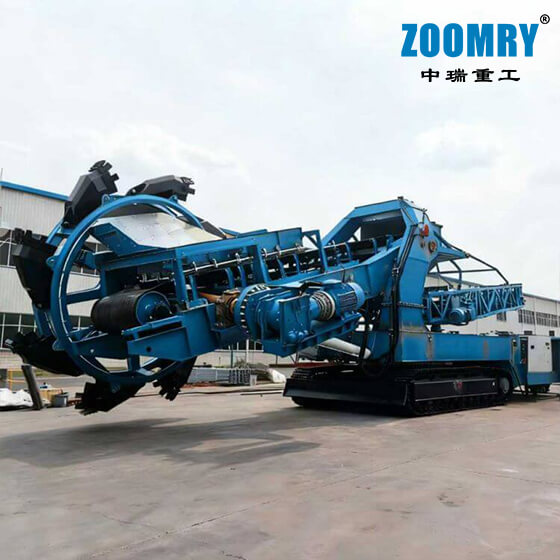
Bucket Wheel Stacker Reclaimer (left) vs Bucket Wheel Excavator (right) — two distinct machines for different mining tasks
What Is the Core Difference: Stacking & Reclaiming vs Excavation
The fundamental distinction comes down to the primary task each machine was designed to perform. A bucket wheel stacker reclaimer is a stockyard management tool — its job is to receive material from an incoming conveyor and stack it into organized stockpiles, then reclaim that material back onto an outgoing conveyor when needed. It is a logistics machine, optimizing material flow between production and shipping.
A bucket wheel excavator is a production machine — its job is to continuously cut into a mine face or bench, extracting raw material that has never been moved before. It replaces the intermittent cycle of drill-blast-load-haul with continuous excavation, feeding directly into a belt conveyor system that carries material out of the pit.
Think of it this way: the stacker reclaimer manages material that has already been mined; the excavator creates the material that the stacker reclaimer will later manage.
Head-to-Head Comparison: Bucket Wheel Stacker Reclaimer vs Bucket Wheel Excavator
| Feature | Bucket Wheel Stacker Reclaimer | Bucket Wheel Excavator |
|---|---|---|
| Primary Task | Stacking incoming material + reclaiming from stockpiles | Continuous excavation of virgin material from mine face |
| Material Source | Already-mined material delivered by conveyor or truck | In-situ ore, overburden, or coal seam at the mine face |
| Material Hardness | Loose to semi-hard bulk (≤100 MPa typical) | Up to 300 MPa hard rock with tungsten carbide blades |
| Blade Design | Mn13 steel + 3 mm tungsten carbide for wear resistance | Mn13 steel + 5 mm tungsten carbide for impact resistance |
| Installation | Fixed or rail-mounted at a dedicated stockyard | Tracked, self-propelled, moves along the mine bench |
| Throughput | 500–3,000 m³/h | 500–3,000 m³/h |
| Bucket Wheel Speed | 2–6 r/min (higher for stacking, lower for reclaiming) | 2–6 r/min (lower for hard rock, higher for soft material) |
| Slewing Range | ±65–360° for full stockpile coverage | ±65–360° for fan-shaped bench excavation |
| Typical Location | Stockyard, port terminal, power plant yard | Open-pit mine bench, overburden removal site |
When to Choose a Bucket Wheel Stacker Reclaimer
Select a bucket wheel stacker reclaimer when your operational priority is efficient stockyard management. These are the scenarios where it excels:
- Blending Operations: When you need to homogenize material from multiple sources — such as blending different coal seams for consistent power plant fuel quality — the stacker reclaimer's layered stacking and precision reclaiming ensure uniform output.
- Buffer Storage: Between intermittent mine production and continuous processing, or between continuous production and intermittent shipping, the stacker reclaimer acts as a buffer — absorbing supply and demand fluctuations.
- Port and Terminal Yards: For port terminal operations where vessels load and unload on irregular schedules, the stacker reclaimer manages the stockpile between ship arrivals.
- Power Plant Fuel Management: In thermal power plants, consistent coal feed to boilers is critical — the stacker reclaimer ensures fuel is always available at the required blend and rate.
When to Choose a Bucket Wheel Excavator
Select a bucket wheel excavator when your operational priority is continuous mine production. These are the scenarios where it excels:
- Overburden Removal: Before reaching the ore body, massive volumes of overburden must be stripped. The excavator's continuous cutting action moves overburden 3–6 times faster than truck-and-shovel methods, directly feeding a conveyor out of the pit.
- Large-Scale Open-Pit Mining: For operations producing millions of tons annually — coal, lignite, oil sands — the excavator eliminates the cost and logistics of a truck fleet. One machine replaces multiple hydraulic excavators and dozens of haul trucks.
- Hard Rock Extraction (with Proper Configuration): When equipped with 5 mm tungsten carbide-coated blades and high-torque drive (up to 1,100 kW), the excavator handles ores up to 300 MPa hardness — suitable for mining operations in iron ore, copper, and bauxite.
Decision Flowchart: Which Machine Fits Your Operation?
| Your Situation | Recommended Equipment | Why |
|---|---|---|
| You need to stack incoming material and reclaim it later | Stacker Reclaimer | Dual function — one machine, one stockyard, two jobs |
| You need to extract virgin material from a mine face | Excavator | Purpose-built for cutting into in-situ material |
| Your material is loose coal, aggregates, or grain | Stacker Reclaimer | Standard blades are sufficient — no need for heavy excavation kit |
| Your material is hard rock over 200 MPa | Excavator | 5 mm tungsten carbide blades + high-torque drive required |
| You operate at a fixed stockyard with conveyor infrastructure | Stacker Reclaimer | Fixed or rail-mounted installation integrates with conveyor network |
| You need to move the machine along a mine bench as extraction progresses | Excavator | Self-propelled tracked mobility for bench advancement |
| You need one machine for multiple stockpiles across your site | Neither — consider a Mobile Bucket Wheel | Universal machine that moves between stockpiles; neither purely stacker nor excavator |
What About Machines That Do Both — or Neither?
ZOOMRY's bucket wheel equipment family includes machines that don't fit neatly into the "stacker reclaimer or excavator" binary. These fill the gaps for operations with mixed requirements:
- Mobile Bucket Wheel: When you need universal stacking and reclaiming across multiple sites — mines, ports, power plants — without being locked to one stockyard. Explore Mobile Bucket Wheel →
- Mobile Stacker Reclaimer: When you need dual stacking and reclaiming capability but with the flexibility to reposition between stockpiles on tracks. Explore Mobile Stacker Reclaimer →
- Bucket Wheel Reclaimer: When reclaiming precision matters more than stacking — dedicated reclaiming with ≤2% deviation for power plant fuel feed. Explore Bucket Wheel Reclaimer →
- Tracked Bucket Wheel Reclaimer: When you need reclaiming precision but on soft ground where wheeled machines cannot operate. Explore Tracked Bucket Wheel Reclaimer →
Frequently Asked Questions
Can a bucket wheel stacker reclaimer be used for excavation?
No — and attempting it will cause expensive damage. The stacker reclaimer's blades are designed for loose, already-mined material. Its 3 mm tungsten carbide coating provides excellent wear resistance against abrasive bulk materials, but lacks the impact resistance needed for cutting into compacted in-situ rock. The drive system is also optimized for the lower torque demands of reclaiming from a stockpile, not the high-impact loads of cutting a mine face.
Can a bucket wheel excavator also stack material?
Yes — with a caveat. The excavator can discharge onto a conveyor for stacking, but it is not optimized for precision stockpile management. It lacks the layered stacking control and blending precision that a dedicated stacker reclaimer provides. If your operation requires both excavation and stockyard management, running both machines — or selecting a Mobile Stacker Reclaimer for the stockyard — is the more efficient configuration.
What capacity of bucket wheel equipment do I need for my mine?
ZOOMRY bucket wheel equipment spans 500–3,000 m³/h across the entire series. The right capacity depends on your annual production target, material density, and operating hours per day. For a typical open-pit mine producing 10 million tons annually with 6,000 operating hours, a 2,000–3,000 m³/h machine is appropriate. Contact our engineers with your specific production data for a precise sizing recommendation — the excavator and stacker reclaimer share the same capacity range but are configured differently for their respective tasks.
Related Solutions for Mining Operations
Not Sure Which Bucket Wheel Equipment Fits Your Mine?
Tell us your material type, annual production target, and site layout — our engineers will recommend the optimal bucket wheel configuration.
Get a Custom RecommendationExplore This Topic: Stackers & Stacker Reclaimers
Stockyard equipment guides: bucket wheel stacker reclaimers, radial and telescopic stackers, and how to select between them.
- What are the risks of mobile stacking conveyor? — Guide
- Tracked Radial Stacker Applications in Ports and Power Plants — Guide
- All Travel Mobile Shiploader – Radial & Telescopic | 100-3500 t/h — Product
- ZOOMRY Stacker Unloading & Motion Testing – Reliable Bulk Material Handling — Guide
- 213ft Radial Stacker, Top 3 Global Radial Stacker Brands — Guide
Let's build it together
Need a custom bulk handling solution?
Talk to our engineers about conveyors, stackers, ship loaders and turnkey EPC systems.