
How Does a Mobile Ship Loader Reduce Port Operating Costs? Lower Investment & Faster Loading | ZOOMRY
ZOOMRY portable shiploaders eliminate rail infrastructure, reduce capital expenditure, and achieve 50% faster loading than truck-and-crane methods.
Quick Answer
The most immediate cost advantage of a mobile shiploader is the elimination of fixed infrastructure. The sections below set out each step with the settings and safety checks to record. Exact capacities, dimensions and standards are confirmed per project in the technical agreement, not from catalogue text.
Port operators worldwide face mounting pressure to reduce cost per ton while increasing throughput. Fixed shiploader systems require multi-million-dollar civil works, rail foundations, and months of installation — locking terminals into rigid infrastructure that can't adapt to changing vessel patterns. A mobile shiploader flips this equation: lower upfront investment, faster deployment, and the flexibility to serve multiple berths with a single unit.
ZOOMRY's mobile ship loader technology has been refined over 20 years of continuous innovation, delivering measurable cost reductions for port and terminal operators across Europe, Southeast Asia, and Africa. Here's how the technology drives operational savings across multiple cost dimensions — from capital expenditure to daily operating expenses.
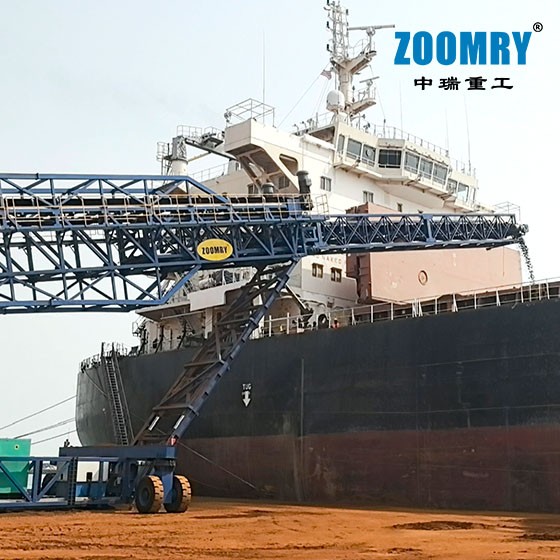
ZOOMRY mobile ship loader in operation — eliminating rail infrastructure and fixed berth dependency
How Does a Mobile Ship Loader Lower Capital Expenditure?
The most immediate cost advantage of a mobile shiploader is the elimination of fixed infrastructure. Traditional stationary systems require reinforced concrete foundations, rail tracks embedded along the entire berth length, extensive piling, and dedicated electrical substations — often representing 40-60% of total project cost before a single ton is loaded.
A mobile ship loader arrives pre-assembled, deploys on existing paved surfaces, and operates from its onboard diesel power-gen or a simple shore power connection. Installation takes hours or days instead of months. For multi-berth terminals, one all-travel unit can service several berths — eliminating the need for multiple fixed loaders and multiplying the capital savings across your entire quay line.
| Cost Category | Fixed Shiploader | Mobile Shiploader | Savings |
|---|---|---|---|
| Civil Works | $500K–$2M+ per berth | Minimal — paved surface sufficient | 80–100% |
| Installation Time | 3–12 months | Hours to days | 90%+ time reduction |
| Equipment per Berth | 1 dedicated unit per berth | 1 unit serves multiple berths | 40–60% equipment cost |
How Much Faster Is Mobile Ship Loading vs Traditional Methods?
A single mobile shiploader achieves continuous loading rates of up to 3,500 tons per hour. Compared to conventional truck-and-crane methods, this translates to:
• 35,000 DWT Handysize vessel loaded in approximately 10–12 hours
• 80,000 DWT Panamax vessel loaded in approximately 22–26 hours
• Up to 50% faster than truck-and-crane loading
• 40–60% lower operating costs compared to truck haulage
For coal ship loader operations at export terminals, these efficiency gains directly reduce vessel demurrage charges — often the single largest variable cost for bulk commodity exporters. Shaving even 4-6 hours off loading time per vessel can save hundreds of thousands of dollars annually for a terminal handling one Panamax vessel per week.
What Operational Flexibility Does a Mobile Ship Loader Provide?
Fixed shiploaders serve one berth for their entire lifecycle. When vessel patterns change — a new trade route opens, a commodity shift occurs — the terminal is locked into its original configuration. A mobile ship loader adapts:
Serve Multiple Berths — One all-travel mobile shiploader drives freely along the quay to where demand is highest. No rail switching, no towing, no crane repositioning.
Handle Multiple Commodities — Switch from grain to aggregates to coal with quick conveyor cleanout. The same unit that loads PKE/PKS at Bintulu Port today can handle fertilizer tomorrow.
Seasonal Redeployment — Relocate equipment to different terminals based on harvest seasons, weather patterns, or contract volumes. A mobile unit isn't a sunk cost — it's a flexible asset.
Real-World Cost Comparison: Mobile vs Fixed Shiploader
| Cost Factor | Fixed Shiploader | Mobile Shiploader |
|---|---|---|
| Initial Equipment Cost | High — includes civil works | Moderate — pre-assembled delivery |
| Infrastructure Investment | $500K–$2M+ per berth | Minimal — paved quay |
| Installation & Commissioning | 3–12 months | 1–3 days |
| Maintenance Cost (Annual) | High — rail, civil, fixed structure | Low — standard conveyor components |
| Berth Flexibility | Single berth only | Multi-berth capable |
| Resale / Redeployment Value | Zero — fixed asset | High — portable asset |
Environmental Cost Savings
Beyond direct financial savings, mobile shiploaders reduce environmental compliance costs. Integrated dust suppression systems — including telescopic cascade chutes, water spray, and enclosed conveyors — minimize airborne particulate matter, helping terminals meet increasingly stringent port emission standards without additional capital expenditure. Diesel-electric hybrid options further reduce carbon footprint, while electric drive configurations enable zero-emission operations where shore power is available.
Related Solutions
How to Reduce Your Port Operating Costs with Mobile Ship Loading?
Share your current loading method, vessel types, and throughput targets — we'll calculate your potential cost savings with a mobile shiploader.
Port Loading Cost Analysis →Explore This Topic: Ship Loaders & Port Loading
Port loading equipment: mobile and fixed shiploaders, telescopic bulk loaders, chutes, dust control and cost factors.
- Mobile Shiploader – Portable Ship Loader for Bulk Material Handling — Product
- Mobile Ship Loading Benefits: Flexibility & Cost Efficiency — Guide
- Fertilizer Handling Conveyor Solutions | Corrosion-Resistant Conveyors & Shiploaders — Industry solution
- Sugar Handling Conveyor Solutions | Enclosed Sugar Conveyors & Ship Loaders — Industry solution
- Mobile Ship Loader Undercarriage Types – Wheel vs Tracked vs Rail — Guide
Let's build it together
Need a custom bulk handling solution?
Talk to our engineers about conveyors, stackers, ship loaders and turnkey EPC systems.