
Ship loader wind anchoring fails? Winter operation sluggish? How to solve safety and operational issues?
Add ground rods or replace strips if resistance exceeds limit. Keep cylinders pressurized after shutdown to prevent moisture ingress.
Quick Answer
Summary: Ship loader safety ancillaries – wind anchoring, audible/visual alarms, grounding, ship-type adaptability, operational speed optimization, and winter performance – directly affect terminal safety and efficiency. This article provides systematic solutions. The sections below set out each step with the settings and safety checks to record.
Summary: Ship loader safety ancillaries – wind anchoring, audible/visual alarms, grounding, ship-type adaptability, operational speed optimization, and winter performance – directly affect terminal safety and efficiency. This article provides systematic solutions.
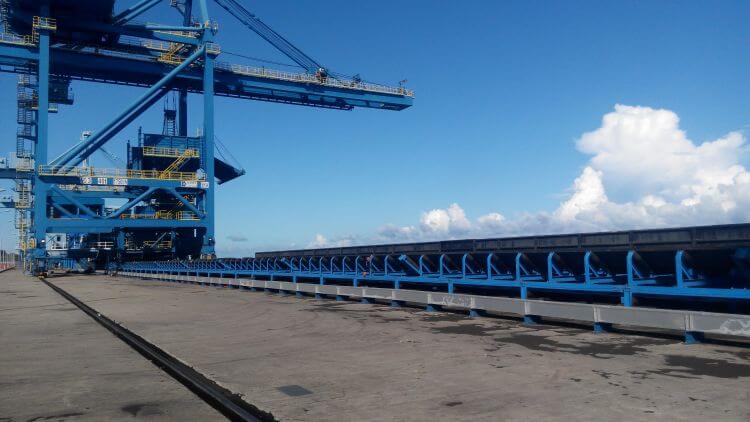
1. Wind Anchoring / Rail Clamp Failure
Symptoms: Rail clamp fails to lock rail in high winds; machine slides or even tips over – major safety risk.
Root causes:
- Insufficient clamping force – hydraulic leakage or spring fatigue;
- Worn clamp jaws – reduced contact area with rail;
- Anchoring device not tested regularly; corrosion or jamming;
- Operator fails to engage anchoring when wind exceeds limit.
Prevention & solutions:
- Regular testing: Monthly clamp force test (loaded and unloaded); ensure force ≥90% of design. ZOOMRY recommends hydraulic clamps with pressure sensors for real-time force display.
- Wear check: Measure jaw thickness quarterly; replace if wear >1/3 of original. Keep jaw/rail contact surfaces clean and free of oil.
- Corrosion prevention: Grease pivot points monthly; apply anti-rust oil on tie rods to prevent jamming.
- Wind interlock: Auto-alarm and clamp engagement when wind >20m/s; forced shutdown and personnel evacuation when wind >25m/s.
2. Audible/Visual Alarm Failure
Symptoms: Alarms or warning lights do not activate during operation; personnel lack machine status awareness.
Root causes:
- Burnt bulbs/LEDs; loose or broken wiring;
- Alarm controller faulty; PLC output point damaged;
- Alarm volume too low (<10dB above background noise);
- Warning light covered with dust – reduced light transmission.
Prevention & solutions:
- Daily check: Test alarms before startup; verify sound and light. ZOOMRY recommends maintaining alarm inspection logs.
- Lamp maintenance: Clean covers monthly; check LED brightness; replace entire unit if brightness drops >30%.
- Volume adjustment: Set alarm volume at least 15dB above ambient noise (typically 75–95dB) for effective warning.
- Wiring check: Inspect controller terminals quarterly; tighten loose connections; verify PLC output voltage (24V±10%).
3. Poor Grounding
Symptoms: Static discharge when touching metal parts; control system interference; signal fluctuations.
Root causes:
- Ground resistance >4Ω; ground strip rusted or loose;
- Static grounding strap worn or broken;
- Cable shield improperly grounded – EMI ingress;
- In dusty environments, static buildup may cause explosion risk.
Prevention & solutions:
- Ground resistance test: Measure every six months (≤4Ω); increase frequency before/after rainy seasons. Add ground rods or replace strips if resistance exceeds limit.
- Static strap check: Monthly inspect copper braided straps; replace if >20% of strands broken; ensure good contact.
- Shield grounding: Single-ended shield grounding; ground wire cross-section ≥4mm². ZOOMRY uses dedicated grounding busbar in control cabinets.
- Explosive areas: In dust explosion zones, all electrical equipment and metal structures must have reliable grounding (≤1Ω).
4. Poor Ship-type Adaptability / Uneven Loading
Symptoms: Boom travel or discharge range cannot match different ship types; uneven loading, underfilled or overflowing hatches.
Root causes:
- Boom luffing/extension range too limited for large ships;
- Restricted slewing angle – inability to adjust drop point flexibly;
- Selection did not fully account for common ship types at terminal;
- Operator lacks experience with multiple ship types.
Prevention & solutions:
- Selection design: Provide common ship types (length, hatch size, number of hatches) during selection. ZOOMRY recommends optimal boom travel and slewing angle based on its ship database.
- Flexible adjustment: Configure telescopic spout or swing chute; add adjustable deflector plates for precise drop point control.
- Operator training: Develop SOPs for different ship types; train operators on hold loading distribution techniques.
- Auto-trimming: Equip with ultrasonic hatch scanning + PLC auto-routing for uniform loading.
5. Low Operating Efficiency / Improper Speed Matching
Symptoms: Discontinuous loading due to poor coordination between belt speed and luffing/slewing motion.
Root causes:
- Operator relies on experience without optimized parameters;
- Improper VFD acceleration/deceleration settings – response lag;
- No interlock between luffing/slewing and belt speed;
- Operation plan does not coordinate individual motion cycles.
Prevention & solutions:
- Parameter optimization: Optimize luffing/slewing speed vs belt speed based on actual terminal conditions. ZOOMRY offers both "Efficiency-first" and "Smooth-first" operation modes.
- Speed interlock: PLC interlock between belt speed and luffing/slewing ensures continuous, even loading.
- Operator aid: Console displays "recommended speed" indicator; auto-suggests optimal speed combination based on hatch position.
- Time analysis: Log cycle times to identify bottlenecks (e.g., slow luffing or slewing); adjust VFD parameters accordingly.
6. Increased Winter Failures / Sluggish Operation
Symptoms: Hydraulic system response slows below 0°C; grease solidifies; machine operation noticeably sluggish.
Root causes:
- Hydraulic oil viscosity increases at low temperature – higher flow resistance;
- Grease thickens – poor lubrication in bearings and pivot points;
- Insufficient hydraulic heater capacity or delayed activation;
- Seals shrink in cold – increased internal/external leakage.
Prevention & solutions:
- Oil selection: Use low-temperature hydraulic oil (HV or HS grade, pour point ≤-30°C). ZOOMRY recommends oil grade based on project location's minimum temperature.
- Heating system: Immersion heaters in oil tank – auto-start when oil <10°C; heat tracing on pipes and valve blocks.
- Warm-up cycle: Run 3-5 minutes no-load warm-up; start loaded operation only after oil ≥20°C. ZOOMRY's control system has built-in winter warm-up program.
- Grease change: Use low-temperature lithium or synthetic grease (operating range -30~120°C); shorten greasing interval (monthly to bi-weekly).
- Seal inspection: Check all cylinder and pipe seals before winter; replace if hardened or cracked. Keep cylinders pressurized after shutdown to prevent moisture ingress.
Conclusion: The reliability of ship loader safety ancillaries and operational optimization directly impacts terminal safety and efficiency. Regular clamp testing, alarm maintenance, grounding checks, ship-type adaptation, speed optimization, and winter preparation significantly reduce safety risks and downtime – ensuring efficient and stable port operations.
Explore This Topic: Ship Loaders & Port Loading
Port loading equipment: mobile and fixed shiploaders, telescopic bulk loaders, chutes, dust control and cost factors.
- Curved Belt Conveyor – Horizontal Curve Bulk Material Transport Up to 180° Without Transfer Poin — Product
- How to Quickly Unload Heavy Trucks Using a Mobile Truck Unloader — Guide
- Telescopic Loading Spout & Ship Loader Chute: Dust-Controlled Bulk Loading — Product
- Truck Unloader & Mobile Ship Loader: Combined Port Solution — Guide
- What Is the Difference Between a Shiploader and a Ship Unloader? — Guide
Let's build it together
Need a custom bulk handling solution?
Talk to our engineers about conveyors, stackers, ship loaders and turnkey EPC systems.