
Spiral Conveyor Selection: Shafted vs Shaftless, and When Each Fits
Free-flowing dry powders, granules, and small solids (cement, fly ash, grain, sugar) run on a shafted screw conveyor. A spiral conveyor runs horizontally or on a gentle incline.
Quick Answer
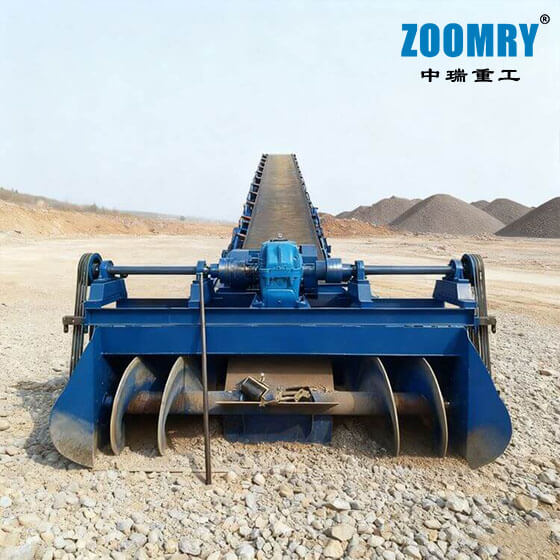
The shafted vs shaftless spiral conveyor decision is driven by the material, not by capacity. Free-flowing dry powders, granules, and small solids (cement, fly ash, grain, sugar) run on a shafted screw conveyor. Sticky, fibrous, stringy, or wet materials (sludge, biomass, wet ash, clay) need a shaftless spiral because the material cannot bridge across a centre pipe. Separately, a spiral conveyor — shafted or shaftless — fits short-to-medium, sealed, low-to-moderate tonnage transfers; for long horizontal runs or steep inclines, an en-masse chain conveyor is the stronger choice. ZOOMRY SSC series shaftless spiral scraper conveyors cover 100–2,000 t/h with 500–800 mm spiral diameters.
Why spiral conveyor selection starts with the material, not the tonnage
Most spiral conveyor enquiries begin with a capacity figure. That is the second question. The first question is whether the material can be conveyed by a spiral at all — and if so, whether it needs a centre pipe. A shafted screw conveyor has a spiral flight welded to a centre pipe, supported by hanger bearings along the length. A shaftless spiral is a single helicoid with no centre pipe and no hanger bearings inside the trough. The geometry difference decides which materials each design can move.
A shafted conveyor handles free-flowing material well because the material rests in the trough and the flight pushes it forward. A shaftless conveyor handles material that would otherwise wrap around or bridge across the centre pipe — sticky, fibrous, stringy, or wet material that clings to a shaft and blinds the flight. The selection is a material test first, and an equipment comparison second.
Shafted vs shaftless: the material-driven decision
| Factor | Shafted screw conveyor | Shaftless spiral conveyor |
|---|---|---|
| Material type | Free-flowing dry powders, granules, small solids — cement, fly ash, lime, grain, sugar, sand | Sticky, fibrous, stringy, wet, or sluggish materials — sludge, biomass, wet ash, clay, screenings |
| Why | Material flows in the trough; centre pipe and hanger bearings are not a blockage point | No centre pipe for material to wrap around or bridge across; no hanger bearings to blind the flight |
| Torque capacity | Higher — the centre pipe carries the torsional load | Lower — the spiral alone carries torque, so diameter and flight thickness are sized up |
| Length limit | Longer runs feasible with hanger bearings | Shorter runs; beyond a point the unsupported spiral deflects |
| Wear point | The shaft and flight wear first | The trough liner wears first; the spiral is often the harder component |
| Maintenance | Hanger bearings inside the trough are a maintenance point | No internal bearings; the trough liner is the replaceable wear part |
Selection tip: if the material is dry and free-flowing, the shafted design is lower cost and higher torque capacity. Do not specify shaftless for a free-flowing powder — it gives up torque and length capability without solving a problem the material does not have.
When a spiral conveyor beats an en-masse chain conveyor — and when it doesn't
The spiral conveyor is one option among several enclosed transfer methods. The comparison that matters in bulk handling is spiral vs en-masse chain (also called drag or tubular chain conveyor). Both are enclosed, both handle dusty material, and both can run horizontally or on a slight incline. The boundary between them is distance, tonnage, and angle.
| Duty | Spiral conveyor | En-masse chain conveyor |
|---|---|---|
| Run length | Short to medium — metres to tens of metres | Long horizontal legs — up to 100–300 ft in one machine |
| Tonnage | Low to moderate per unit; sealed and metered | High tonnage; lower speed, lower degradation |
| Incline | Horizontal or gentle incline | Steeply inclined or vertical |
| Sealing | Good — enclosed trough or tube | Good — fully enclosed chain path |
| Material | Powders, granules, sticky or fibrous material (shaftless) | Fragile, friable, or high-tonnage bulk where degradation matters |
| Typical use | Metering, short sealed transfer, sanitary or dusty duty | Long horizontal transfer, silo discharge, high-capacity enclosed conveying |
Selection tip: if the duty is short, horizontal, sealed, and low-to-moderate tonnage, the spiral conveyor is the simpler and often lower-cost choice. If the run is long, the tonnage is high, or the route needs a steep incline, the en-masse chain conveyor owns that duty and the spiral will be undersized for the distance.
ZOOMRY SSC series: shaftless spiral scraper configuration
ZOOMRY’s SSC series is a shaftless spiral scraper conveyor for enclosed bulk handling. The range covers 100–2,000 t/h with spiral diameters of 500–800 mm and belt widths of 800–1,400 mm. The shaftless geometry suits sticky, fibrous, and fine materials that would bridge on a shafted design — the applications where a conventional screw conveyor blinds and stalls.
| Configuration | Capacity | Spiral diameter | Application |
|---|---|---|---|
| SSC-ST (standard) | 100–2,000 t/h | 500–800 mm | Fixed installations for powders and granules |
| SSC-TR (tracked) | 100–2,000 t/h | 500–800 mm | Complex terrain, mobile receiving points |
| SSC-GR (grain) | 100–2,000 t/h | 500–800 mm | Low-damage grain handling |
| SSC-LD (loading) | 100–2,000 t/h | 500–800 mm | Loading-optimised discharge |
Selection tip: the SSC-GR grain configuration is specified when crystal or kernel damage matters; the standard SSC-ST is for general powders and granules where breakage is not a constraint. The shaftless geometry is the common thread — it is what allows the SSC series to handle materials that would stall a shafted screw.
Selection checklist
Material first. Free-flowing dry powder or granule → shafted. Sticky, fibrous, stringy, or wet → shaftless.
Run length and angle. Short and horizontal → spiral. Long horizontal or steep incline → en-masse chain.
Tonnage per unit. Metering and sealed short transfer → spiral. High-tonnage long transfer → chain.
Wear part strategy. Shafted: shaft and flight wear. Shaftless: trough liner wears — confirm the liner material and replacement procedure.
Sanitary or food-grade requirement. Confirm stainless contact surfaces and cleanable design if the material is food or feed.
Explosive dust. Enclosed spiral conveyors handling sugar, flour, or other combustible dust need ATEX-rated construction for the internal atmosphere.
FAQ
When should I choose a shaftless spiral conveyor instead of a shafted screw conveyor?
When the material is sticky, fibrous, stringy, or wet — sludge, biomass, wet ash, clay, or screenings. These materials wrap around the centre pipe of a shafted conveyor or bridge across it, blinding the flight. A shaftless spiral has no centre pipe and no internal hanger bearings, so the material cannot clog the same way.
Can a spiral conveyor handle the same tonnage as an en-masse chain conveyor?
Not at the same run length. A spiral conveyor is suited to short-to-medium runs at low-to-moderate tonnage per unit. An en-masse chain conveyor handles long horizontal legs — up to 100–300 ft in one machine — at high tonnage and low speed. The spiral is the simpler choice for short sealed transfers; the chain owns long and high-tonnage duty.
What is the capacity range of a ZOOMRY SSC series spiral conveyor?
The SSC series covers 100–2,000 t/h with spiral diameters of 500–800 mm and belt widths of 800–1,400 mm. The range spans standard, tracked, grain, and loading configurations.
Is a shaftless spiral conveyor better than a shafted one?
Neither is universally better. Shafted has higher torque capacity and longer length capability for free-flowing material. Shaftless handles sticky and fibrous material that would clog a shafted unit. The material decides which design applies; specifying shaftless for a free-flowing powder gives up torque and length without solving a problem.
Can a spiral conveyor run on an incline?
A spiral conveyor runs horizontally or on a gentle incline. For steeply inclined or vertical duty, an en-masse chain conveyor is the appropriate enclosed transfer method. Specifying a spiral for a steep incline leads to material fallback and reduced capacity.
Explore This Topic: Spiral Scraper & Special Conveyors
Special conveying equipment for reclaim, scraping and enclosed transfer duties.
- Spiral Scraper Conveyor — Topic hub
- Spiral scraper conveyor high resistance, chain misalignment? How to fix common issues? — Guide
- Spiral Scraper Conveyor for Sugar, Sand & Fine Powders: Selection Guide — Guide
- Spiral Scraper Conveyor: Enclosed Bulk Reclaiming System for Coal, Gravel & Ore — Product
- Tracked Spiral Scraper Conveyor – Mobile Bulk Handling for Complex Terrain | 100–2000 tph | ZOOM — Product
Let's build it together
Need a custom bulk handling solution?
Talk to our engineers about conveyors, stackers, ship loaders and turnkey EPC systems.