
CEMA B equal impact troughing idlers combine symmetrical three-roller design with rubber cushion rings for loading zone protection at crusher discharge and transfer points.
ZOOMRY CEMA B equal impact troughing idlers combine a symmetrical three equal-length roller design with rubber cushion rings for light-duty loading zone protection. Engineered to CEMA B standards for mining and aggregate conveyors up to 48-inch belt width, these impact troughing idlers absorb the majority of impact energy at crusher discharge and transfer points — protecting both belt and structure from premature failure. Available in 20°, 35°, and 45° trough angles with 4-inch and 5-inch impact-rated rollers and labyrinth seals.
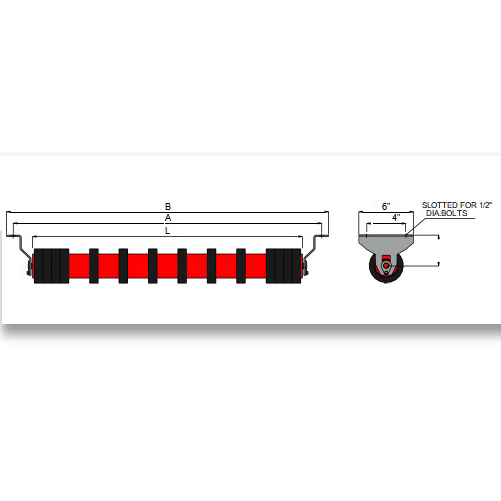
Unlike standard carrying idlers, each roller is fitted with molded rubber cushion rings spaced along the roller length. These rings compress under falling material impact, then rebound — dissipating kinetic energy that would otherwise damage the belt carcass. The equal-length roller configuration ensures uniform impact distribution across the full belt width, making these idlers the preferred choice for aggregate and cement crusher discharge zones with centered loading.
At conveyor loading zones, material falling from a crusher or preceding conveyor generates high-energy impact forces concentrated at the point of belt contact. Standard carrying idlers transmit these forces directly to the belt carcass — accelerating splice fatigue, cover wear, and idler bearing damage over time.
The CEMA B equal impact troughing idler solves this with molded rubber cushion rings installed at regular intervals along each of the three equal-length rollers. As material impacts the belt, these rings compress — converting kinetic energy into elastic deformation. The rings then rebound gradually, preventing secondary shock waves through the belt. This mechanism absorbs the majority of impact energy, helping to extend belt life at transfer points in coal and mineral processing applications.
Symmetrical Three Equal-Length Rollers — Uniform impact distribution across the full belt width, matching the CEMA B equal troughing geometry for consistent belt support from standard sections into loading zones.
Molded Rubber Cushion Rings — Multi-stage compression absorbs the majority of falling material impact energy, helping to prevent belt puncture and splice damage at transfer points.
CEMA B Light-Duty Rating — 4-inch and 5-inch diameter impact-rated rollers for belt widths up to 48 inches — suitable for light-duty crusher discharge in aggregate and sand processing operations.
Three Trough Angles — Available in 20°, 35°, and 45° to match existing carrying idler geometry, ensuring seamless belt transition from standard sections into impact zones.
Advanced Labyrinth Sealing — Multi-stage seals protect bearings from fine dust and moisture ingress common in crushing and mineral processing environments.
| Feature | CEMA B Equal Impact (B8) | CEMA B Equal Troughing (B7) |
|---|---|---|
| Roller Surface | Rubber cushion rings on steel shell | Smooth steel shell |
| Primary Function | Impact absorption + belt protection | Maximum carrying capacity |
| Impact Protection | Yes — rubber rings absorb impact energy | Minimal — steel-on-belt contact |
| Best Application | Crusher discharge, transfer points, loading zones | Standard conveyor carrying sections |
| Spacing Recommendation | 300–450 mm at impact zone | 900–1,200 mm standard spacing |
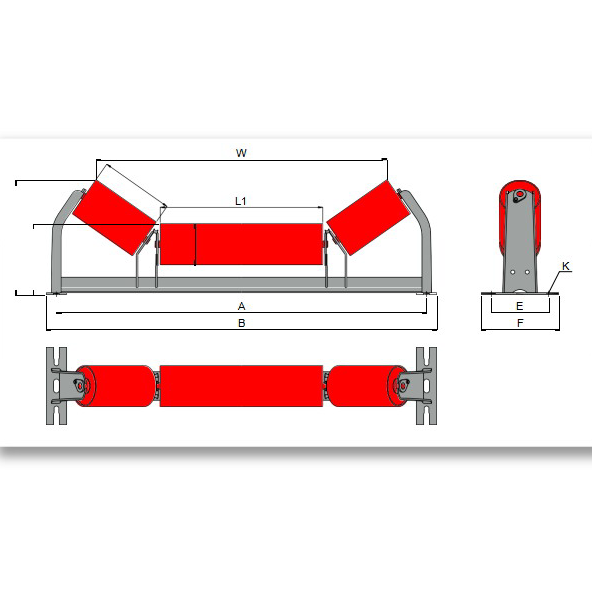
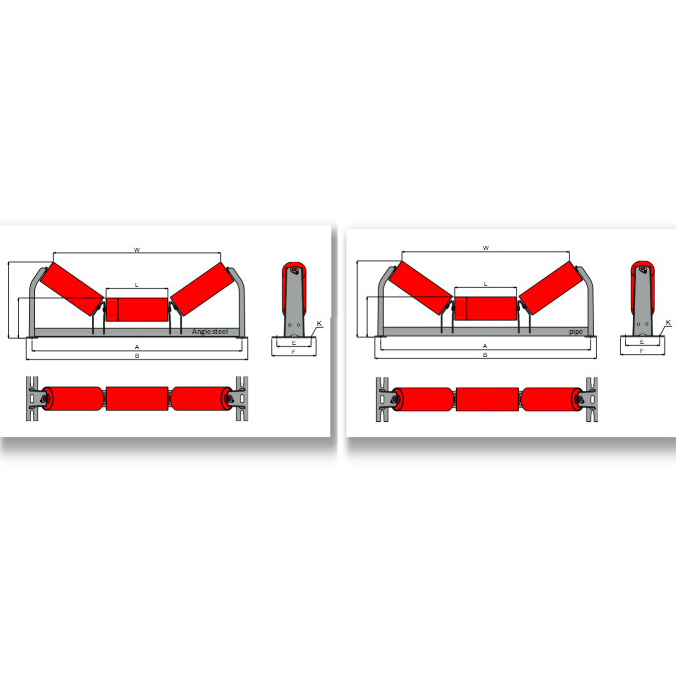
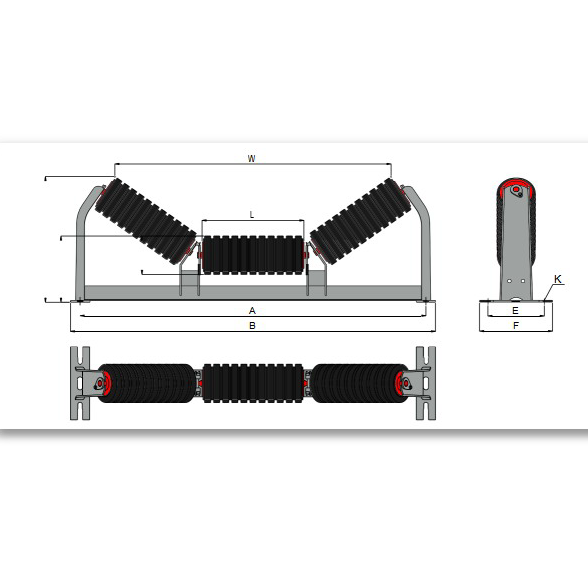
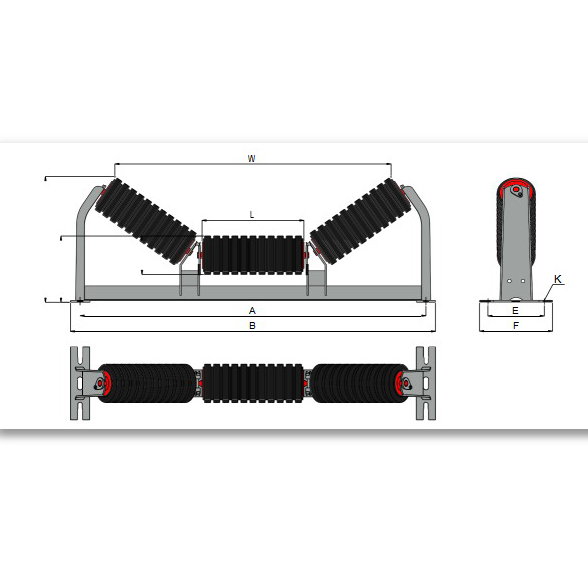
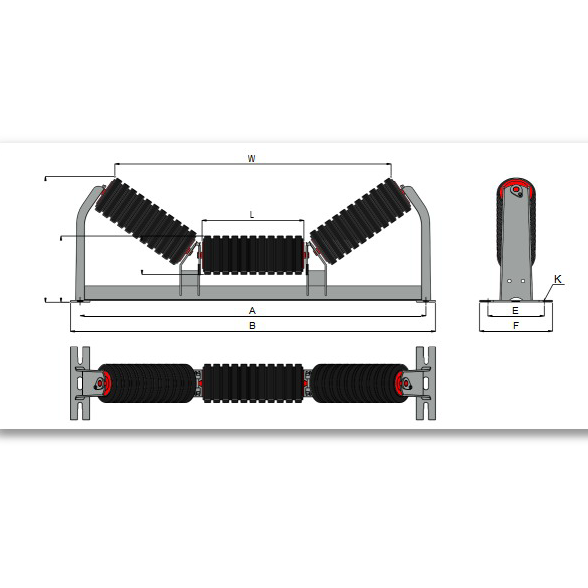
ZOOMRY CEMA B equal impact troughing idlers share the same frame geometry as CEMA B equal troughing idlers, with rubber cushion rings on each roller. Manufactured with 4-inch and 5-inch impact-rated roller configurations for belt widths from 18 to 48 inches. Suitable for light-duty CEMA B loading zones in mining, coal, cement, and aggregate conveyors:
| 4" Roller | 5" Roller | ||||||||||||
|---|---|---|---|---|---|---|---|---|---|---|---|---|---|
| Angle | BW | A | B | L | H1 | H2 | W | H1 | H2 | W | E | F | K |
| 20° | 18 | 27 | 29 | 7 1/4 | 6 1/2 | 8 5/8 | 21 1/2 | 7 | 9 1/16 | 21 1/8 | 6 | 8 | 1/2 |
| 24 | 33 | 35 | 9 1/16 | 6 1/2 | 8 5/8 | 27 1/2 | 7 | 9 1/16 | 27 1/8 | 6 | 8 | 1/2 | |
| 30 | 39 | 41 | 11 1/8 | 6 1/2 | 8 5/8 | 33 1/4 | 7 | 9 1/16 | 32 7/8 | 6 | 8 | 1/2 | |
| 36 | 45 | 47 | 13 1/4 | 6 1/2 | 8 5/8 | 39 1/4 | 7 | 9 1/16 | 38 7/8 | 6 | 8 | 1/2 | |
| 42 | 51 | 53 | 15 7/16 | 7 | 9 1/16 | 45 1/4 | 7 1/2 | 9 9/16 | 44 7/8 | 7 1/2 | 9 1/2 | 5/8 | |
| 48 | 57 | 59 | 17 1/16 | 7 | 9 1/16 | 51 1/4 | 7 1/2 | 9 9/16 | 50 7/8 | 7 1/2 | 9 1/2 | 5/8 | |
| 35° | 18 | 27 | 29 | 7 1/4 | 6 1/2 | 10 3/16 | 19 1/2 | 7 | 10 9/16 | 19 1/16 | 6 | 8 | 1/2 |
| 24 | 33 | 35 | 9 1/16 | 6 1/2 | 10 3/16 | 25 1/4 | 7 | 10 9/16 | 24 7/8 | 6 | 8 | 1/2 | |
| 30 | 39 | 41 | 11 1/8 | 6 1/2 | 11 1/2 | 30 3/4 | 7 | 11 7/8 | 30 3/16 | 6 | 8 | 1/2 | |
| 36 | 45 | 47 | 13 1/4 | 6 1/2 | 11 1/2 | 36 5/8 | 7 | 11 7/8 | 36 1/16 | 6 | 8 | 1/2 | |
| 42 | 51 | 53 | 15 7/16 | 7 | 13 1/4 | 40 3/4 | 7 1/2 | 13 5/8 | 40 3/16 | 7 1/2 | 9 1/2 | 5/8 | |
| 48 | 57 | 59 | 17 1/16 | 7 | 13 1/4 | 46 3/4 | 7 1/2 | 13 5/8 | 46 3/16 | 7 1/2 | 9 1/2 | 5/8 | |
| 45° | 18 | 27 | 29 | 7 1/4 | 6 1/2 | 11 1/8 | 17 3/4 | 7 | 11 1/2 | 17 5/16 | 6 | 8 | 1/2 |
| 24 | 33 | 35 | 9 1/16 | 6 1/2 | 11 1/8 | 23 1/4 | 7 | 11 1/2 | 22 13/16 | 6 | 8 | 1/2 | |
| 30 | 39 | 41 | 11 1/8 | 6 1/2 | 12 13/16 | 28 3/8 | 7 | 13 1/16 | 27 13/16 | 6 | 8 | 1/2 | |
| 36 | 45 | 47 | 13 1/4 | 6 1/2 | 12 13/16 | 33 7/8 | 7 | 13 1/16 | 33 5/16 | 6 | 8 | 1/2 | |
| 42 | 51 | 53 | 15 7/16 | 7 | 15 1/16 | 37 3/4 | 7 1/2 | 15 3/8 | 37 3/16 | 7 1/2 | 9 1/2 | 5/8 | |
| 48 | 57 | 59 | 17 1/16 | 7 | 15 1/16 | 43 3/4 | 7 1/2 | 15 3/8 | 43 3/16 | 7 1/2 | 9 1/2 | 5/8 | |
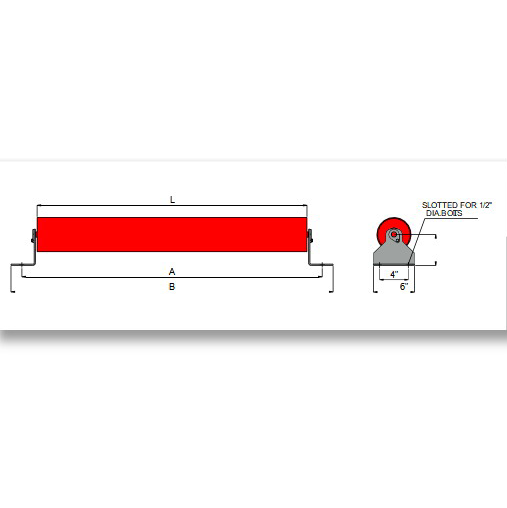
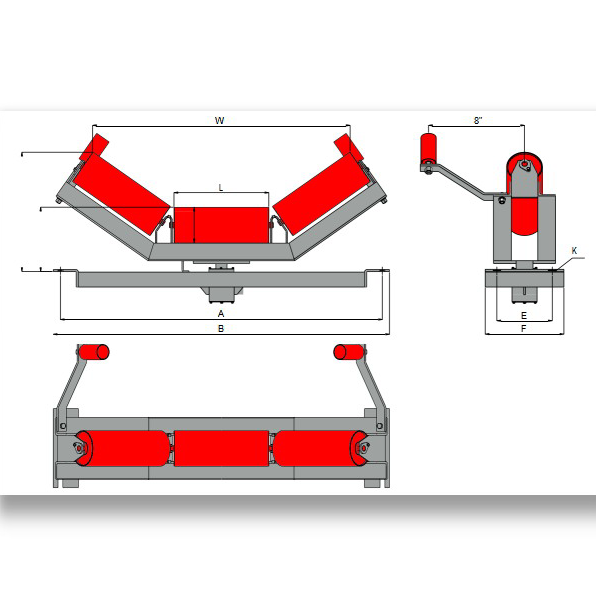
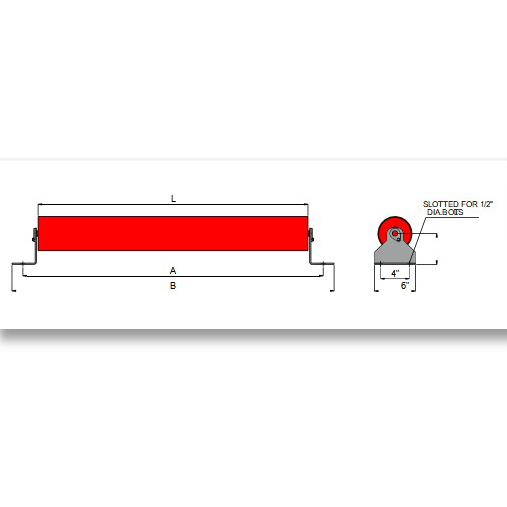
Dimensions per CEMA B industry standards. Frame geometry matches CEMA B equal troughing idlers. Rubber cushion rings add approximately 1–2 inches to the effective roller diameter at the ring location. A=Frame width, B=Overall width, L=Roller length, H1=Base height, H2=Overall height, W=Center-to-center mounting width, E/F/K=Mounting dimensions. All dimensions in inches.

Tell us your material lump size, drop height, and belt width — our engineers will recommend the optimal impact idler configuration with correct cushion ring spacing.
Request Impact Idler Recommendation →CEMA B Light-Duty Rating — 4-inch and 5-inch diameter impact-rated rollers for belt widths up to 48 inches — suitable for light-duty crusher discharge in aggregate and sand processing operations.
Three Trough Angles — Available in 20°, 35°, and 45° to match existing carrying idler geometry, ensuring seamless belt transition from standard sections into impact zones.
The practical differences from the CEMA B Equal Troughing (B7) are: roller surface — Rubber cushion rings on steel shell instead of Smooth steel shell; primary function — Impact absorption + belt protection instead of Maximum carrying capacity; impact protection — Yes — rubber rings absorb impact energy instead of Minimal — steel-on-belt contact.
This model, CEMA B Equal Impact Troughing Idlers, sits in the CEMA B class — the medium-light duty tier of the CEMA idler range. That class is intended for light-to-medium load and moderate belt speeds, and it is most often specified for general aggregate, grain and light industrial conveyors.
Within that class, this Equal Impact Troughing variant uses equal troughing rollers fitted with impact-resistant rings, which makes it suited to loading zones where lump impact must be absorbed at the carry side. Compared with other forms in the same CEMA B family, the difference is in how the rollers support and steer the belt rather than in the duty rating itself.
Selecting between CEMA classes and forms starts from the calculated idler load, belt width, speed and material density. Check the calculated idler load and belt speed before confirming the class for the final drawing. Bearing sealing and lubricant selection govern service life in dusty or wet conditions.
Full CEMA Idler Catalog for all CEMA B, C, D and E idler variants.
Compare adjacent models, sizes and duty classes in this category before requesting a quotation.
Browse all Conveyor Idler models or the complete product range.