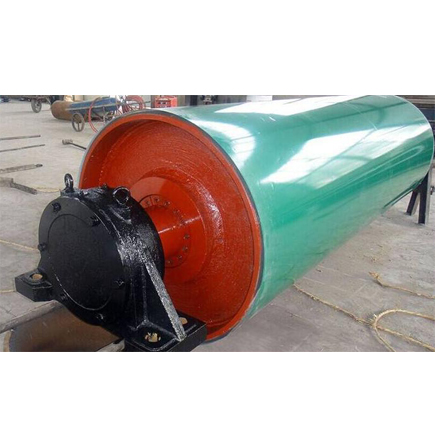
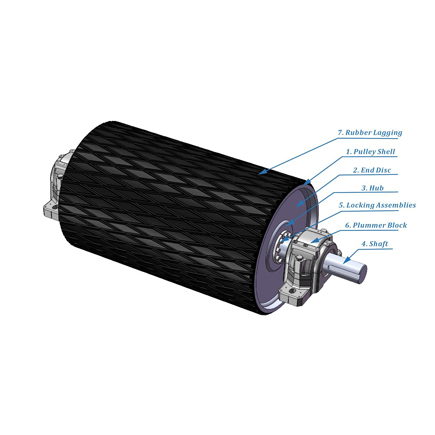
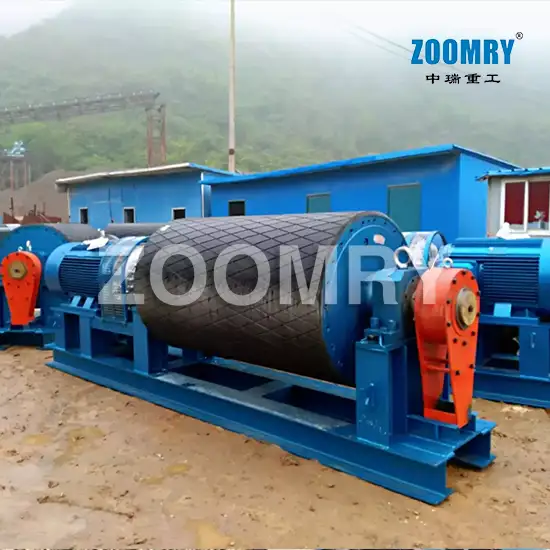
For over two decades, ZOOMRY has manufactured heavy-duty conveyor pulleys for mining, cement, quarry, and recycling operations worldwide. Our complete range covers drive pulleys, tail pulleys, snub pulleys, take-up pulleys, motorized pulleys, quarry duty pulleys, and lagged pulleys with ceramic or rubber coating – manufactured from 16Mn steel or 40Cr forged material with belt widths from 400mm to 2,400mm.
Wondering which pulley type fits your 2026 project? The choice depends on your drive power requirements, belt tension, and operating environment. Compare our main types below: drive/head pulleys for power transmission, tail and bend pulleys for direction changes, snub pulleys for wrap angle optimization, take-up pulleys for tension control, motorized pulleys for compact drive solutions, and lagged pulleys with ceramic or rubber coating for enhanced grip in abrasive applications.
Each pulley undergoes CNC four-roll rounding, ultrasonic flaw detection, and tempering stress relief – with ovality below 1.5mm and designed for a service life exceeding 50,000 hours. Contact our engineers for project-specific recommendations.
| Pulley type | Function | Belt width | Notes |
|---|---|---|---|
| Drive / head pulley | Transmits drive torque to the belt | 500–2,400 mm | Diameter 500–2,400 mm, matched to belt width and tension |
| Tail / bend pulley | Reverses the belt at the tail end | 500–2,400 mm | Plain or lagged surface depending on build-up risk |
| Take-up pulley | Maintains belt tension | 500–2,800 mm | Pulley length 500–3,200 mm |
| Snub pulley | Increases wrap angle on the drive pulley | 500–2,800 mm | Raises available traction without a larger drive pulley |
| Motorized pulley | Integrated motor and gearbox inside the drum | 400–2,600 mm | 1.5–630 kW, 0.35–4.0 m/s, drum 200–1,800 mm |
| Quarry duty pulley | Heavy abrasive duty | 500–2,800 mm | 16Mn shell, 45#/40Cr/42CrMo shaft, 50,000 h design life |
Drive pulley diameter follows belt width: a 500 mm belt runs a 500 mm pulley, a 1,400 mm belt runs 1,000–1,350 mm, and a 2,400 mm belt runs 1,800–2,400 mm. Larger diameters reduce belt flex and extend splice life.
No models match your filter.