
What Is a Carrying Idler? Troughing Idler Types and Selection Guide
In belt conveyor systems, the carrying idler supports the loaded belt and the material being conveyed on the carrying side.
Quick Answer
A carrying idler is an idler assembly installed on the carrying side of a belt conveyor to support the belt and the conveyed material. Further down: component details, operating limits, and related ZOOMRY equipment. Exact capacities, dimensions and standards are confirmed per project in the technical agreement, not from catalogue text.
In belt conveyor systems, the carrying idler supports the loaded belt and the material being conveyed on the carrying side. Also called a troughing idler or troughing roller, this component directly affects belt tracking, load distribution, and overall conveyor performance. Choosing the right carrying idler requires matching roller diameter, trough angle, CEMA class, sealing, and frame configuration to the material and operating conditions. As a professional bulk material handling solution provider with over 20 years of experience, ZOOMRY manufactures conveyor idlers for mining, cement, port, and aggregate applications. This guide explains carrying idler types, selection factors, and CEMA ratings to help you specify the right configuration.
What Is a Carrying Idler?
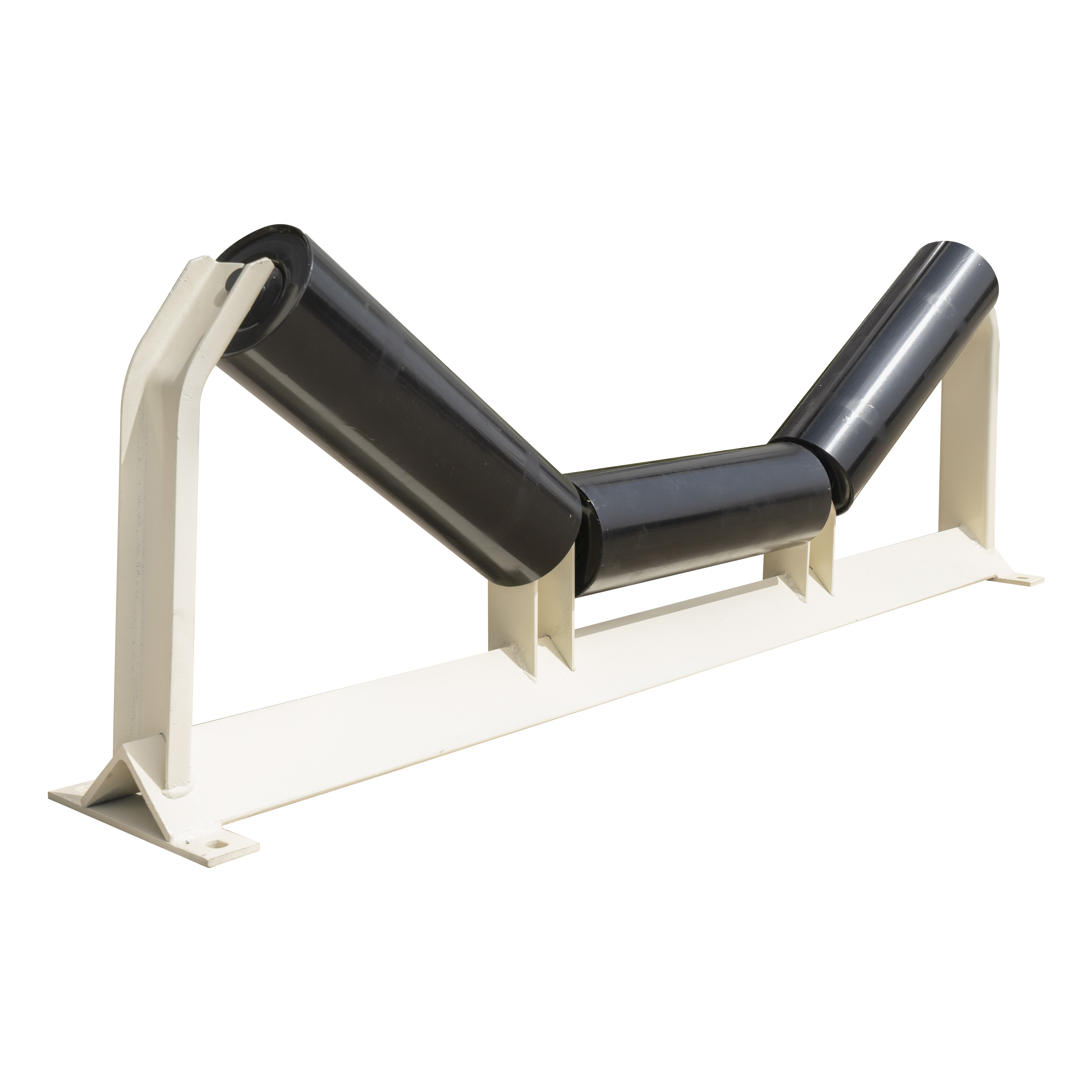
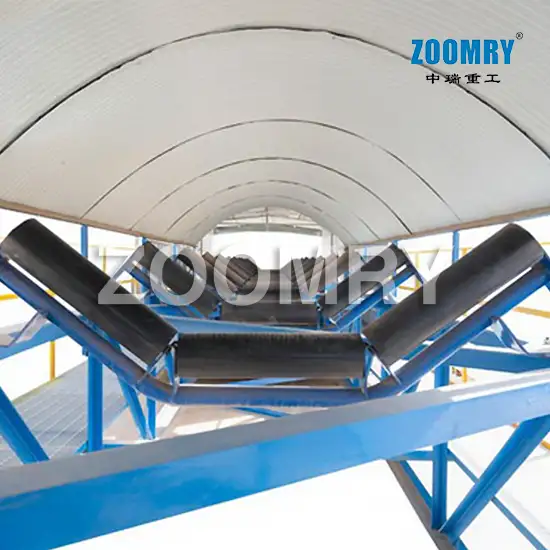
A carrying idler is an idler assembly installed on the carrying side of a belt conveyor to support the belt and the conveyed material. The most common configuration is the troughing carrying idler, which uses two or three rollers arranged at a fixed angle — typically 20°, 35°, or 45° — to form the belt into a trough shape. This trough profile increases the conveyor's carrying cross-section and helps keep material centered on the belt.
Carrying idlers are distinct from return idlers, which support the empty belt on the return side. On the carrying side, idlers must handle the combined weight of the belt and the material load, and they are often specified with heavier-duty roller construction than return-side components.
Types of Troughing Carrying Idlers
Equal Troughing Idlers
Equal troughing idlers use three rollers of equal length arranged symmetrically. This is the standard configuration for most bulk material handling applications and provides maximum carrying capacity for a given belt width.
Unequal Troughing Idlers
Unequal troughing idlers use rollers with different lengths or an offset geometry to suit selected conveyor structures and carrying-side support requirements. They can be specified where belt profile, frame arrangement, loading conditions, or retrofit dimensions differ from a standard equal troughing arrangement.
Low Profile Channel Troughing Idlers
Low profile channel troughing idlers combine an offset roller geometry with a reduced-height frame. They are designed for space-constrained installations where vertical clearance is limited, while still providing effective carrying-side support.
Self-Aligning Troughing Idlers
Self-aligning troughing idlers are mounted on a pivot frame with guide rollers. When the belt drifts off-center and contacts a guide roller, the idler frame can pivot to help steer the belt back toward the center. They are commonly used on selected long overland, reversible, or tracking-sensitive conveyor sections, but they do not replace correct conveyor alignment, centered loading, and proper belt tension.
Carrying Idler Selection Factors
Selecting the right carrying idler involves more than matching belt width. The following factors should be evaluated together to achieve reliable belt support and acceptable idler service life.
- Belt width and roller diameter: Carrying idlers are available across CEMA B, C, D, and E ratings, with belt widths typically ranging from 18" to 96". Roller diameter must match the CEMA class and load requirements.
- Trough angle: Higher trough angles can increase the usable carrying cross-section for a given belt width. However, they also increase belt edge lift, belt bending requirements, transition-zone design requirements, and sensitivity to belt construction and material loading conditions.
- Material characteristics: Bulk density, lump size, moisture, and abrasiveness affect the required idler load rating, roller material, and sealing arrangement.
- CEMA class: CEMA B is light-duty, CEMA C is medium-duty, CEMA D is heavy-duty, and CEMA E is extra heavy-duty. The class determines load rating, roller diameter, and frame construction.
- Sealing and lubrication: Labyrinth seals and appropriate bearing lubrication are critical for extended idler service life in dusty, wet, or corrosive environments.
- Idler spacing: Closer spacing is required for high-impact loading zones, wide belts, and high-tension areas near the head and tail pulleys.
CEMA B/C/D/E Carrying Idler Comparison
The table below summarizes the general load classes and typical applications for CEMA carrying idlers. Final selection should be confirmed based on calculated belt tension, material load, and site operating conditions.
| CEMA Class | Roller Diameter | Belt Width Range | Typical Application |
|---|---|---|---|
| B — Light-Duty | 4" – 5" | 18" – 48" | Light aggregate, grain, packaged materials, lower-capacity conveyors |
| C — Medium-Duty | 4" – 5" | 18" – 60" | Aggregate, sand, gravel, coal, general bulk material handling |
| D — Heavy-Duty | 5" – 6" | 24" – 72" | Iron ore, copper concentrate, heavy aggregate, high-capacity mining conveyors |
| E — Extra Heavy-Duty | 6" – 7" | 36" – 96" | Overland conveyors, high-tension long-distance systems, extreme material loads |
Note: CEMA class is not selected by belt width or roller diameter alone. Final idler selection should consider belt speed, idler spacing, material bulk density, belt width, conveyor capacity, belt tension, impact conditions, roller diameter, bearing size, frame rating, and site operating environment.
When Should You Use Carrying, Impact, or Self-Aligning Idlers?
| Idler Type | Primary Purpose | Typical Installation Location |
|---|---|---|
| Standard Carrying Idler | Supports the loaded belt and forms the required trough profile | Normal carrying-side conveyor sections |
| Impact Idler | Helps absorb material impact and supports the belt at loading zones | Transfer points, crusher discharge zones, and high-drop loading areas |
| Self-Aligning Troughing Idler | Helps guide the belt back toward center when selected tracking issues occur | Selected tracking-sensitive, long-distance, or reversible conveyor sections |
Related Products
Explore This Topic: Conveyor Rollers, Idlers & Pulleys
Component-level guides for selecting, classifying and replacing conveyor rollers, idlers, pulleys and belt-cleaning parts.
- Mining Conveyor Rollers Guide — Heavy-Duty Idlers — Topic hub
- Maintenance of Conveyor Rollers – Bearing, Seal & Service Life Guide — Guide
- Conveyor Guide Roller: Self-Aligning Idlers for Belt Tracking & Alignment — Product
- Conveyor Idler Systems: CEMA B/C/D/E Carrying, Return & Impact Rollers — Product
- What Are Conveyor Rollers? Types, Functions & Selection — Guide
- CEMA C Self-Aligning Troughing Idlers: Medium-Duty Carrying Side Tracking, 20°/35°/45° — Product
Let's build it together
Need a custom bulk handling solution?
Talk to our engineers about conveyors, stackers, ship loaders and turnkey EPC systems.