
CEMA C self-aligning troughing idlers feature a pivot-mounted frame with side guide rollers for automatic carrying side belt tracking.
ZOOMRY CEMA C self-aligning troughing idlers provide automatic belt tracking correction on the carrying side via a pivot-mounted frame with side guide rollers. Engineered to CEMA C standards for mining and industrial conveyors up to 42-inch belt width, these troughing idlers detect belt drift and pivot the entire roller assembly to steer the belt back to center — reducing edge wear and material spillage without sensors or external power. Available in 20°, 35°, and 45° trough angles with 4-inch and 5-inch diameter rollers.
Self-aligning troughing idlers are essential for long overland conveyors and coal handling systems where carrying side mistracking causes belt edge fraying, material spillage, and idler junction stress. The pivot mechanism operates continuously — no sensors, no actuators, no operator intervention — making it a robust tracking solution for remote and unattended conveyor sections.
On the carrying side of a belt conveyor, material load is rarely perfectly centered. Uneven feeding, belt camber, wind loads, and frame settlement all contribute to lateral belt drift. Over time, the belt edge can rub against fixed idler brackets — causing progressive fraying, splice fatigue, and material spillage along the conveyor path.
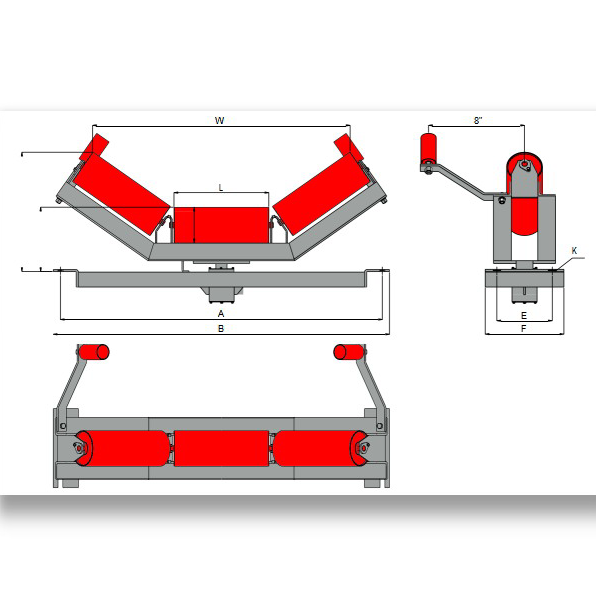
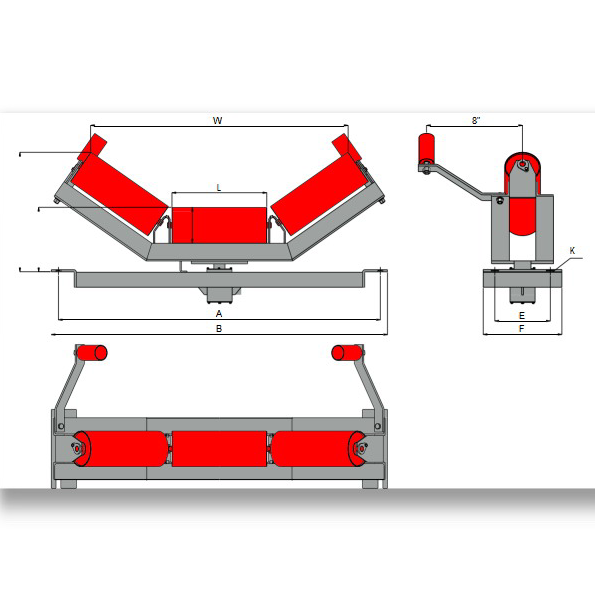
The CEMA C self-aligning troughing idler addresses this by using a center-pivot frame and two side-mounted guide rollers positioned at belt edge height. When the loaded belt drifts to one side, the corresponding guide roller contacts the belt edge and rotates the entire three-roller assembly around the center pivot. This steering action redirects the belt back toward the center. In normal operation, misalignment is corrected within a few belt revolutions once the belt edge engages the guide roller. The mechanism is purely mechanical: no sensors, no wiring, no pneumatic or hydraulic connections.
Pivot-Mounted Three-Roller Assembly — The entire troughing set rotates around a center pivot when guide rollers detect belt drift, providing a steering correction range appropriate for most carrying-side tracking issues. By actively steering the belt back to center, it helps significantly reduce carrying side edge wear compared with standard fixed troughing idlers, especially in cement and aggregate conveyor applications.
Side Guide Rollers — Vertical rollers at both belt edges act as mechanical “sensors” that react directly to belt drift — with no electronic components to fail in dusty, wet, or high-vibration environments.
CEMA C Medium-Duty Rating — 4-inch and 5-inch diameter rollers engineered for belt widths up to 42 inches — suitable for aggregate quarry and mining conveyor carrying sections.
Three Trough Angles — Available in 20°, 35°, and 45° to match existing carrying idler geometry, ensuring seamless integration into standard CEMA C conveyor structures.
Fully Passive Operation — No sensors, no actuators, no wiring — purely mechanical pivot design for continuous tracking correction in remote and unattended conveyor sections.
| Feature | CEMA C Self-Aligning Troughing (C4) | CEMA C Equal Troughing (C10) |
|---|---|---|
| Frame Type | Center-pivot with guide rollers | Fixed rigid frame |
| Belt Tracking | Active automatic correction | Passive — frame alignment dependent |
| Edge Wear | Helps reduce belt edge wear and spillage on the carrying side | Baseline — no automatic corrective action |
| Installation Spacing | Often installed periodically (e.g., every 30–50 m) on long conveyors | Standard 1–1.2 m idler spacing |
| Best For | Long overland, reversible, high-speed conveyors | Standard straight conveyor sections |
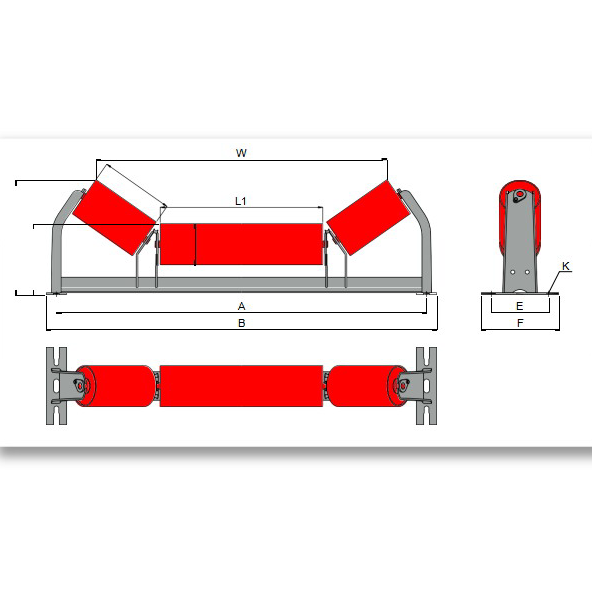
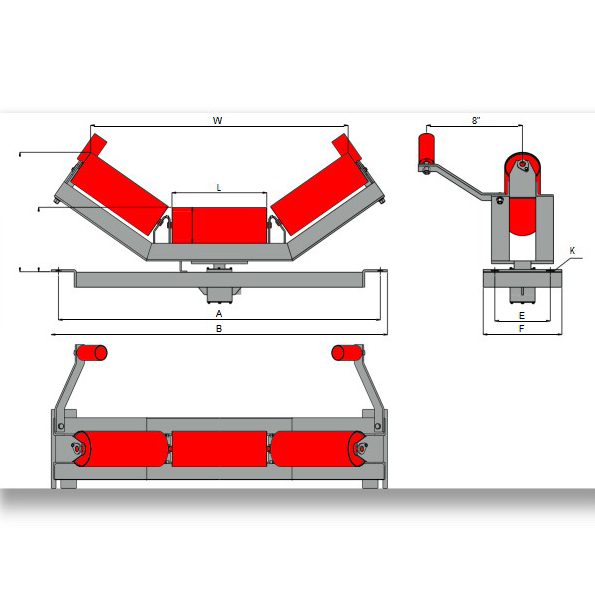
ZOOMRY CEMA C self-aligning troughing idlers are manufactured with 4-inch and 5-inch roller configurations for belt widths from 18 to 42 inches at all three standard trough angles:
| 4" Roller | 5" Roller | ||||||||||||
|---|---|---|---|---|---|---|---|---|---|---|---|---|---|
| Angle | BW | A | B | L | H1 | H2 | W | H1 | H2 | W | E | F | K |
| 20° | 18 | 27 | 29 | 7 1/4 | 8 1/2 | 11 3/8 | 21 5/8 | 9 | 11 13/16 | 21 1/4 | 6 | 11 | 5/8 |
| 24 | 33 | 35 | 9 1/16 | 8 7/8 | 12 1/8 | 27 11/16 | 9 3/8 | 12 9/16 | 27 3/8 | 6 | 11 | 5/8 | |
| 30 | 39 | 41 | 11 1/8 | 8 15/16 | 12 7/8 | 33 7/16 | 9 7/16 | 13 5/16 | 33 1/8 | 6 | 11 | 5/8 | |
| 36 | 45 | 47 | 13 1/4 | 8 15/16 | 13 9/16 | 39 3/16 | 9 7/16 | 14 | 38 7/8 | 6 | 11 | 5/8 | |
| 42 | 51 | 53 | 15 7/16 | 9 5/16 | 14 5/8 | 44 15/16 | 9 13/16 | 15 1/16 | 44 5/8 | 7 1/2 | 11 | 5/8 | |
| 35° | 18 | 27 | 29 | 7 1/4 | 8 1/2 | 13 1/4 | 19 3/8 | 9 | 13 3/4 | 18 7/8 | 6 | 11 | 5/8 |
| 24 | 33 | 35 | 9 1/16 | 8 7/8 | 14 1/8 | 25 1/16 | 9 3/8 | 14 11/16 | 24 11/16 | 6 | 11 | 5/8 | |
| 30 | 39 | 41 | 11 1/8 | 8 15/16 | 15 5/16 | 30 13/16 | 9 7/16 | 15 7/8 | 30 | 6 | 11 | 5/8 | |
| 36 | 45 | 47 | 13 1/4 | 8 15/16 | 16 7/16 | 36 7/16 | 9 7/16 | 17 | 35 1/4 | 6 | 11 | 5/8 | |
| 42 | 51 | 53 | 15 7/16 | 9 5/16 | 17 15/16 | 41 11/16 | 9 13/16 | 18 1/2 | 40 9/16 | 7 1/2 | 11 | 5/8 | |
| 45° | 18 | 27 | 29 | 7 1/4 | 8 1/2 | 14 5/8 | 17 11/16 | 9 | 15 1/16 | 17 3/16 | 6 | 11 | 5/8 |
| 24 | 33 | 35 | 9 1/16 | 8 7/8 | 15 9/16 | 23 5/16 | 9 3/8 | 15 15/16 | 22 3/4 | 6 | 11 | 5/8 | |
| 30 | 39 | 41 | 11 1/8 | 8 15/16 | 17 | 28 9/16 | 9 7/16 | 17 3/8 | 27 5/8 | 6 | 11 | 5/8 | |
| 36 | 45 | 47 | 13 1/4 | 8 15/16 | 18 3/8 | 33 11/16 | 9 7/16 | 18 3/4 | 33 | 6 | 11 | 5/8 | |
| 42 | 51 | 53 | 15 7/16 | 9 5/16 | 20 3/16 | 38 1/2 | 9 13/16 | 20 9/16 | 37 13/16 | 7 1/2 | 11 | 5/8 | |
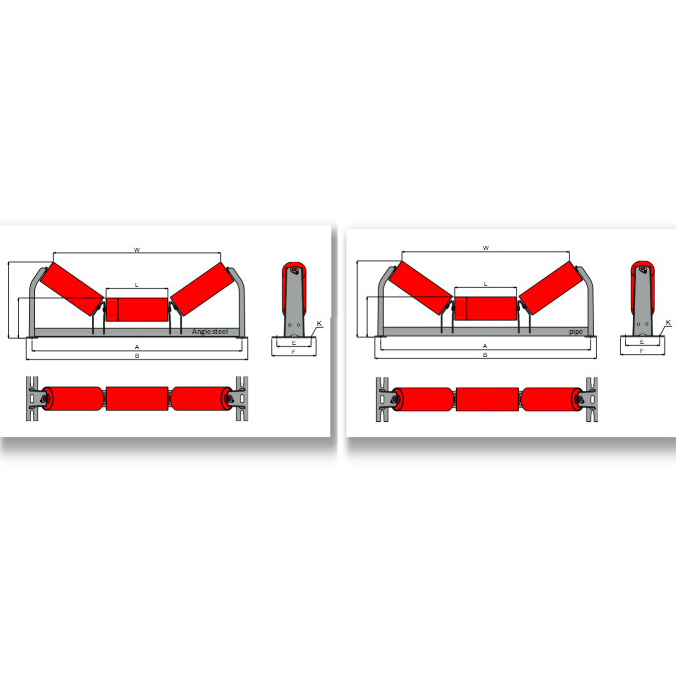
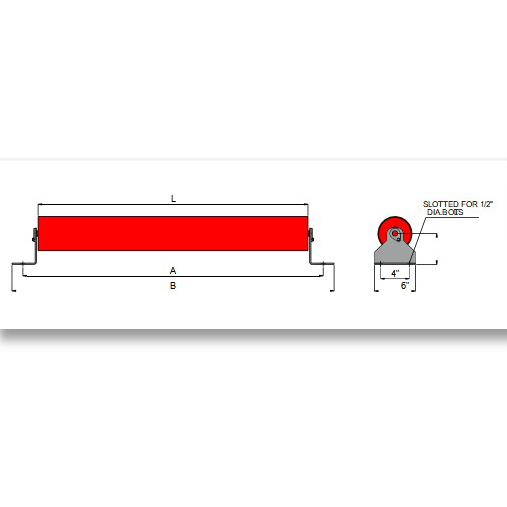
Dimensions per CEMA C industry standards. A = Frame width, B = Overall width (including guide rollers), L = Roller length, H1 = Base height, H2 = Overall height, W = Center-to-center mounting width, E/F/K = Mounting dimensions. B values are larger than standard fixed troughing idlers due to the pivot frame and guide roller assembly. All dimensions in inches. Suitable for belt widths from 18 to 42 inches on medium-duty CEMA C carrying sections.

Tell us your conveyor length, belt width, and tracking issues — our engineers will calculate a practical placement and configuration for your carrying side.
Request Tracking Idler Layout →The CEMA C Self-Aligning Troughing Idlers is specified for Long overland, reversible, high-speed conveyors. The CEMA C Equal Troughing (C10) is specified for Standard straight conveyor sections.
CEMA C Medium-Duty Rating — 4-inch and 5-inch diameter rollers engineered for belt widths up to 42 inches — suitable for aggregate quarry and mining conveyor carrying sections.
The practical differences from the CEMA C Equal Troughing (C10) are: frame type — Center-pivot with guide rollers instead of Fixed rigid frame; belt tracking — Active automatic correction instead of Passive — frame alignment dependent; edge wear — Helps reduce belt edge wear and spillage on the carrying side instead of Baseline — no automatic corrective action.
This model, CEMA C Self-Aligning Troughing Idlers, sits in the CEMA C class — the medium duty tier of the CEMA idler range. That class is intended for standard industrial loads and continuous operation, and it is most often specified for quarry, cement and general bulk handling lines.
Within that class, this Troughing variant uses a multi-roller carrying trough, which makes it suited to general loaded-belt support. Compared with other forms in the same CEMA C family, the difference is in how the rollers support and steer the belt rather than in the duty rating itself.
Selecting between CEMA classes and forms starts from the calculated idler load, belt width, speed and material density. Check the calculated idler load and belt speed before confirming the class for the final drawing. For abrasive material, plan wear-part replacement together with the maintenance schedule.
Full CEMA Idler Catalog for all CEMA B, C, D and E idler variants.
Compare adjacent models, sizes and duty classes in this category before requesting a quotation.
Browse all Conveyor Idler models or the complete product range.