
How to Fix Conveyor Belt Mistracking: Long Overland Conveyor Guide
Why Belt Mistracking Is a Critical Problem On a short conveyor, a slightly off-center belt may only cause minor spillage. In these cases, hydraulic belt alignment devices are used.
Quick Answer
Conveyor belt mistracking on long overland conveyors is caused by uneven loading, misaligned idlers, insufficient tension, or structural deflection. The most effective solution is a combination of self-aligning idler sets at curve entry and exit points, hydraulic belt alignment devices for high-tension systems, and a belt turnover device to keep the return side clean. ZOOMRY has applied these solutions on an 8,617 m curved conveyor and a 3,300 m overland iron ore conveyor.
Why Belt Mistracking Is a Critical Problem
On a short conveyor, a slightly off-center belt may only cause minor spillage. On a long overland or curved conveyor, the consequences are much more severe:
Belt edge damage: Continuous rubbing against the structure can destroy the belt edge in weeks.
Material spillage: Off-center belts spill material along the entire route, creating cleanup costs and environmental issues.
Structural damage: A misaligned belt can contact the steel structure or gallery walls, causing expensive repairs.
Downtime: Repeated tracking issues require frequent shutdowns for adjustment.
Common Causes of Mistracking on Long Conveyors
| Cause | Description |
|---|---|
| Uneven loading | Material placed off-center on the belt pushes it to one side. |
| Misaligned idlers | Idlers not perpendicular to the belt centerline create lateral forces. |
| Insufficient tension | Low tension allows the belt to sag and wander. |
| Structural deflection | Long spans can deflect under load, tilting the idlers. |
| Curved route geometry | Horizontal curves create centrifugal forces that push the belt outward. |
| Material buildup | Carryback on return idlers changes roller diameter and causes tracking drift. |
Solution 1: Self-Aligning Idler Sets
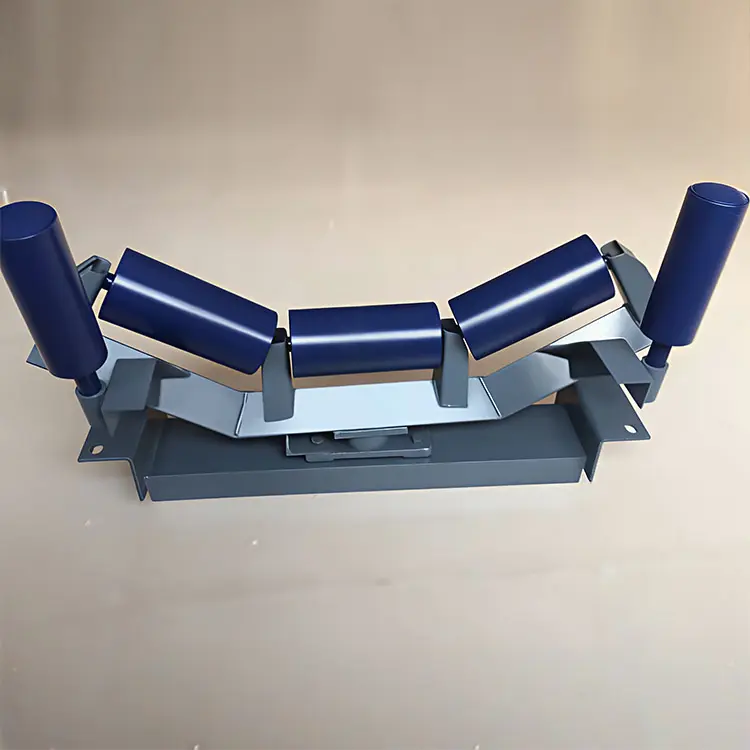
Self-aligning idler sets are the first line of defense against mistracking. They use a pivot-mounted frame with side guide rollers. When the belt moves off-center, it contacts the guide roller, which pivots the frame and steers the belt back to center.
On a long overland conveyor, self-aligning idlers should be installed at:
Entry and exit of every horizontal curve.
After every transfer point.
Before and after inclined sections.
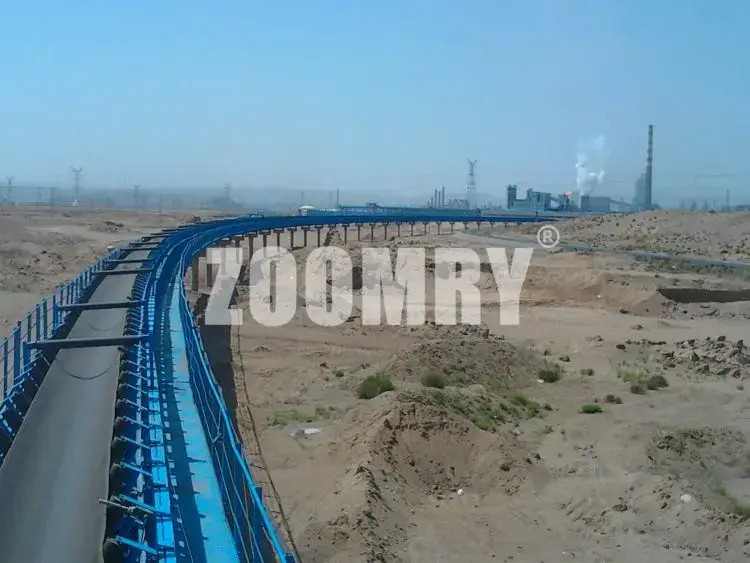
Project data: On the Hubei 8,617 m curved conveyor (9 horizontal curves, max 36°), ZOOMRY installed self-aligning idler sets at every curve entry and exit. The system has maintained stable belt tracking without manual adjustment.
Solution 2: Hydraulic Belt Alignment Devices
For high-tension, high-capacity conveyors, mechanical self-aligning idlers may not provide enough correction force. In these cases, hydraulic belt alignment devices are used.
These devices use sensors to detect belt position and hydraulic actuators to adjust the idler angle in real time. They provide stronger correction force than mechanical idlers and can handle larger tracking deviations.
Solution 3: Belt Turnover Device
On the return side, material carryback is a major cause of mistracking. As sticky material builds up on return rollers, the roller diameter becomes uneven, causing the belt to drift.
A belt turnover device rotates the belt 180° after discharge, so the clean side runs on the return idlers. This prevents carryback buildup and eliminates a major source of mistracking.
Solution 4: Proper Loading and Tension Control
Even the best tracking hardware cannot compensate for poor loading or incorrect tension. Key practices include:
Center loading: Use loading chutes or skirts to ensure material is placed in the center of the belt.
Correct tension: Maintain proper take-up tension to prevent sag and wander.
Regular inspection: Check idler alignment and belt condition at regular intervals.
Comparison of Tracking Solutions
| Solution | Correction Force | Best For |
|---|---|---|
| Self-Aligning Idlers | Moderate | Standard conveyors, curve entry/exit |
| Hydraulic Alignment Device | High | High-tension, high-capacity conveyors |
| Belt Turnover Device | Preventive | Sticky materials, long return runs |
| Loading Chute / Skirt | Preventive | All conveyors, especially at transfer points |
Project Data: ZOOMRY Tracking Solutions in the Field
Project 1: Hubei 8,617 m Curved Conveyor
9 horizontal curves (max 36°)
Self-aligning idlers at every curve entry and exit
Belt turnover device at the tightest curves
Stable tracking without manual adjustment
Project 2: Hebei 3,300 m Iron Ore Conveyor
3 horizontal curves (radius 1,200 m)
Self-aligning idlers and hydraulic alignment devices
Equipment availability: 99.3%
Frequently Asked Questions
What causes conveyor belt mistracking?
Common causes include uneven loading, misaligned idlers, insufficient tension, structural deflection, curved route geometry, and material buildup on return idlers.
How do self-aligning idlers work?
Self-aligning idlers use a pivot-mounted frame with side guide rollers. When the belt moves off-center, it contacts the guide roller, which pivots the frame and steers the belt back to center.
When should I use a hydraulic belt alignment device instead of a self-aligning idler?
Hydraulic alignment devices provide stronger correction force and are better suited for high-tension, high-capacity conveyors where mechanical idlers may not be sufficient.
What is a belt turnover device and how does it prevent mistracking?
A belt turnover device rotates the belt 180° after discharge so the clean side runs on the return idlers. This prevents carryback buildup, which is a major cause of mistracking on the return side.
How often should I inspect belt tracking on a long conveyor?
Inspection frequency depends on the conveyor length and operating conditions. For long overland conveyors, weekly inspection of idler alignment and belt position is recommended.
Related Products

Industry Applications

Explore This Topic: Belt Conveyor Systems
Foundations of belt conveying: system components, layouts, drive methods, types, cleaning and maintenance.
- How to solve common pipe belt conveyor problems in bulk handling — Guide
- FAQs on Belt Conveyors and Bulk Material Handling Equipment (Issue 4) — Guide
- Frequently Asked Questions about Belt Conveyors (Part 2) — Guide
- What Type of Cover Closure is Used for Belt Conveyors When Mobile Reception and Conveying — Guide
- What Is the Difference Between a Belt Cleaner and a Belt Scraper? — Guide
Let's build it together
Need a custom bulk handling solution?
Talk to our engineers about conveyors, stackers, ship loaders and turnkey EPC systems.