
Pipe Conveyor Working Principle – How Tubular Belt Conveyors Operate
A pipe conveyor is an enclosed belt conveyor designed for bulk material transport where dust control, spillage reduction, material protection, or route flexibility are important.
Quick Answer
A pipe conveyor is an enclosed belt conveyor designed for bulk material transport where dust control, spillage reduction, material protection, or route flexibility are important. During the pipe-form conveying section, the belt is rolled into a tubular shape that encloses the material. The rest of the page explains the design, the duty range, and where it is used.
A pipe conveyor is an enclosed belt conveyor designed for bulk material transport where dust control, spillage reduction, material protection, or route flexibility are important. During the pipe-form conveying section, the belt is rolled into a tubular shape that encloses the material. Understanding the pipe conveyor working principle helps engineers evaluate how tubular belt conveyors handle curves, inclined routes, and environmentally sensitive conveying conditions compared with conventional open troughed conveyors.
Basic Structure of a Pipe Conveyor
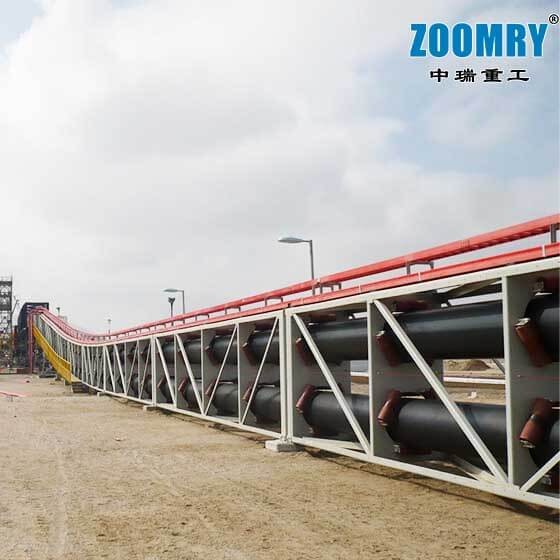
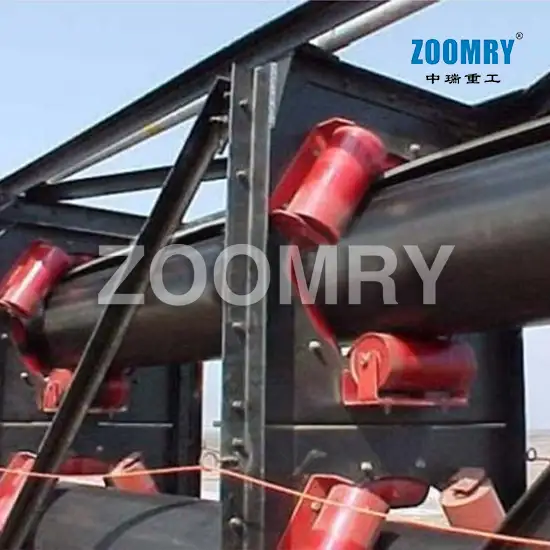
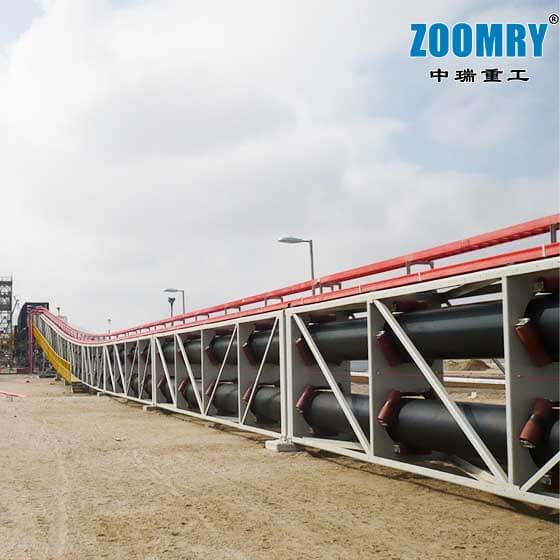
A pipe conveyor consists of head and tail pulleys, the conveyor belt, idler sets, drive units, and structural frames. Unlike conventional trough belt conveyors, a pipe conveyor uses hexagonal or octagonal idler arrangements along the carrying side to gradually form the flat belt into a circular tube, enclosing the material within the belt during the pipe-form conveying section.
How Does a Pipe Conveyor Work?
The tubular belt conveyor working principle can be divided into three stages:
- Transition (tail) section: The belt is flat at the tail pulley, where material is loaded evenly onto the center of the belt via a chute or feeder.
- Pipe formation section: As the belt moves forward, specially arranged idlers gradually fold the belt edges upward, forming a circular tube that encloses the material.
- Opening and discharge (head) section: At the head pulley, the belt gradually opens from a tube back to a flat shape, allowing material to be discharged at the head end.
During the pipe-form conveying section, the material remains enclosed within the tubular belt. This arrangement can significantly reduce exposure to wind, rain, dust release, and material spillage along the route. Final environmental performance also depends on loading, transfer, discharge, sealing, cleaning, and maintenance design.
Key Advantages of Pipe Conveyors
- Environmental performance: The enclosed tubular belt arrangement can significantly reduce dust release and material spillage along the conveying route, supporting compliance with environmental requirements.
- Inclined conveying capability: Pipe conveyors can be designed for steeper inclined routes than many conventional open trough conveyors. The achievable inclination depends on material properties, belt construction, filling ratio, belt speed, and project-specific design conditions.
- 3D spatial curves: Handle horizontal and vertical curves, flexibly bypass obstacles and reduce transfer points.
- Material protection: Shield materials from rain, wind, oxidation, and contamination during the pipe-form conveying section.
Key Design Considerations for Pipe Conveyors
Pipe conveyors require more than simply replacing a conventional belt with a tubular belt. The pipe-forming process, material flow behavior, belt stiffness, idler arrangement, route geometry, and transition sections must be engineered as a complete system.
- Material characteristics: Bulk density, moisture, particle size, abrasiveness, flowability, and tendency to stick affect pipe formation and carrying capacity.
- Pipe formation and transition length: The belt must gradually form and open through properly designed transition zones to avoid excessive belt stress or unstable pipe shape.
- Route geometry: Horizontal and vertical curve radii must be coordinated with belt stiffness, idler spacing, belt tension, and the required pipe diameter.
- Loading and discharge design: Even, centered loading is important for stable pipe formation and reduced material carryback.
- Maintenance access: Idler arrangements, belt inspection, cleaning, emergency access, and monitoring should be considered during route and structure design.
Typical Applications of Pipe Conveyors
Pipe conveyors are widely used in:
- Mining and metallurgy: Transporting ores, concentrates, coal, and other dusty materials.
- Ports and terminals: Long-distance transport of coal, ores, and aggregates with minimized dust.
- Power plants and chemical plants: Handling limestone, FGD gypsum, fertilizers, and other high-sealing materials.
- Selected industrial and agricultural bulk materials: Conveying applications where material protection, contamination control, or weather protection are important, subject to belt material and hygiene requirements.
ZOOMRY provides pipe belt conveyor engineering and manufacturing solutions for mining, coal, cement, port, power, and selected industrial bulk material applications. View the Shandong coal pipe conveyor project case to see an enclosed conveying application.
Related Products
Explore This Topic: Pipe, Curved & Long-Distance Conveyors
Enclosed and geometry-driven conveying: pipe conveyors, horizontally curved belts, steep incline and long-distance overland systems.
- What Is a Pipe Conveyor and How Does It Work? — Topic hub
- Inside the 8,617 m Hubei Curved Conveyor: 9 Horizontal Curves Solved (2026) — Guide
- Chengde Iron Ore – 3,300m Curved Belt Conveyor — Case study
- HuaXia JianLong Group – 2,600 t/h Curved Belt Conveyor — Case study
- Long Distance Conveying Solution for Coal and Ore in Vietnam — Case study
- Long-Distance Conveying for Sand and Gravel, Southeast Mining — Case study
Let's build it together
Need a custom bulk handling solution?
Talk to our engineers about conveyors, stackers, ship loaders and turnkey EPC systems.