
Inside the 8,617 m Hubei Curved Conveyor: 9 Horizontal Curves Solved (2026)
How ZOOMRY engineered an 8,617 m curved conveyor with 9 horizontal curves (max 36) for Hubei Southeast Mining. Belt width 1,200 mm, capacity 2,500 t/h, EPC + 8-year O&M.
Quick Answer
ZOOMRY engineered an 8,617 m long-distance curved conveyor for Hubei Southeast Mining, with 9 horizontal curves (maximum 36°), belt width 1,200 mm, and capacity 2,500 t/h. The system was delivered as an EPC project with an 8-year O&M contract. This case study explains the engineering challenges, the solutions, and the measured results.
Project Background
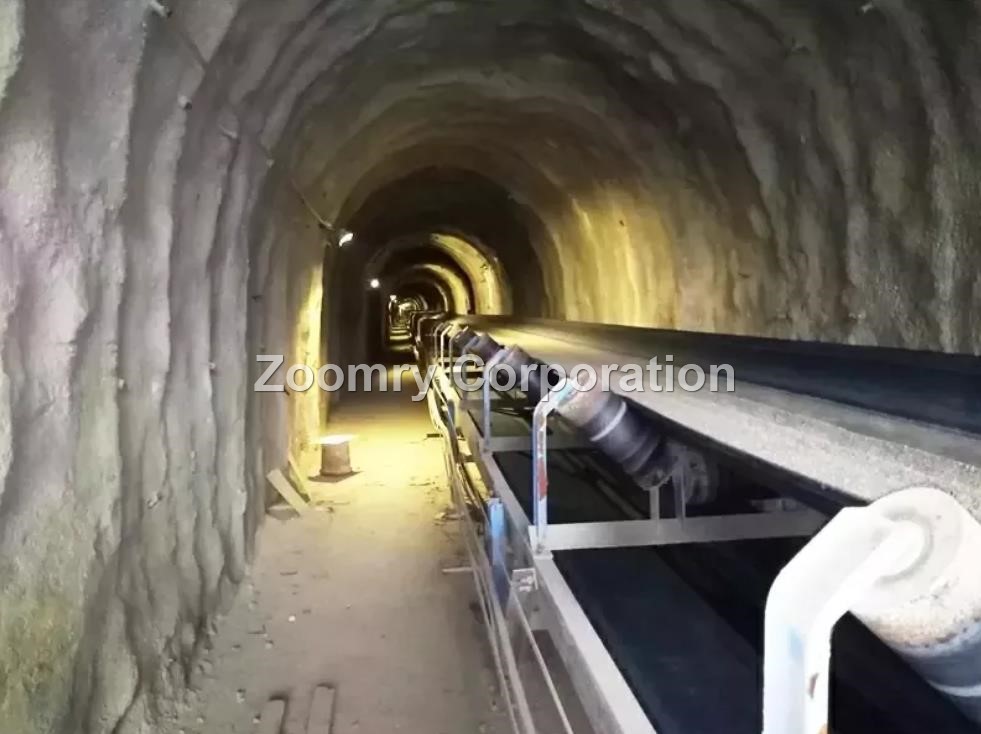
Hubei Southeast Mining operates a sand and gravel aggregate operation in Wuxue, Hubei Province, China. The material needs to be transported from the mine to the port terminal, a distance of 8,617 m, across complex terrain with multiple horizontal curves.
The original plan used truck haulage, but the cost per ton, road maintenance, and dust emissions were unsustainable at the required capacity of 2,500 t/h. ZOOMRY was contracted to design, manufacture, install, and commission a long-distance curved conveyor system, with an 8-year operation and maintenance contract.
| Parameter | Value |
|---|---|
| Project location | Wuxue, Hubei, China |
| Material | Sand and gravel aggregate |
| Conveying length | 8,617 m |
| Belt width | 1,200 mm |
| Capacity | 2,500 t/h |
| Horizontal curves | 9 (maximum 36°) |
| Delivery model | EPC + 8-year O&M |
Engineering Challenge 1: 9 Horizontal Curves
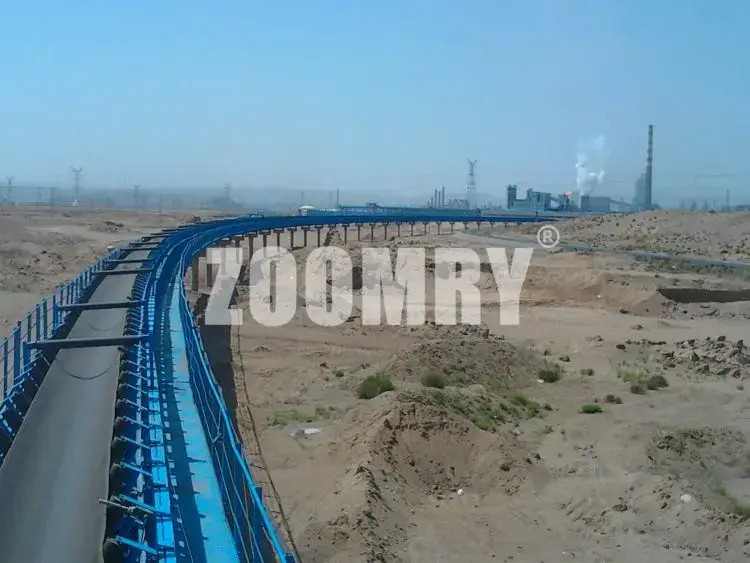
The route required 9 horizontal curves, with a maximum curve angle of 36°. Standard trough conveyors can handle gentle curves, but 9 curves in a single flight creates several engineering challenges:
Belt tracking: Each curve creates lateral forces that push the belt off-center.
Belt stress: Curves increase belt edge tension and reduce belt life.
Material spillage: Off-center belts spill material at curve entry and exit.
Solution: Self-Aligning Idler Sets + Belt Turnover Device
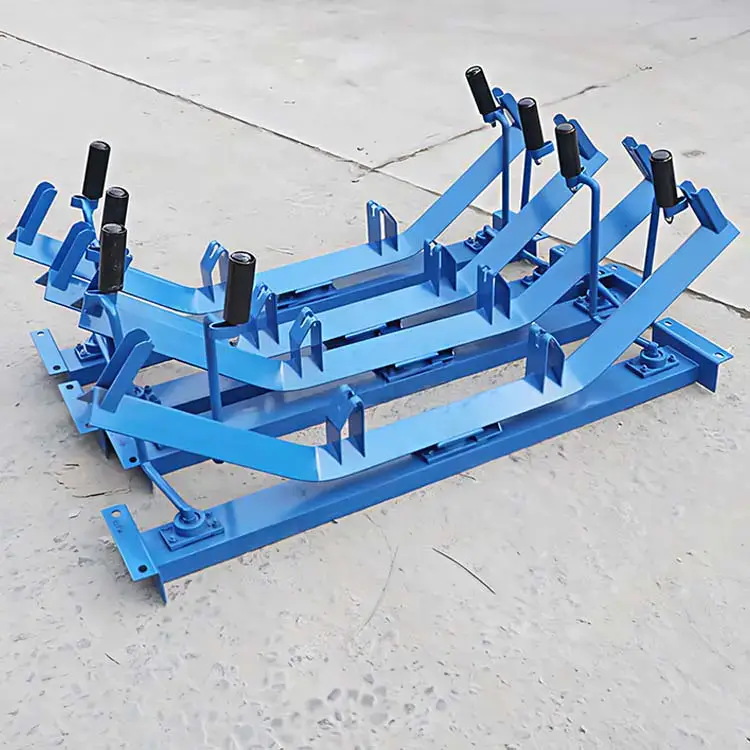
ZOOMRY used self-aligning idler sets at each curve entry and exit to automatically correct belt tracking. The idler sets use pivot-mounted frames with side guide rollers, which detect off-center belt movement and correct it before it becomes a problem.
At the tightest curves (36°), ZOOMRY also installed a belt turnover device, which rotates the belt 180° so the carry side becomes the return side. This distributes wear evenly across both belt surfaces and extends belt life.
Engineering Challenge 2: 2,500 t/h Capacity
The required capacity of 2,500 t/h is high for a 1,200 mm belt. Standard design would require a wider belt (1,400 mm or 1,600 mm), which increases cost and weight.
Solution: High Belt Speed + Optimized Trough Angle
ZOOMRY optimized the belt speed and trough angle to achieve 2,500 t/h on a 1,200 mm belt. The belt speed was increased to 4.0 m/s, and the trough angle was set to 45°. This combination provides the required capacity without increasing belt width.
Engineering Challenge 3: Energy Consumption
Long-distance conveyors are energy-intensive. The original design estimate was 1.2 kWh/t. ZOOMRY was asked to reduce this.
Solution: Optimized Idler Spacing + High-Efficiency Drive
ZOOMRY optimized the idler spacing to reduce running resistance, and used high-efficiency motors with variable frequency drives (VFD). The measured unit power consumption is 1.0 kWh/t, a 17% reduction from the original estimate.
Engineering Challenge 4: 8-Year O&M Contract
The project included an 8-year operation and maintenance contract. This required ZOOMRY to design for maintainability, not just performance.
Solution: Modular Design + Remote Monitoring
ZOOMRY used modular idler frames and pulley assemblies, allowing quick replacement without specialized tools. The system also includes remote monitoring for belt tension, motor current, and idler temperature, allowing the O&M team to detect problems before they cause downtime.
Measured Results
| Metric | Result |
|---|---|
| Conveying length | 8,617 m |
| Capacity achieved | 2,500 t/h |
| Unit power consumption | 1.0 kWh/t (17% below original estimate) |
| Horizontal curves | 9 (maximum 36°) |
| Belt tracking | Self-aligning idler sets at all curves |
| Belt life extension | Belt turnover device at tightest curves |
| O&M contract | 8 years |
Key Engineering Takeaways
Self-aligning idler sets are essential for multi-curve conveyors: Without automatic belt tracking, 9 curves in a single flight would cause frequent spillage and belt damage.
Belt turnover devices extend belt life: Rotating the belt 180° at the tightest curves distributes wear evenly and extends belt life by up to 30%.
Capacity can be achieved without increasing belt width: Higher belt speed and optimized trough angle can achieve high capacity on a narrower belt, reducing cost and weight.
Energy consumption can be reduced through design: Optimized idler spacing and high-efficiency drives reduced unit power consumption by 17%.
Design for maintainability when O&M is included: Modular design and remote monitoring reduce downtime and maintenance cost over the 8-year contract.
Frequently Asked Questions
How many horizontal curves can a long-distance conveyor handle?
The number of curves depends on the belt type, curve radius, and belt tracking system. The Hubei 8,617 m conveyor uses 9 horizontal curves (maximum 36°) with self-aligning idler sets at each curve.
What is the maximum curve angle for a curved conveyor?
Standard curved conveyors can handle curve angles up to 180°, but the practical limit depends on belt width, belt speed, and material. The Hubei project uses a maximum curve angle of 36° per curve.
How is belt tracking maintained on a multi-curve conveyor?
Self-aligning idler sets are installed at each curve entry and exit. These idler sets use pivot-mounted frames with side guide rollers to detect and correct off-center belt movement automatically.
What is a belt turnover device and why is it used?
A belt turnover device rotates the belt 180° so the carry side becomes the return side. This distributes wear evenly across both belt surfaces and extends belt life. It is used at the tightest curves where belt edge stress is highest.
What is the unit power consumption of the Hubei 8,617 m conveyor?
The measured unit power consumption is 1.0 kWh/t, which is 17% below the original design estimate of 1.2 kWh/t. This was achieved through optimized idler spacing and high-efficiency drives with variable frequency drives.
Related Products
Industry Applications
Explore This Topic: Pipe, Curved & Long-Distance Conveyors
Enclosed and geometry-driven conveying: pipe conveyors, horizontally curved belts, steep incline and long-distance overland systems.
- What Is a Pipe Conveyor and How Does It Work? — Topic hub
- Weiyuan Mining Long Distance Belt Conveyor Case — Case study
- What is a Pipe Conveyor? Tubular Belt Conveyor Technology Overview — Guide
- What is a Pipe Conveyor? Working Principle, Components & Features — Guide
- Wuxue Southeast Mining – 2,500 t/h Curved Belt Conveyor EPC — Case study
- Long Distance Belt Conveyor – Overland Bulk Material Transport Up to 15 km Single Flight | ZOOMR — Product
Let's build it together
Need a custom bulk handling solution?
Talk to our engineers about conveyors, stackers, ship loaders and turnkey EPC systems.