
Available in 11 pipe diameters from 100 mm to 850 mm with belt widths 430–3,100 mm. Handles inclines up to 30 and tight 3D curves without transfer points.
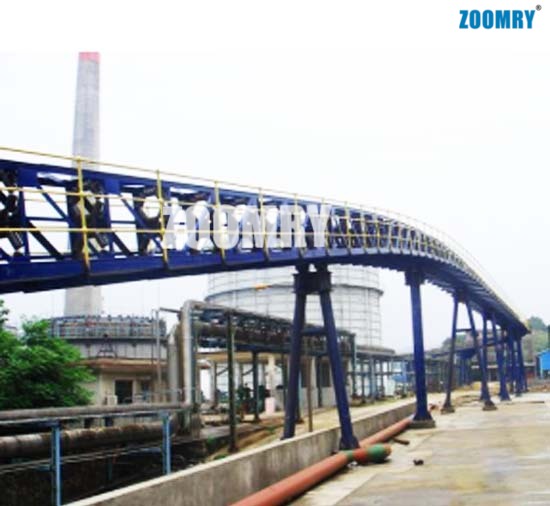
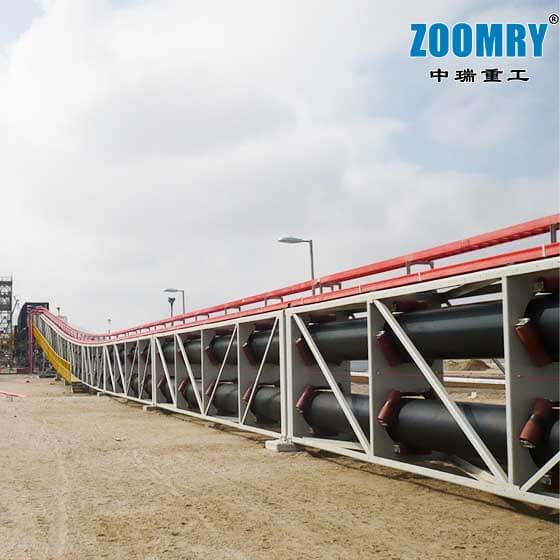
A pipe conveyor — also called a tubular conveyor — forms the belt into a sealed circular shape using six idler rollers arranged in a hexagon. This enclosed design allows the conveyor to negotiate tight horizontal and vertical curves, climb inclines up to 30°, and cover long center distances without intermediate transfer stations. Material remains enclosed in both the carrying and return strands, supporting dust-controlled transport for mining, cement, power, and other environmentally sensitive applications.
ZOOMRY offers 11 standard pipe conveyor models — JKGD01 through JKGD11 — covering nominal pipe diameters from 100 mm to 850 mm and belt widths from 430 mm to 3,100 mm. Final pipe diameter, belt width, and cross-sectional area are selected according to material characteristics, required throughput, curve radii, and conveying distance.
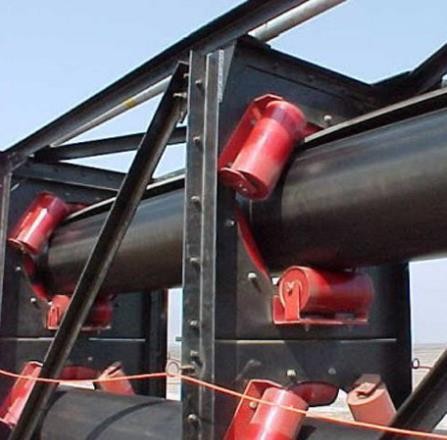
ZOOMRY Pipe Conveyor — Enclosed Tubular Belt Conveyor for Dust-Controlled Material Transport
| Model | Nominal Pipe Diameter (mm) | Pipe ID (mm) | Belt Width (mm) | Cross-Sectional Area (m²) | Max Granularity (mm) |
|---|---|---|---|---|---|
| JKGD01 | 100 | 100.2 | 430 | 0.0059 | 20–30 |
| JKGD02 | 150 | 150.7 | 600 | 0.0134 | 30–50 |
| JKGD03 | 200 | 199.1 | 780 (800) | 0.0234 | 50–70 |
| JKGD04 | 250 | 263.5 | 1,000 | 0.0409 | 70–90 |
| JKGD05 | 300 | 285.2 | 1,100 (1,200) | 0.0479 | 90–100 |
| JKGD06 | 350 | 334.3 | 1,300 (1,400) | 0.0658 | 100–120 |
| JKGD07 | 400 | 426.5 | 1,600 | 0.1071 | 120–150 |
| JKGD08 | 500 | 509.5 | 1,900 (2,000) | 0.1529 | 150–200 |
| JKGD09 | 600 | 603.5 | 2,250 | 0.2145 | 200–250 |
| JKGD10 | 700 | 690.6 | 2,550 | 0.2809 | 250–300 |
| JKGD11 | 850 | 828.1 | 3,100 | 0.4041 | 300–400 |
Nominal pipe diameter and belt width represent the standard series range. Final selection depends on material bulk density, lump size, moisture content, required throughput, curve radii, and total conveying distance. Non-standard configurations may be evaluated for specific project requirements.

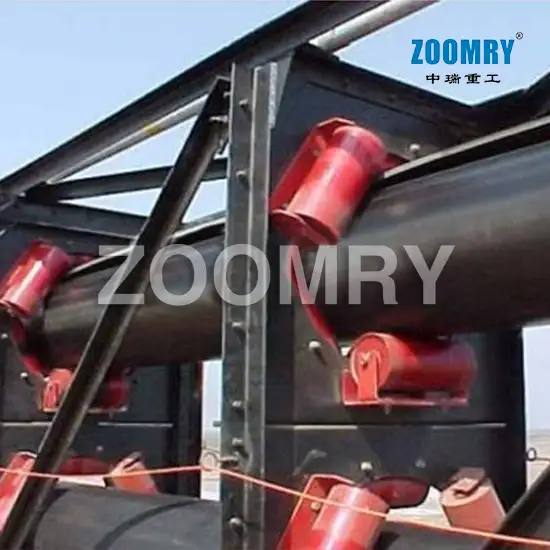
The pipe conveyor transitions through three distinct zones along its route. At the tail end, the belt is open and flat like a conventional conveyor, allowing material to be fed from a standard chute. Through a series of hexagonally arranged idler rollers, the belt edges are gradually folded upward until they overlap, forming a sealed tubular shape.
This tube is maintained throughout the conveying distance — through curves, inclines, and declines — before opening again at the head end for discharge. The overlap zone helps prevent material leakage during curve negotiation, and the belt returns to the tail in the same sealed tube shape, helping eliminate return-side spillage along the route.
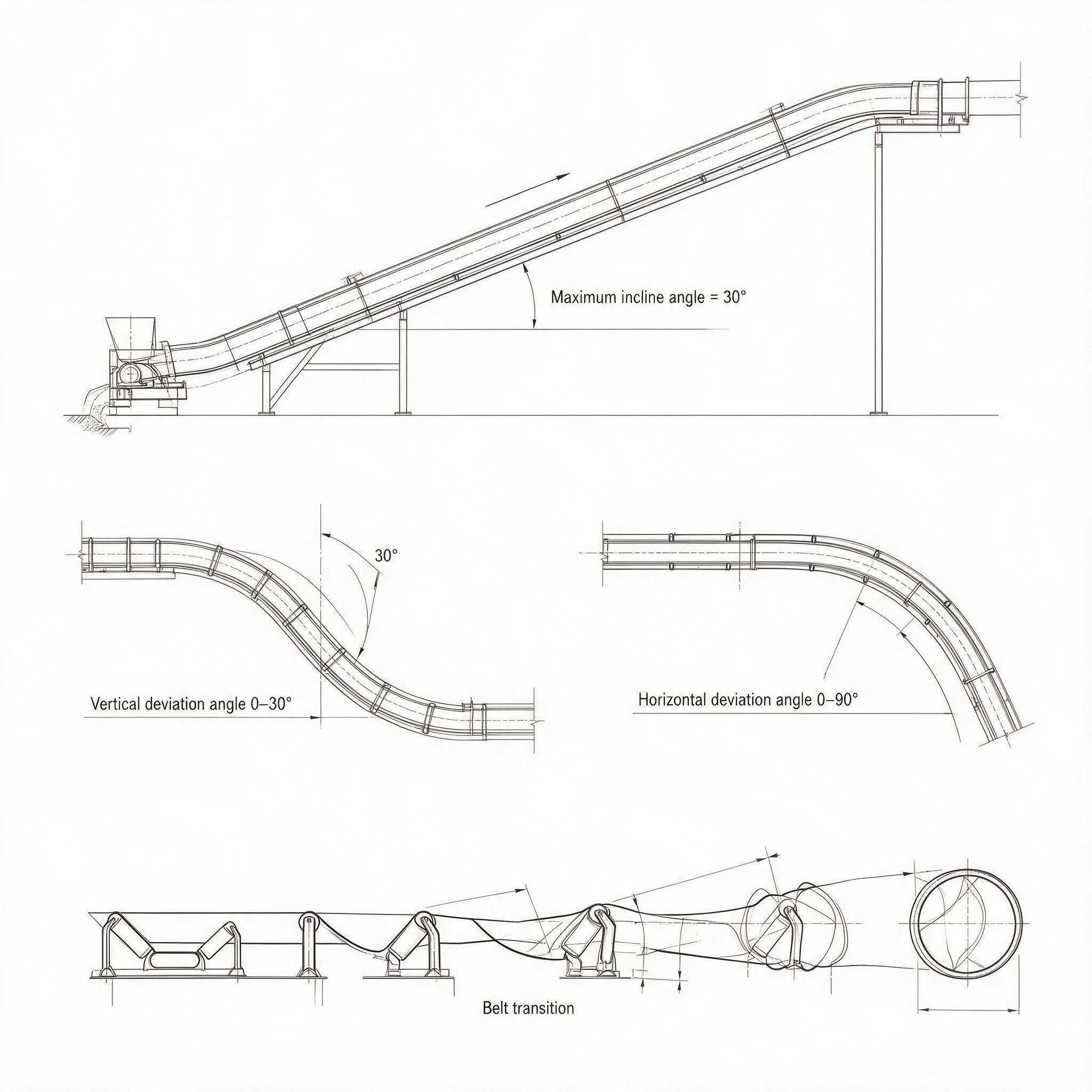
Pipe conveyors offer several advantages over open-trough belt conveyors in suitable applications:
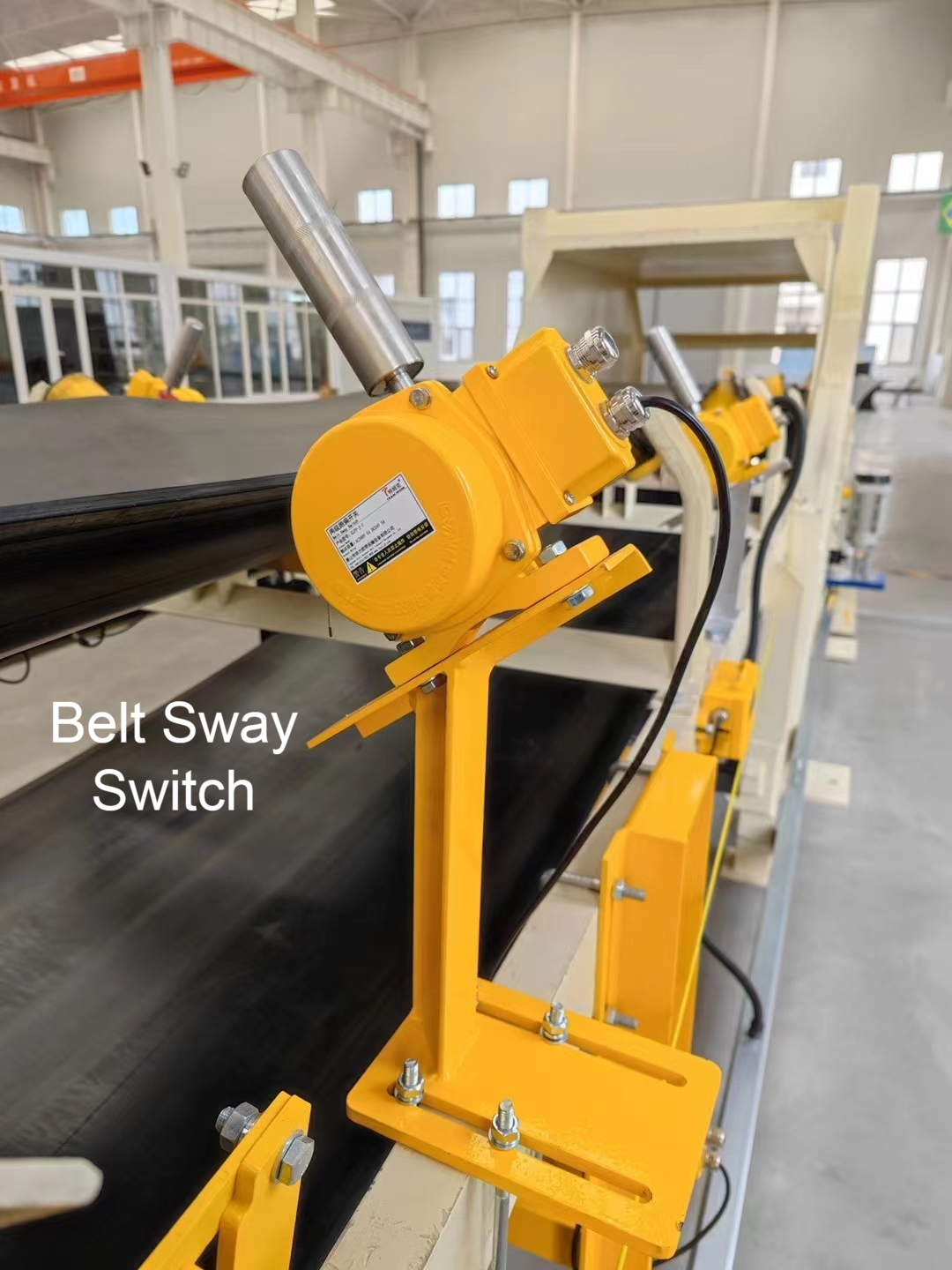
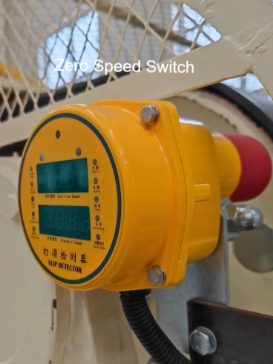
Belt Sway Switch — Detects belt deviation and sends a warning or shutdown signal. Deviation can damage the belt edges and create safety risks. Switches are typically installed in pairs on both sides of the conveyor at critical tracking points.
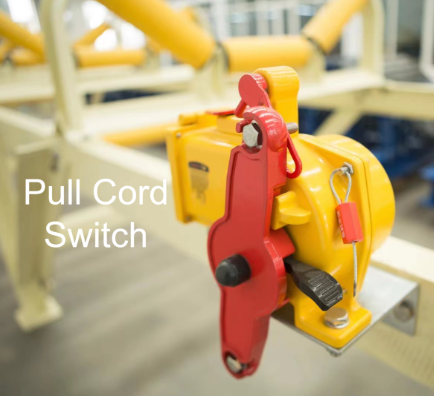
Pull Cord Switch — A wire rope runs along the full length of the conveyor, allowing operators to trigger an emergency stop from any position. Available in single-sided or double-sided arrangements and generally used in conjunction with walkways.
Zero Speed Switch — Monitors belt or pulley rotation speed to detect slippage early. Common causes of belt slip include overloading, insufficient belt tension, or worn drive pulley lagging. The switch compares actual speed against a set reference and activates an alarm or stop signal when deviation exceeds the configured threshold.
ZOOMRY provides engineering design, component supply, installation support, and after-sales service for pipe conveyor systems. For long-running belt conveyor installations and mobile telescopic stackers, on-site conveyor belt vulcanizing services are available to support belt splicing and maintenance. We can supply vulcanizing equipment and technical guidance for long distance belt conveyor systems where continuous operation is a project requirement.
Compare adjacent models, sizes and duty classes in this category before requesting a quotation.
Browse all Pipe conveyor system models or the complete product range.
Contact our engineering team for pipe diameter selection, curve radius calculation, and project-specific system design.
Request Pipe Conveyor Engineering Review →ZOOMRY offers 11 standard pipe conveyor models — JKGD01 through JKGD11 — covering nominal pipe diameters from 100 mm to 850 mm and belt widths from 430 mm to 3,100 mm.
This enclosed design allows the conveyor to negotiate tight horizontal and vertical curves, climb inclines up to 30°, and cover long center distances without intermediate transfer stations.