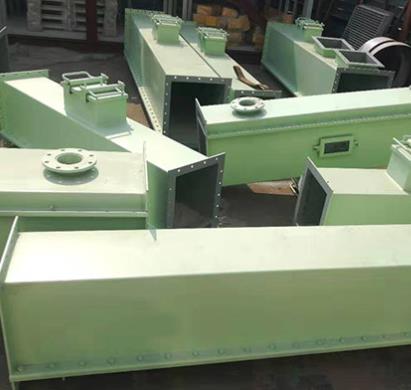

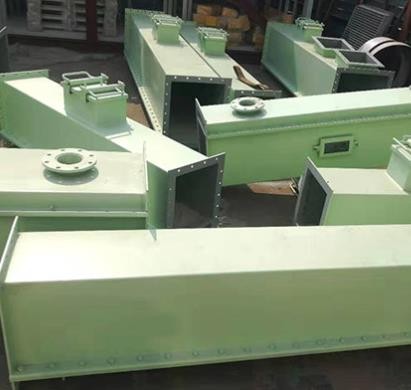
The air conveying chute operates on fluidization principle. Dry powder is fed into the upper chamber while compressed air enters the lower chamber through a dedicated blower.
ZOOMRY air conveying chute is a pneumatic gravity-flow system for dry powdery materials with moisture content ≤1% and temperature ≤150°C. Compared to the standard air chute conveyor, this model is optimized for modular plant layouts — supporting multi-point feeding and discharge with convenient direction changes in cement and power applications. No rotating parts, good sealing, and low power consumption.
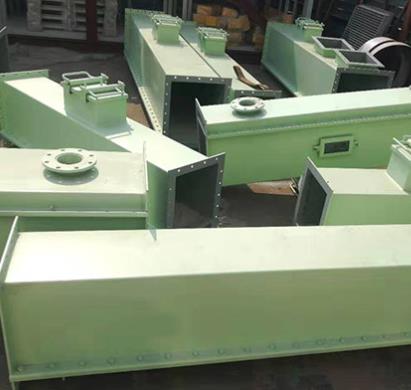
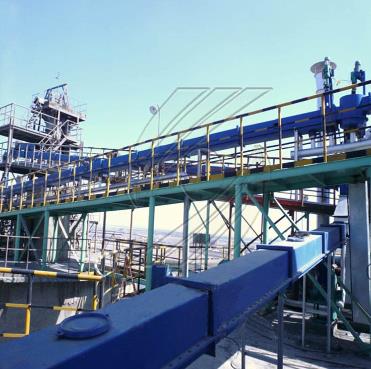
ZOOMRY Air Conveying Chute — Pneumatic Gravity Flow for Cement and Raw Meal Powder
The air conveying chute operates on fluidization principle. Dry powder is fed into the upper chamber while compressed air enters the lower chamber through a dedicated blower. The air passes upward through a breathable synthetic fiber layer, suspending material particles in a fluidized state. This gasification reduces internal friction, allowing the powder to flow down a slight incline (4°–12°) under gravity — achieving continuous transport without any mechanical moving parts in the material stream.
This principle makes air conveying chutes fundamentally different from belt conveyors or screw conveyors: there is no belt to wear out, no screw to jam, and no bearings to fail in the material contact zone. The only consumable is the breathable fabric layer, which can be replaced during scheduled maintenance.
Choosing the correct air conveying chute depends on three key factors:
| Specification | XZ200 | XZ250 | XZ315 | XZ400 | XZ500 | XZ630 | XZ800 | ||
|---|---|---|---|---|---|---|---|---|---|
| Trough Width (mm) | 200 | 250 | 315 | 400 | 500 | 630 | 800 | ||
| Conveying Capacity (t/h) | α=4° | Cement | 22 | 40 | 70 | 130 | 220 | 320 | 400 |
| Raw Meal | 16 | 30 | 55 | 100 | 165 | 245 | 310 | ||
| α=6° | Cement | 40 | 65 | 120 | 250 | 400 | 610 | 765 | |
| Raw Meal | 30 | 55 | 90 | 185 | 300 | 455 | 565 | ||
| α=8° | Cement | 50 | 80 | 140 | 300 | 470 | 720 | 900 | |
| Raw Meal | 35 | 65 | 110 | 225 | 355 | 540 | 670 | ||
| α=10° | Cement | 60 | 100 | 170 | 380 | 570 | 900 | 1080 | |
| Raw Meal | 45 | 80 | 140 | 285 | 425 | 670 | 800 | ||
| α=12° | Cement | 70 | 120 | 205 | 455 | 685 | 1080 | 1295 | |
| Raw Meal | 50 | 95 | 165 | 340 | 510 | 805 | 960 | ||
| Trough Section Length (mm) | Standard | 2,000 | |||||||
| Non-standard | 250 | ||||||||
| Required Air Pressure (kPa) | 4 – 5.5 | ||||||||
| Required Air Volume (m³/m²·min) | 1.5 – 2 | ||||||||
| Air Permeable Layer | Material | Synthetic Fiber | |||||||
| Thickness (mm) | 4 – 6 | ||||||||
| Temperature Resistance (℃) | 150 | ||||||||
| Radial Breaking Strength (N/cm width) | 4,700 | ||||||||
| Resistance (Pa) | 800 – 1,200 (at 2m³/m²·min) | ||||||||
Compare adjacent models, sizes and duty classes in this category before requesting a quotation.
Browse all Air chute conveyor models or the complete product range.
Contact ZOOMRY for an air conveying chute engineered to your material, slope, and capacity — backed by ISO 9001 certified manufacturing.
Contact Us TodayWider troughs deliver higher capacity — an XZ800 at 12° slope handles up to 1,295 t/h of cement versus 70 t/h for an XZ200 at the same angle.
ZOOMRY air conveying chute is a pneumatic gravity-flow system for dry powdery materials with moisture content ≤1% and temperature ≤150°C.