
Steel Structures for Belt Conveyor Systems: Design & Benefits
Proper design and fabrication directly affect conveyor stability, alignment, and long-term service life.
Quick Answer
Belt conveyor systems require support structures that can maintain precise alignment over long distances while withstanding dynamic loads, material weight, wind forces, and environmental exposure. Steel is the standard material for these applications because it combines high strength-to-weight ratio with predictable fabrication quality. The rest of the page explains the design, the duty range, and where it is used.
Steel structures for belt conveyor systems are the structural framework that supports conveyor galleries, transfer towers, walkways, and support frames. In bulk material handling, steel structures provide the load-bearing backbone for long-distance overland conveyors, pipe conveyors, and stockyard equipment. Proper design and fabrication directly affect conveyor stability, alignment, and long-term service life.
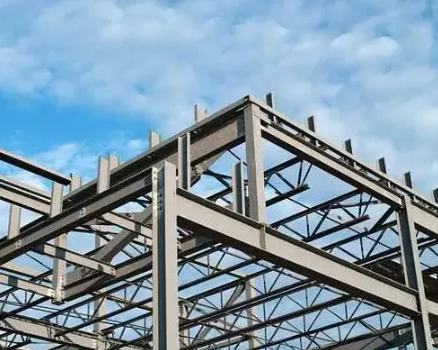
Why Steel Structures Are Used in Conveyor Systems
Belt conveyor systems require support structures that can maintain precise alignment over long distances while withstanding dynamic loads, material weight, wind forces, and environmental exposure. Steel is the standard material for these applications because it combines high strength-to-weight ratio with predictable fabrication quality.
Unlike concrete, steel structures can be prefabricated in a workshop and assembled on site with bolted or welded connections. This modular approach shortens installation time and allows quality control to be applied at the factory stage rather than in the field.
Key Advantages of Steel Structures for Bulk Handling
High Strength-to-Weight Ratio
Steel provides the load-bearing capacity needed for long-span conveyor galleries and transfer towers without excessive self-weight. This reduces foundation requirements and allows longer spans between support points, which is particularly important for overland conveyors crossing uneven terrain.
Prefabrication and Fast Site Assembly
Steel sections can be cut, welded, drilled, and test-assembled in a workshop before delivery. On site, pre-aligned components are assembled with bolted connections, reducing field welding and installation time. This contributes to faster project schedules and more consistent quality than fully site-built alternatives.
Dimensional Accuracy for Conveyor Alignment
Belt conveyor idlers and pulleys require precise positioning to maintain belt tracking. Steel structures fabricated with controlled tolerances provide a stable reference for idler installation. This dimensional accuracy helps reduce belt mistracking and related wear during operation.
Corrosion Protection Options
Steel structures can be protected with galvanizing, multi-layer paint systems, or a combination of both to suit the operating environment. For coastal ports, salt exposure, or chemically aggressive sites, the protective system is selected according to the required service life and maintenance access.
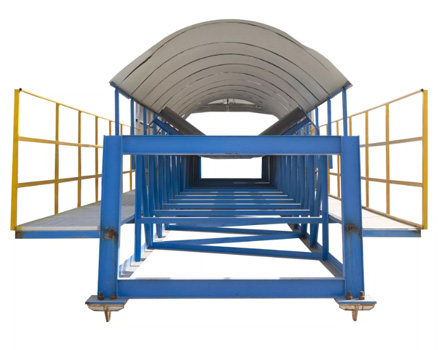
Design Flexibility
Steel frames can be configured as trusses, box girders, or portal frames depending on span, load, and site constraints. This flexibility supports curved conveyors, elevated galleries, and transfer towers with different height and access requirements.
Reusability and Modification
Steel structures can be disassembled, relocated, or reinforced as conveyor routes change. For mining operations with phased expansion or temporary conveying routes, steel supports offer greater adaptability than permanent concrete structures.
Typical Applications in Bulk Material Handling
- Conveyor galleries — enclosed or open truss structures supporting the carrying and return runs
- Transfer towers — multi-level steel frames housing transfer chutes and maintenance platforms
- Take-up and drive stations — structural support for tensioning devices and drive units
- Stockyard equipment supports — frames for stackers, reclaimers, and related equipment foundations
- Walkways and access platforms — maintenance access along the conveyor route
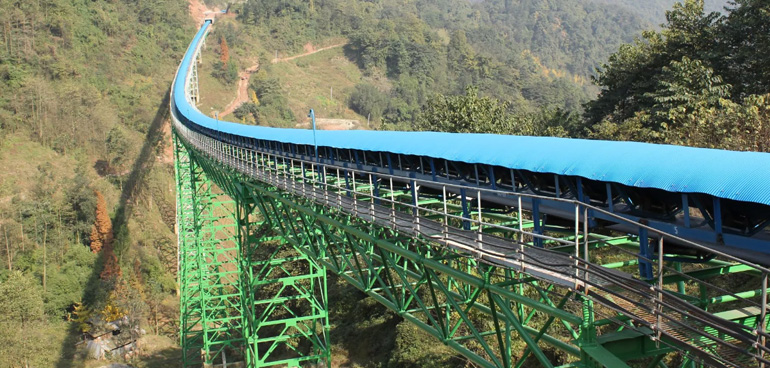
Design Considerations for Conveyor Steel Structures
When specifying steel structures for bulk handling systems, several factors affect design and fabrication:
- Span and load — belt weight, material load, wind load, and live load requirements
- Site conditions — terrain, foundation quality, seismic requirements, and temperature range
- Corrosion environment — coastal salt, industrial emissions, or chemical exposure
- Connection type — welded for permanent structures or bolted for field assembly and future modification
- Quality standards — welding per AWS D1.1 or equivalent, dimensional control for idler alignment
Steel structures are a foundational element of belt conveyor systems, providing the strength, accuracy, and adaptability required for long-distance and high-capacity bulk material handling. For conveyor gallery, transfer tower, or support frame requirements, see steel structure options for belt conveyor systems or explore steel structure engineering and fabrication.
Related Products
Industry Applications
Explore This Topic: Belt Conveyor Systems
Foundations of belt conveying: system components, layouts, drive methods, types, cleaning and maintenance.
- Conveyor Belt Manufacturer: How to Evaluate a Bulk Handling Belt Supplier — Guide
- Coupling Between Motor and Reducer – SL Series Snake Spring Coupling for Conveyor Drives | ZOOMR — Product
- Criteria for Mining Enterprises to Choose Belt Conveyors – 8 Key Selection Factors — Guide
- Design Considerations for Long Distance Belt Conveyors – Belt, Idler & Drive Selection — Guide
- Detailed Explanation of Industrial Conveyor Belts – Types, Selection & Applications — Guide
Let's build it together
Need a custom bulk handling solution?
Talk to our engineers about conveyors, stackers, ship loaders and turnkey EPC systems.