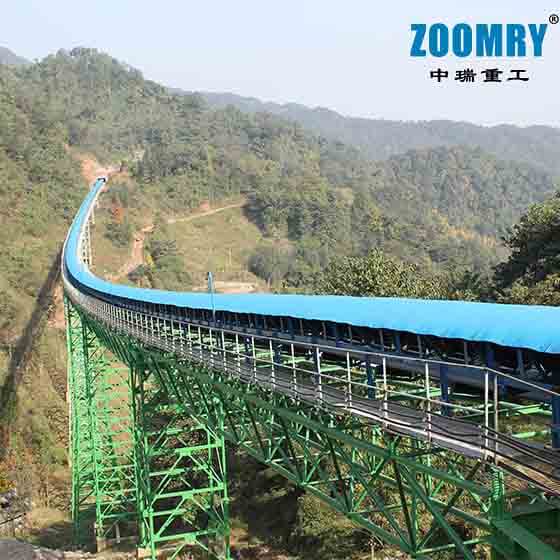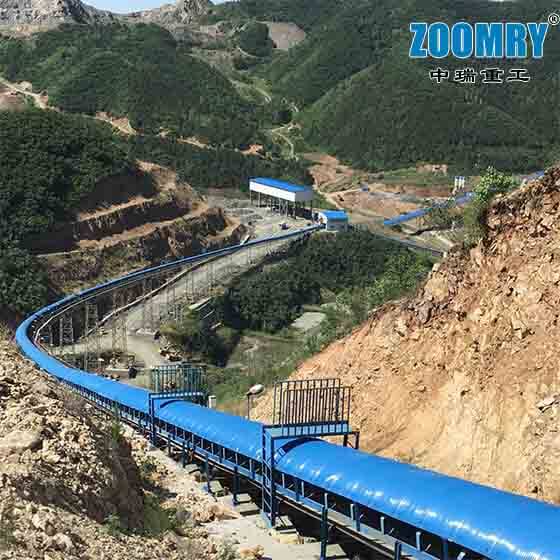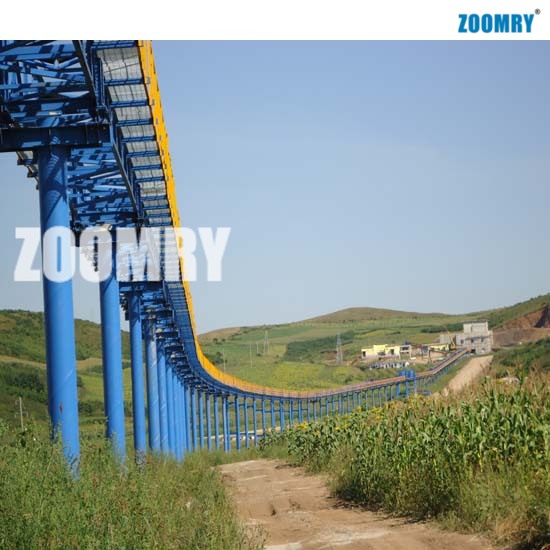

Long distance curved belt conveyor system for bulk material transport over extended distances up to 15 km or more in a single flight.
The long-distance curved belt conveyor is a conveyor developed to adapt to complex terrain and long-distance transportation needs in the wild. It can be installed following the undulations of the ground and avoid obstacles and buildings through curved turns. The length of a single conveyor can reach more than 15 km.
Long-distance curved belt conveyors are widely used in mines, docks, cement plants, sand and gravel aggregates, container terminals, and various raw material factories. They are used to replace conventional multiple belt conveyor overlapping or road transportation.
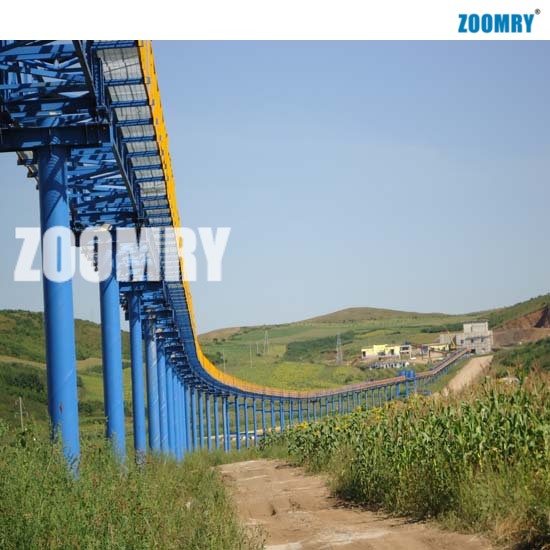
A long distance curved belt conveyor integrates two critical capabilities: extended single-flight transport and curve navigation. The system uses tapered rollers and specialized belting to maintain belt tracking through horizontal curves, while multiple drive stations and high-tension steel cord belts enable continuous operation over long distances. The combination of these features allows the conveyor to follow terrain contours, bypass obstacles, and minimize the number of transfer points — significantly reducing infrastructure costs and operational complexity.
Single-flight long distance
A single conveyor can extend 15 km or more, eliminating multiple transfer points and reducing dust control, maintenance, and power consumption.
Curve navigation
The system follows natural terrain through horizontal curves (typically 300 × belt width radius) and vertical curves, avoiding obstacles, buildings, and roads — simplifying project approval and later operation management.
Environmental benefits
Long-distance conveyor transport produces no dust pollution (when enclosed or covered) and minimal noise. The power source is clean electric energy, with no air pollution or exhaust gas emissions — significantly more environmentally friendly than truck haulage.
Energy efficiency & safety
Belt conveyors are inherently more energy-efficient than truck transport, consuming less energy per ton-kilometer. They do not occupy local transportation resources and avoid safety hazards associated with truck traffic.
Typical industry reference values — actual specifications vary by application and material characteristics.
Belt Width & Pulley Diameter Reference
| Width (mm) | Max Roller Diameter (mm) | Max Drive Pulley Diameter (mm) | Max Reversing Pulley Diameter (mm) |
| 400 | 89 | 400 | 315 |
| 500 | 89 | 500 | 400 |
| 650 | 108 | 630 | 500 |
| 800 | 133 | 1250 | 1000 |
| 1000 | 159 | 1250 | 1000 |
| 1200 | 159 | 1600 | 1250 |
| 1400 | 159 | 1600 | 1250 |
| 1600 | 194 | 1600 | 1250 |
| 1800 | 194 | 1600 | 1250 |
| 2000 | 194 | 1800 | 1400 |
| 2200 | 194 | 1800 | 1400 |
| 2400 | 219 | 1800 | 1400 |
Conveying Capacity Reference — Belt Speed 0.8 – 2.0 m/s (m³/h)
| Width (mm) | 0.8 m/s | 1.0 m/s | 1.3 m/s | 1.6 m/s | 2.0 m/s |
| 400 | 41 | 51 | 64 | 82 | 103 |
| 500 | 69 | 87 | 108 | 139 | 174 |
| 650 | 127 | 159 | 198 | 254 | 318 |
| 800 | 199 | 248 | 310 | 398 | 497 |
| 1000 | 324 | 405 | 507 | 649 | 811 |
| 1200 | — | 594 | 742 | 951 | 1188 |
| 1400 | — | 825 | 1032 | 1321 | 1651 |
| 1600 | — | — | — | — | 2185 |
| 1800 | — | — | — | — | 2795 |
| 2000 | — | — | — | — | 3467 |
| 2200 | — | — | — | — | — |
| 2400 | — | — | — | — | — |
Conveying Capacity Reference — Belt Speed 2.5 – 6.5 m/s (m³/h)
| Width (mm) | 2.5 m/s | 3.2 m/s | 4.0 m/s | 5.0 m/s | 6.5 m/s |
| 400 | — | — | — | — | — |
| 500 | 217 | — | — | — | — |
| 650 | 397 | — | — | — | — |
| 800 | 621 | 786 | — | — | — |
| 1000 | 1014 | 1278 | 1622 | — | — |
| 1200 | 1485 | 1872 | 2377 | 2971 | — |
| 1400 | 2064 | 2601 | 3303 | 4129 | — |
| 1600 | 2732 | 3442 | 4371 | 5464 | — |
| 1800 | 3493 | 4402 | 5590 | 6987 | 9083 |
| 2000 | 4334 | 5461 | 6935 | 8668 | 11277 |
| 2200 | — | 6841 | 8687 | 10859 | 14120 |
| 2400 | — | 8286 | 10522 | 13152 | 17104 |
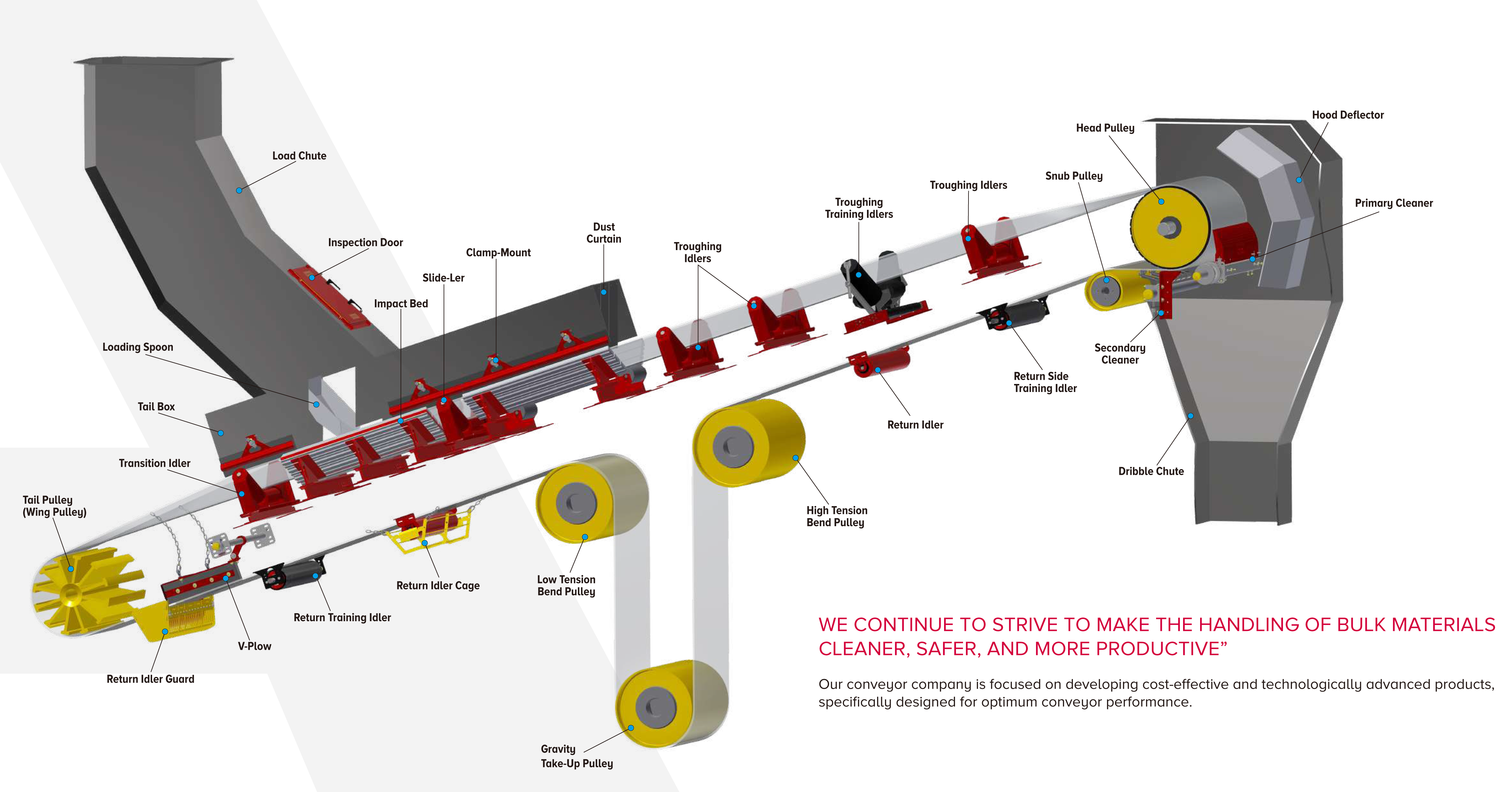
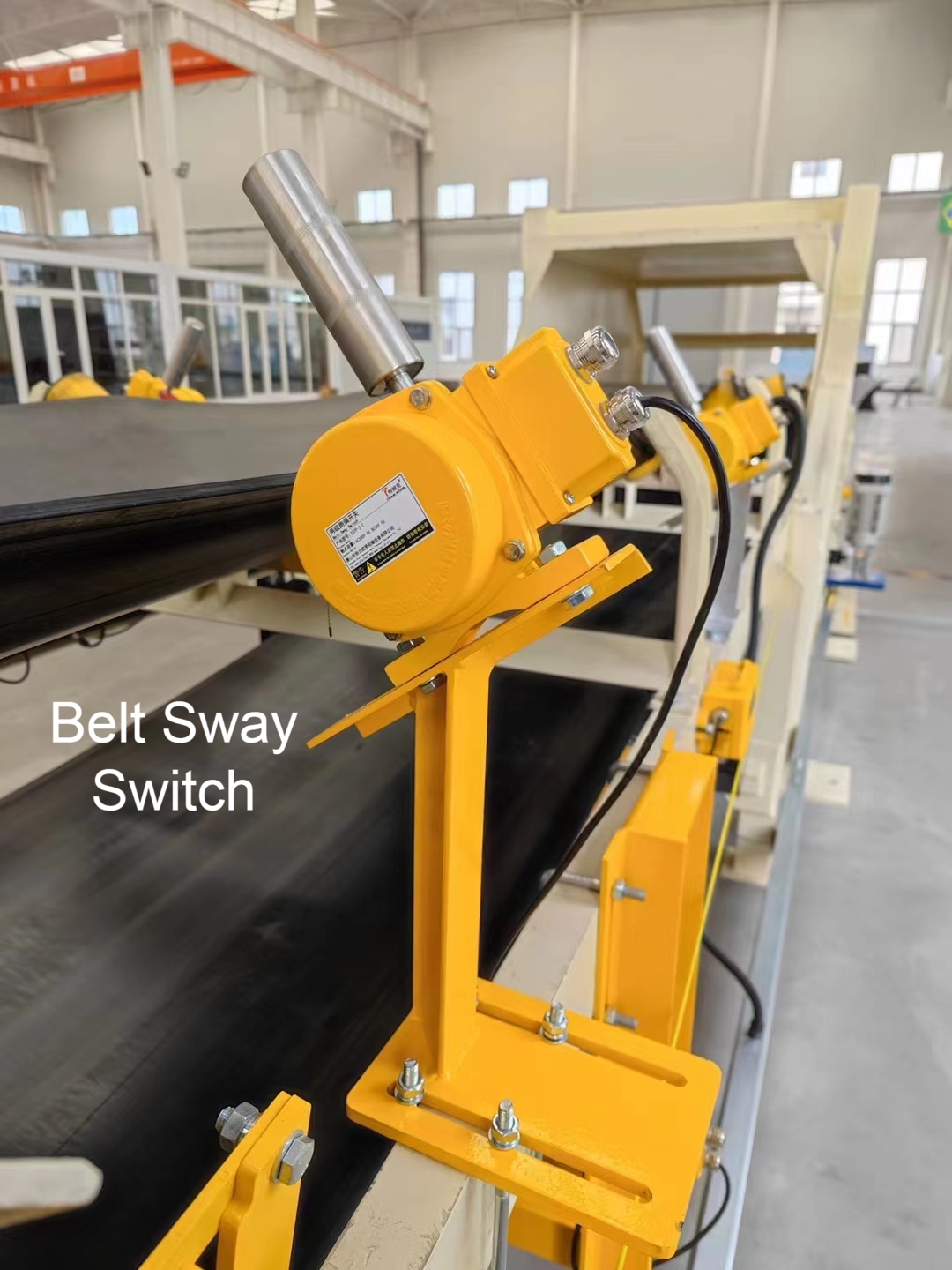
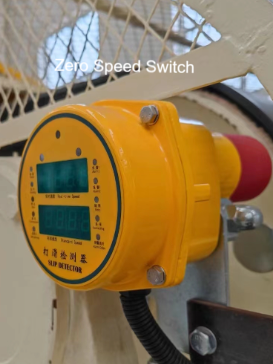
Detect whether the belt is deviating and send out a slight alarm or shutdown signal. Deviation will damage the belt and cause safety accidents. Deviation switches need to be purchased and installed in pairs.
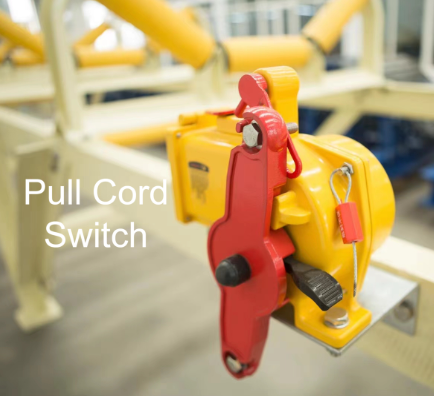
Pull the wire rope to realize the switch action, which is used for emergency shutdown. It is a safety switch and is arranged along the entire length of the fuselage.
When an emergency occurs on the belt conveyor, the conveyor can be stopped urgently at any position. There are single-sided and double-sided arrangements. They are generally used in conjunction with walkways.
Detect whether the belt is slipping with the head roller. After slippage occurs, the Conveyor Belt speed will decrease. When the transport volume is overloaded, the belt tension is insufficient, or the rubber layer of the driving roller is worn out, slippage may easily occur. The conveyor belt speed can be monitored (also the rotational speed is calculated) or the drum rotation speed can be monitored.
If the belt conveyor in the stacker encounters an unexpected situation, such as a power outage or a broken wire rope, the stacker has a self-protection function:
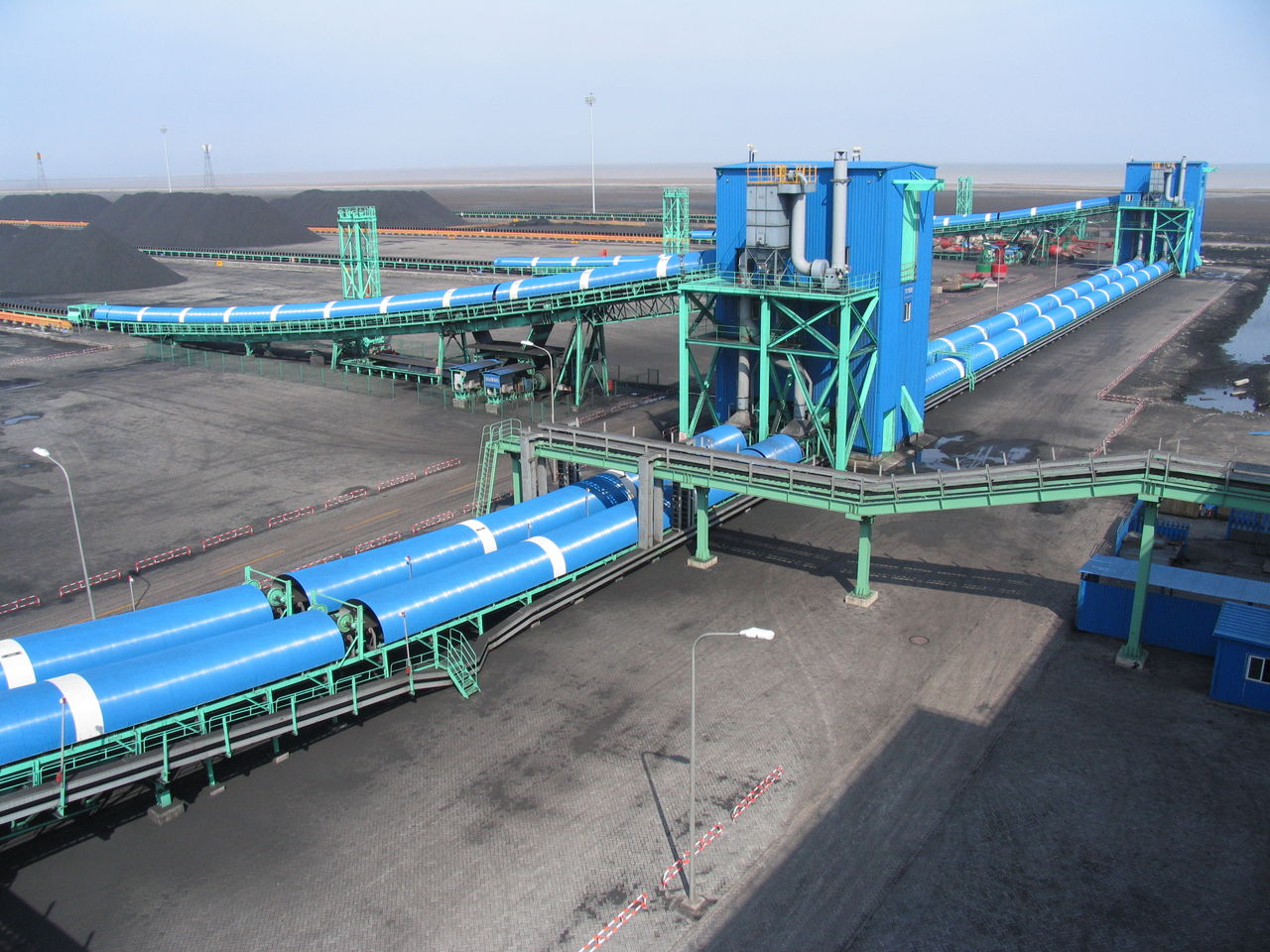
Brazil Steel Raw Material Plant
Capacity: 2 × 5,000 t/d
Material type: Coal
Angle: 31°
Belt width: 1,000 mm
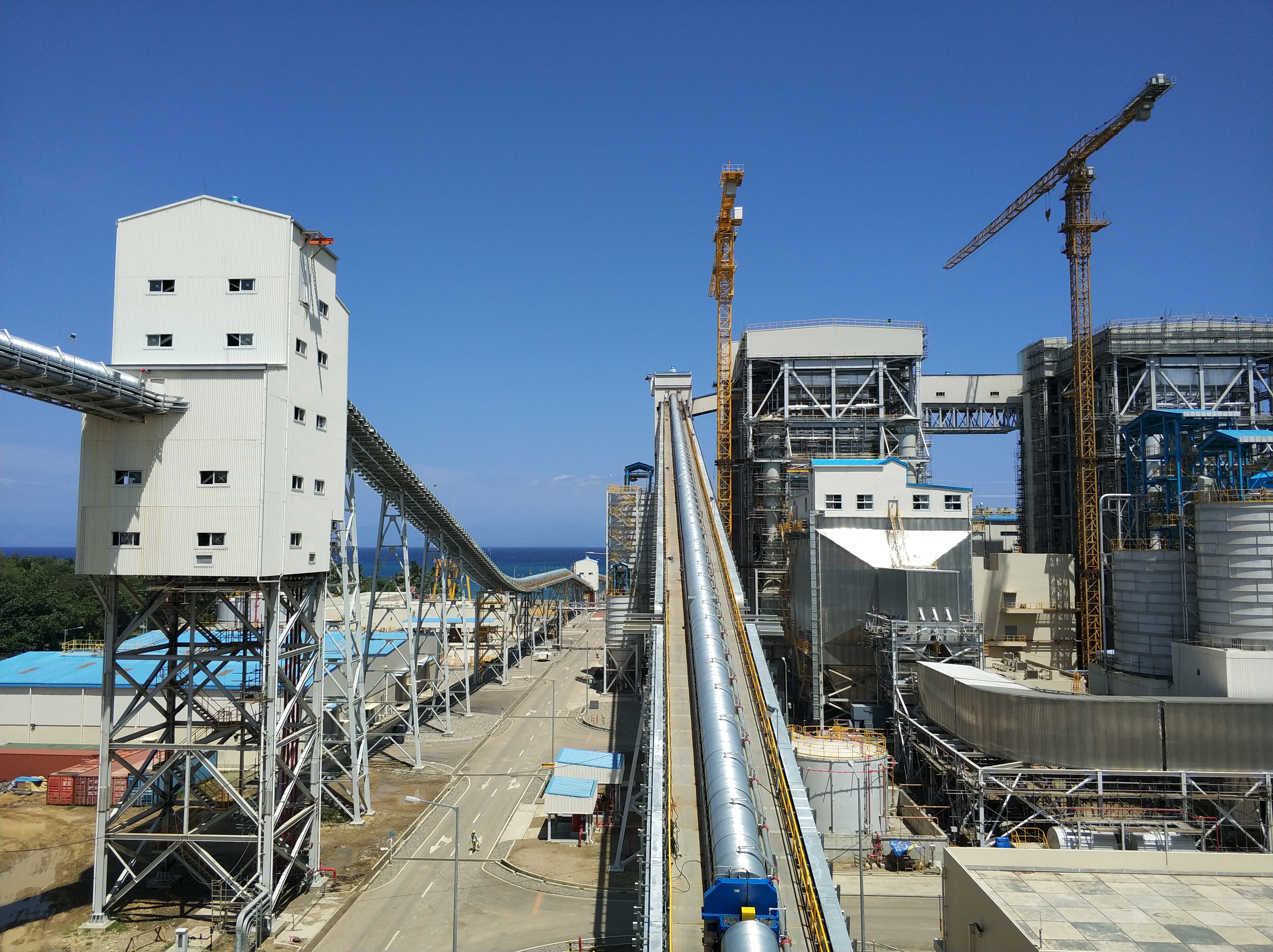
Philippines Power Plant (2018)
Belt conveyor system
Capacity: 4 × 1,800 t/h
Belt width: 1,200 mm
ZOOMRY has been engineering bulk material handling solutions since 2002, with a 40,000m² production facility and ISO 9001/14001-certified quality systems. ZOOMRY specializes in long-distance overland conveyor systems with curve navigation, offering EPC (Engineering, Procurement, and Construction) services as well as management and operation support. Export markets include Europe, the Americas, Southeast Asia, and South Africa. Our commitment is to help customers lower production costs, increase productivity, and lessen environmental impacts through reliable, efficient conveyor solutions.
The minimum horizontal curve radius is typically 300 times the belt width. For example, a 1,200 mm wide belt can navigate a curve with a radius of approximately 360 meters. Smaller radii may be possible with specialized belting and idler configurations, depending on belt tension and operating speed.
Yes. Long distance curved conveyors can incorporate multiple horizontal and vertical curves in a single flight, as demonstrated in project references. The system uses tapered rollers and specialized belting to maintain belt tracking through each curve, with booster drives and tensioning stations strategically placed along the route to ensure stable operation.
A single-flight long distance curved belt conveyor can reach 15 km or more, depending on terrain, material characteristics, and drive configuration. For longer systems, booster drives and intermediate tensioning stations can be added to extend the effective length while maintaining stable belt operation.
Long distance curved conveyors offer several advantages: (1) lower energy consumption per ton-kilometer, (2) no dust or exhaust emissions, (3) reduced road traffic and safety risks, (4) continuous operation with minimal labor, (5) lower long-term operating costs compared to truck fleets, and (6) the ability to follow terrain curves and avoid obstacles, simplifying project approval and environmental compliance.
Long distance curved conveyors handle a wide range of bulk materials including coal, iron ore, limestone, aggregates, cement clinker, gypsum, and grain. The system can be customized with covers or enclosures for dusty materials to meet environmental requirements.
ZOOMRY offers comprehensive after-sales support including installation guidance, complete engineering drawings and documentation, on-site technical assistance by dispatched engineers, and a 2-year warranty on the machine with 50,000-hour warranty on rollers. Global service coverage extends to Europe, the Americas, Southeast Asia, and South Africa.
For belt conveyor and mobile telescopic stackers, if to make the machine running for long time, client need to do the vulcanizing at site.
We can supply the vulcanizing machine with the telestacker or long distance belt conveyor system.
How to do the site Conveyor belt vulcanizing →
✉
Compare adjacent models, sizes and duty classes in this category before requesting a quotation.
Browse all Curved belt conveyor models or the complete product range.
Our engineering team can design a long distance curved belt conveyor to match your specific terrain, material, and capacity requirements.
Contact Us Today