 ZOOMRY

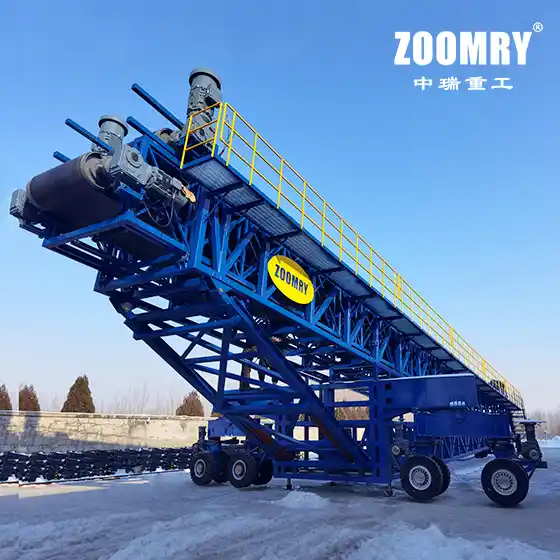
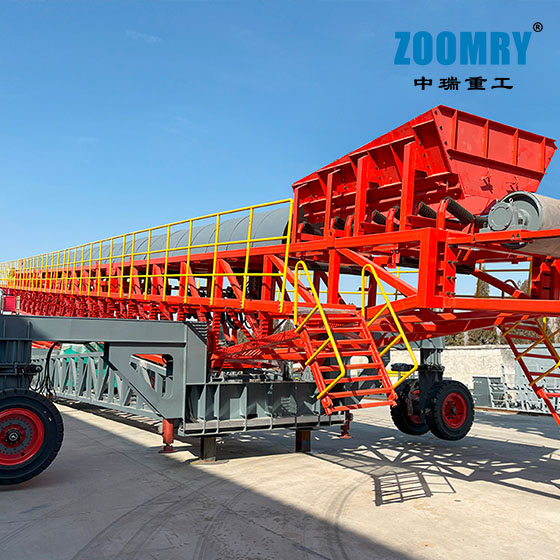
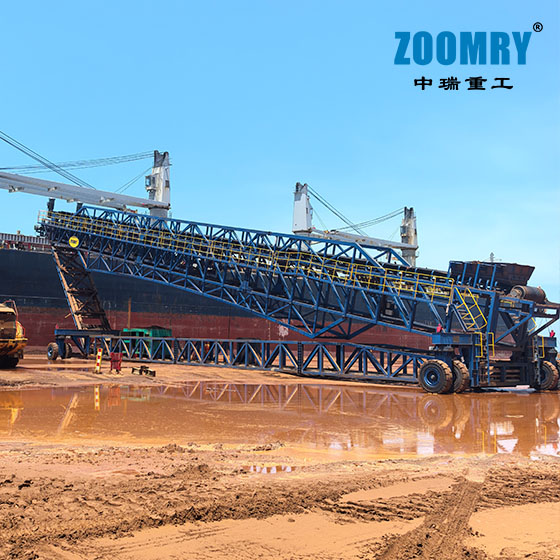
ZOOMRY Telescopic Stacker reaches a maximum stacking height of 20 metres with radial, telescopic, and luffing features that give the operator full control when stockpiling a wide range of bulk materials — eliminating segregation, degradation, contamination, and compaction. The optimized design provides up to 28% larger stockpile capacity compared to conventional fixed-length conveyor systems. Unlike fixed radial stackers, the telescopic model can be moved as a whole between job sites — making it ideal for operations requiring both high capacity and frequent relocation across mining, port, and quarry environments.
How Does a Telescopic Stacker Compare to Other Stacking Solutions?
Choosing the right stacker for your operation depends on your mobility needs, stockpile size, and project duration. Here's how the telescopic stacker fits into the broader stacking equipment landscape:
- Telescopic Stacker vs Fixed Radial Stacker: The fixed radial stacker is anchored to one position and offers the highest stability for continuous, high-tonnage operations in permanent installations. The telescopic stacker trades a degree of base stability for full mobility — it can be relocated between stockpile zones or job sites in hours, not days. Choose the fixed model for permanent yard operations; choose the telescopic model for multi-site flexibility and medium-term projects.
- Telescopic Stacker vs Tracked Radial Stacker: The tracked stacker offers superior traction on soft, uneven, and muddy terrain — ideal for undeveloped mine sites and remote locations. The telescopic wheeled stacker offers faster travel speeds on prepared surfaces and lower undercarriage maintenance costs. For established sites with compacted ground and good access roads, the wheeled telescopic model provides the best cost-performance ratio.
- Telescopic Stacker vs Wheel Loader: A single telescopic stacker replaces multiple wheel loaders for stockpile building — eliminating fuel costs, tyre wear, operator fatigue, and material double-handling. The controlled layering method reduces segregation by up to 60% compared to loader-dumped piles, improving product quality and consistency.
How to Choose the Right Telescopic Stacker Model?
ZOOMRY offers five telescopic stacker models — from the compact ZR80SF to the high-capacity ZR160SF. Here's how to match the right model to your application:
- ZR80SF (800mm belt / 450 m³/h): The entry-level model for small to medium aggregate operations, sand and gravel quarries, and construction material stockpiling. Compact footprint with a 40m reach — ideal where space is constrained and throughput demands are moderate.
- ZR100SF (1000mm belt / 700 m³/h): The mid-range workhorse for medium-scale quarries, coal handling, and port operations. Balances capacity with mobility — the most popular choice for multi-site operations that need to move the stacker between locations every few months.
- ZR120SF (1200mm belt / 1,000 m³/h): Increased capacity with a 50m reach — suitable for high-throughput mining and large quarry operations where a single stacker must serve multiple stockpile zones.
- ZR140SF (1400mm belt / 1,500 m³/h): High-capacity stacking for cement plants, large mines, and port terminals. The wider belt and higher speed handle abrasive materials with extended service life.
- ZR160SF (1600mm belt / 2,400 m³/h): The flagship model for maximum throughput — ideal for high-capacity port loading, iron ore stockpiling, and operations where tonnage rates directly impact profitability.
Key factors to consider when selecting a model: material density and abrasiveness (determine belt speed and cover grade), required stockpile capacity (determine telescopic length and stacking height), and site layout (determine whether radial slewing range is sufficient or machine repositioning is needed). ZOOMRY's engineering team can analyze your specific material sample and site survey data to recommend the optimal model configuration.
Specification
| Product Name | Telescopic Stacker | ||||||
| Material | High Quality Carbon Steel | ||||||
| Belt Width | 800mm; 914mm (36"); 1000mm; 1200mm; 1400mm; 1600mm (custom sizes available) | ||||||
| Max Capacity | 450 – 2,400 m³/h (custom sizes available) | ||||||
| Certification | ISO9001, CE, ISO14001, EAC | ||||||
| Advantages | Portable, rotatable, inclination adjustable, telescopic, radial movement | ||||||
| Applications | Mining, Port, Cement, Steel, Metallurgy, Electric Power, Coal, Machinery | ||||||

ZOOMRY Telescopic Stacker — Specification Overview, 5 Models from ZR80SF to ZR160SF
Model Parameters
| Type | Width (mm) | Max Capacity (m³/h) | Speed (m/s) | Telescopic Length (m) | Max Inclined Angle | Telescopic Range (m) |
|---|---|---|---|---|---|---|
| ZR80SF | 800 | 450 | 2.5 | 40 | 20° | 10-15 |
| ZR100SF | 1000 | 700 | 2.5 | 40 | 20° | 10-15 |
| ZR120SF | 1200 | 1000 | 2.5 | 50 | 20° | 15-20 |
| ZR140SF | 1400 | 1500 | 2.5 | 50 | 20° | 15-20 |
| ZR160SF | 1600 | 2400 | 2.5 | 55 | 20° | 15-20 |
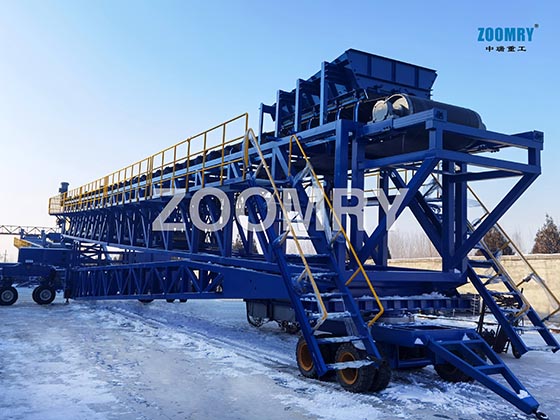
ZOOMRY Telescopic Stacker — 5 Models Covering Belt Widths from 800mm to 1,600mm, Capacities up to 2,400 m³/h
Structural Components
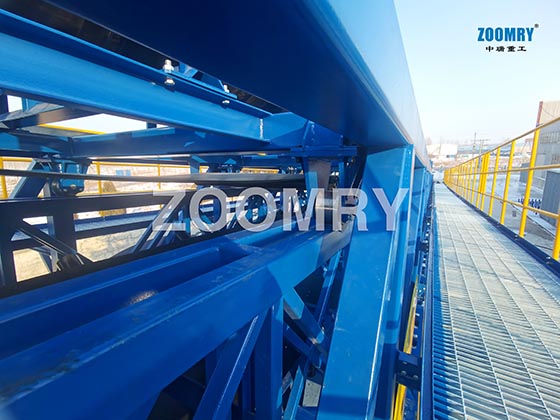
ZOOMRY Telescopic Stacker — Front Wheel Walking Device with Hydraulic motor Drive
Front Wheel Walking Device: Mainly consists of walking frame, hydraulic motor, walking tires, chain and chain guard, connected with the base through the pin. Note that the tire pressure of the walking tires is 11-12 MPa, the maximum cannot exceed 12 MPa. In normal use, the hydraulic legs lift the front part of the base completely. After the tires leave the ground, remote control the front wheel walking device to the working position. After arriving, use the tie rods on both sides of the base to connect with the pins of the front wheel walking device, then the hydraulic outriggers can be retracted, allowing normal work or rotation. When the mobile stacker needs to leave the work site, lift the cylinder outriggers again, and remotely control the front wheel driving device.
Tail Wheel Rotating Device: Mainly composed of a tire, a turntable, and a bracket. The base and the fixed frame of the belt conveyor are all installed on the bracket of the tail wheel rotating device, enabling 360° rotation for radial stacking.
Structural composition of stacker:
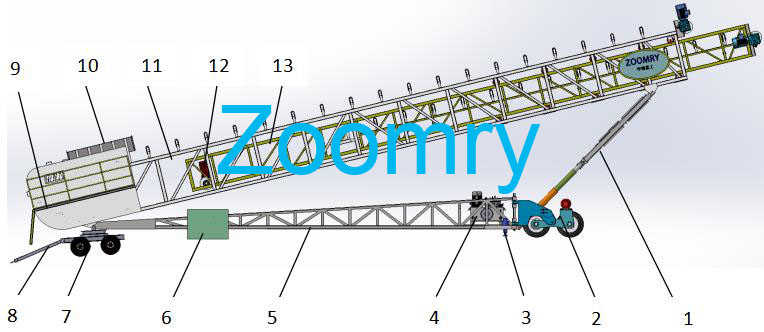
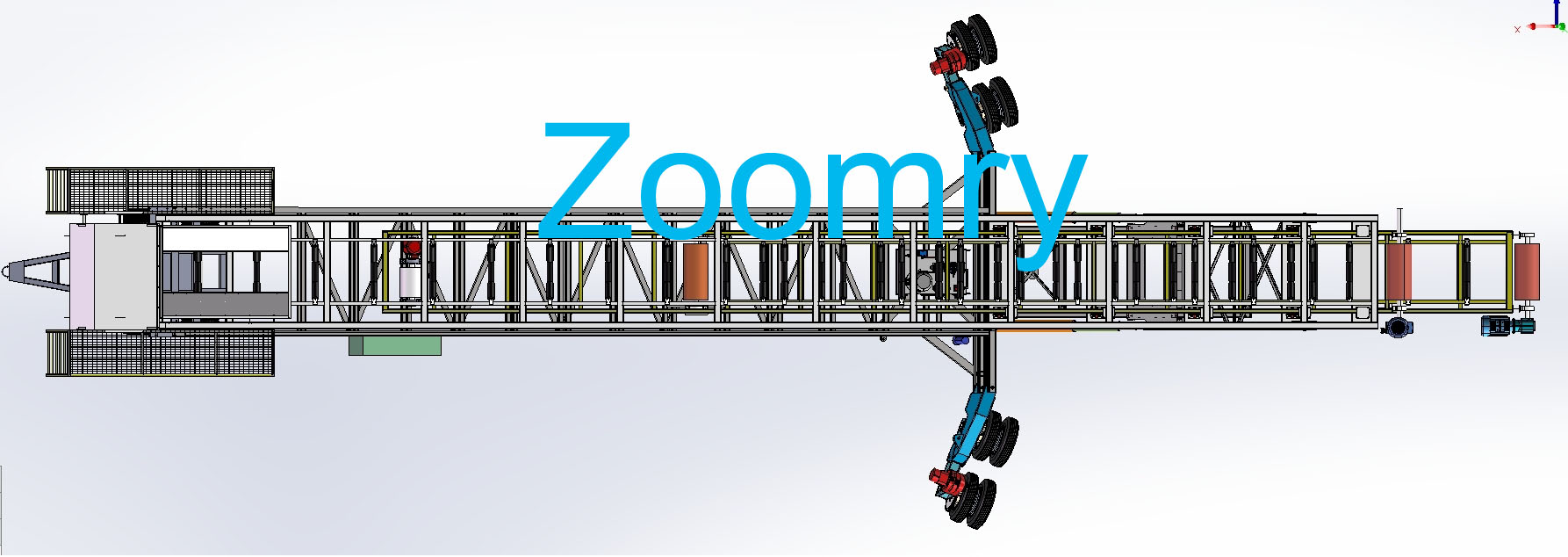
1-Hydraulic lifting system 2-Front wheel walking device 3-Hydraulic outriggers 4-Hydraulic station system 5-Base 6-Electrical control box 7-Tail wheel rotation device 8-Tow bar 9-Maintenance platform 10-Hopper 11-Main Conveyor Belt 12-Wire rope traction device 13-Telescopic conveyor belt
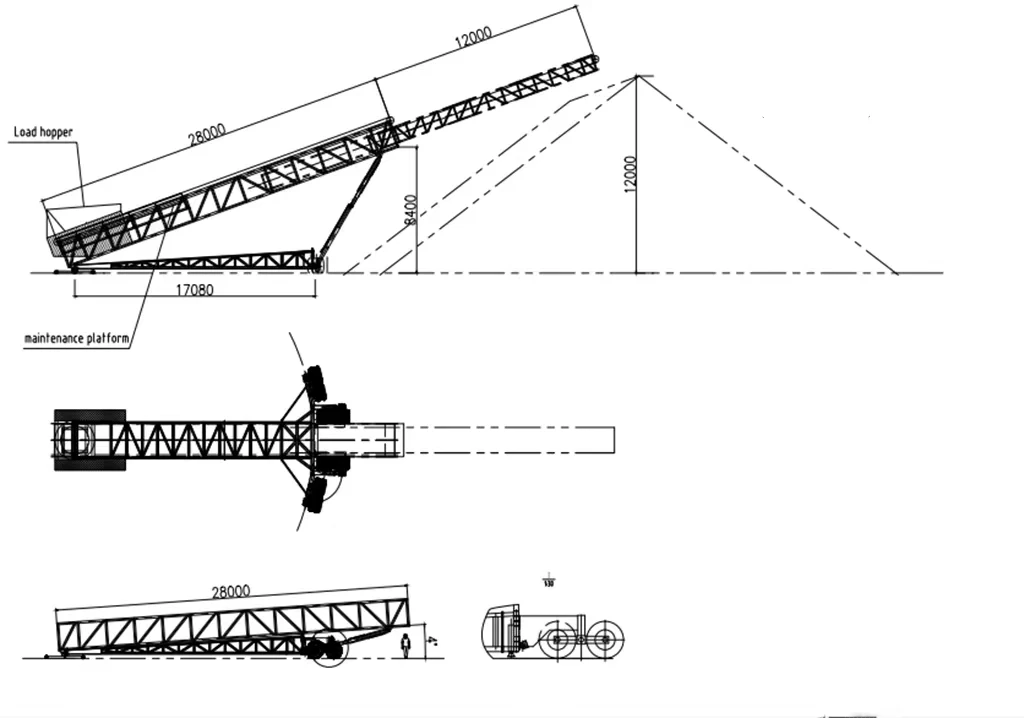
ZOOMRY Telescopic Stacker — Complete System Overview, 13 Key Components for Reliable Stockpile Operation
How Does the Telescopic Stacker Work in a Complete System?
A telescopic stacker is rarely used alone — it typically forms the final link in a mobile stockpiling system. Material flows from a hopper feeder or truck unloader, through a series of grasshopper conveyors that bridge the distance from the receiving point to the stockpile area, and finally onto the telescopic stacker for precision radial stockpiling. This integrated system eliminates wheel loader double-handling entirely — reducing fuel consumption, labour costs, and material degradation.
For operations that need both stockpiling and reclaiming capability, the telescopic stacker can be paired with a Bucket Wheel Stacker Reclaimer — the stacker builds the pile, and the reclaimer recovers material for onward transport. This two-machine configuration is common in port terminals and large mining operations where high throughput and flexible stockpile management are both essential.
Key Advantages
- Adjustable telescopic length: The telescopic length can be adjusted to increase stacking capacity — up to 28% larger stockpile capacity compared to conventional fixed-length conveyor systems. This reduces the need for auxiliary stacking equipment and maximizes yard utilization.
- Full mobility with rapid repositioning: The stacker can be moved as a whole between stockpile zones or job sites — no disassembly required. Combined with the wireless remote-controlled front wheel walking device, relocation takes minutes, not hours — reducing downtime and improving equipment utilization across multiple projects.
- Hydraulic inclination adjustment: The stacking height can be changed by adjusting the inclination of the stacker through the hydraulic cylinder — controlling material degradation, dust emissions, and segregation during discharge at heights up to 20 metres.
- Custom design available: The stacker can be designed according to user needs — matching specific material characteristics, site conditions, and throughput requirements for quarry, mining, and port applications. Belt width, telescopic length, drive power, and optional dust suppression systems are all customizable.
- Proven global track record: Since 2005, ZOOMRY has delivered over 200 telescopic stacker units to customers in more than 30 countries. Equipment is built to CEMA and ISO standards, with CE and EAC certifications — ensuring compliance with international safety and quality requirements.
Related Industry Solutions
Need a Customized Telescopic Stacker?
Contact ZOOMRY for a telescopic stacker engineered to your specific material, capacity, and site requirements — backed by 20+ years of bulk material handling expertise.
Contact Us Today