
Steel Cord vs Fabric Conveyor Belt – Which Conveyor Belt Type Do You Need? | ZOOMRY
Choosing the right conveyor belt carcass — steel cord or fabric — is one of the most critical decisions in bulk material handling system design.
Quick Answer
A fabric conveyor belt uses multiple plies of woven textile — typically EP (polyester/nylon) or nylon (NN) — as its tension member. Below: side-by-side differences in design, capacity, and application fit. Exact capacities, dimensions and standards are confirmed per project in the technical agreement, not from catalogue text.
Choosing the right conveyor belt carcass — steel cord or fabric — is one of the most critical decisions in bulk material handling system design. The wrong choice leads to premature belt failure, unplanned downtime, and excessive operating costs. This guide compares steel cord conveyor belts and fabric conveyor belts across tensile strength, elongation, splice requirements, and total cost of ownership — helping you select the right belt for your specific application.
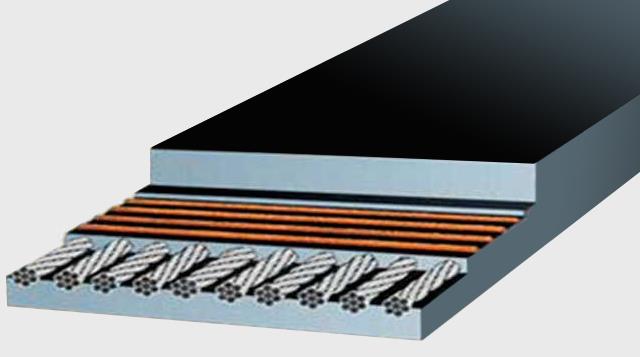
Steel cord conveyor belt — high tensile strength for long distance conveying
What is a Steel Cord Conveyor Belt?
A steel cord conveyor belt uses longitudinally arranged steel cables as its tension member, embedded in a rubber compound. Unlike fabric belts that rely on multiple plies of woven textile, steel cord belts concentrate tensile strength in a single layer of high-carbon steel wires — achieving tensile strengths up to 4,000 N/mm. This makes them the preferred choice for long distance belt conveyors spanning 5 km to over 15 km in a single flight.
Key characteristics of steel cord belts:
- Ultra-low elongation: Typically 0.1%–0.25% at rated load, minimizing take-up travel requirements
- High impact resistance: Steel cords absorb impact energy without tearing — critical for mining applications with large lump sizes
- Excellent troughability: Forms a deep trough for high-capacity material containment even at wide belt widths
- Long splice life: Hot vulcanized finger splices can last the full service life of the belt when properly executed
What is a Fabric Conveyor Belt?
A fabric conveyor belt uses multiple plies of woven textile — typically EP (polyester/nylon) or nylon (NN) — as its tension member. Available in 2 to 6 ply constructions with tensile strengths from 200 to 3,150 N/mm, fabric belts are an economical choice for moderate distances, lower tensions, and applications requiring frequent belt replacement or shorter conveyor lengths.
Key characteristics of fabric belts:
- Lower initial cost: 30%–50% lower material cost than equivalent steel cord belts
- Easier splicing: Mechanical fasteners or cold vulcanization — faster and requiring less specialized equipment
- Good flexibility: Suitable for smaller pulley diameters and tighter curve radii
- Mold and moisture resistance: EP belts in particular resist moisture absorption, ideal for wet environments
Steel Cord vs Fabric Conveyor Belt: Head-to-Head Comparison
| Parameter | Steel Cord Belt | Fabric Belt (EP/NN) |
|---|---|---|
| Tensile Strength | Up to 4,000 N/mm | 200 – 3,150 N/mm |
| Elongation at Rated Load | 0.1% – 0.25% | 1.5% – 4% |
| Splice Type | Hot vulcanized finger splice | Mechanical fasteners or cold/hot vulcanized step splice |
| Splice Time | 6 – 12 hours (skilled crew) | 2 – 4 hours |
| Take-Up Travel | Minimal (low elongation) | Significant (higher elongation + permanent stretch) |
| Impact Resistance | Excellent (steel absorbs energy) | Good (depends on ply count and cover grade) |
| Minimum Pulley Diameter | Larger (≥ 600 mm for ST630+) | Smaller (≥ 250 mm) |
| Troughability | Good (wide belts form deep trough) | Excellent (highly flexible) |
| Belt Weight | Higher (steel density) | Lower |
| Initial Cost | Higher | Lower (30%–50% less) |
| Lifespan (Typical) | 10 – 20+ years | 3 – 8 years |
| Best Application | Long distance, high tension, high capacity | Moderate distance, lower tension, frequent replacement |
When Should You Choose a Steel Cord Conveyor Belt?
Select a steel cord conveyor belt when your application meets one or more of the following conditions:
- Conveyor length exceeds 1,000 meters: Low elongation minimizes take-up stroke — a critical advantage in long distance curved belt conveyors where take-up travel directly impacts tunnel or gallery design cost
- High tension requirement: When calculated belt tension exceeds 1,600 N/mm — common in iron ore and copper concentrate overland conveyors with high lift and tonnage
- Long service life expected: Steel cord belts in cement and power plant applications routinely achieve 15–20 year service life with proper maintenance
- High impact loading: When primary crushed material (lump size 300 mm+) is dropped directly onto the belt — steel cords resist gouging and tearing better than fabric plies
- Multi-flight overland systems: Fewer splices across 15+ km systems mean fewer potential failure points and lower inspection costs
When Should You Choose a Fabric Conveyor Belt?
A fabric conveyor belt is the better choice when:
- Conveyor length is under 500 meters: The cost premium of steel cord is rarely justified for short conveyors
- Frequent belt replacement expected: In quarry applications where abrasive materials wear covers quickly, lower belt cost and faster splicing reduce total cost of ownership
- Small pulley diameters required: Mobile equipment like mobile stackers and tracked radial stackers use compact pulleys that favor fabric belt flexibility
- Budget-constrained projects: 30%–50% lower initial cost frees capital for other system components like conveyor rollers and conveyor pulleys
- Wet or chemically aggressive environments: EP fabric belts resist moisture absorption; specialized covers handle fertilizer and chemical exposure
Steel Cord Conveyor Belt Specifications
ZOOMRY steel cord conveyor belts are available in a full range of tensile strengths and cover grades to match your application:
| Specification | Range |
|---|---|
| Tensile Strength | ST630 – ST4000 (630–4,000 N/mm) |
| Belt Width | 800 – 2,400 mm |
| Cover Grade Options | Abrasion-resistant (DIN Y/Z), Heat-resistant (T1/T2/T3), Flame-retardant (ISO 340), Oil-resistant |
| Cord Diameter | 2.5 – 12.2 mm |
| Cord Pitch | 10 – 25 mm |
| Top Cover Thickness | 5 – 12 mm |
Related Equipment
Industry Solutions
Deep Dive Case Studies
See how ZOOMRY steel cord belts perform in real-world overland and curved conveyor projects:
- Inside the 8,617 m Hubei Curved Conveyor: 9 Horizontal Curves Solved — Engineering challenges and solutions for the Wuxue project.
- Inside the 9.6 km Jiangxi Hengchuang Conveyor: EPC Challenges & Solutions — How a 3,000 t/h ultra-long gallery was delivered.
Need Help Selecting the Right Conveyor Belt?
Tell us your conveyor length, material type, and tonnage. Our engineers will recommend the optimal belt carcass — steel cord or fabric — for your application.
Get a Quote →Explore This Topic: Steel Cord & Conveyor Belts
Belt carcass and cover selection: steel cord ST grades, fabric EP/NN belts, splice design and cost trade-offs.
- Steel Cord Conveyor Belt — ST630 to ST4000 — Topic hub
- Steel Cord Conveyor Belt Specifications: ST630 to ST4000 Explained — Guide
- Solid Woven Conveyor Belt – Flame Retardant PVC/PVG Belt for Underground Mining — Product
- ZOOMRY Conveyor Belts – Reliable for Mining, Ports & Heavy Industry — Guide
- How to Choose the Right Conveyor Belt for Your Application? | Steel Cord vs Fabric vs Chevron | — Guide
- Fire Resistant Conveyor Belt – Flame Retardant Belt for Underground Coal Mining — Product
Let's build it together
Need a custom bulk handling solution?
Talk to our engineers about conveyors, stackers, ship loaders and turnkey EPC systems.