 ZOOMRY

1. Product Overview
ZOOMRY CEMA B equal impact troughing idlers combine a symmetrical three equal-length roller design with rubber cushion rings for light-duty loading zone protection. Engineered to CEMA B standards for mining and aggregate conveyors up to 48-inch belt width, these impact troughing idlers absorb the majority of impact energy at crusher discharge and transfer points — protecting both belt and structure from premature failure. Available in 20°, 35°, and 45° trough angles with 4-inch and 5-inch impact-rated rollers and labyrinth seals.
Unlike standard carrying idlers, each roller is fitted with molded rubber cushion rings spaced along the roller length. These rings compress under falling material impact, then rebound — dissipating kinetic energy that would otherwise damage the belt carcass. The equal-length roller configuration ensures uniform impact distribution across the full belt width, making these idlers the preferred choice for aggregate and cement crusher discharge zones with centered loading.
2. How Rubber Cushion Rings Protect the Belt at Loading Zones
At conveyor loading zones, material falling from a crusher or preceding conveyor generates high-energy impact forces concentrated at the point of belt contact. Standard carrying idlers transmit these forces directly to the belt carcass — accelerating splice fatigue, cover wear, and idler bearing damage over time.
The CEMA B equal impact troughing idler solves this with molded rubber cushion rings installed at regular intervals along each of the three equal-length rollers. As material impacts the belt, these rings compress — converting kinetic energy into elastic deformation. The rings then rebound gradually, preventing secondary shock waves through the belt. This mechanism absorbs the majority of impact energy, helping to extend belt life at transfer points in coal and mineral processing applications.
3. Key Features
Symmetrical Three Equal-Length Rollers — Uniform impact distribution across the full belt width, matching the CEMA B equal troughing geometry for consistent belt support from standard sections into loading zones.
Molded Rubber Cushion Rings — Multi-stage compression absorbs the majority of falling material impact energy, helping to prevent belt puncture and splice damage at transfer points.
CEMA B Light-Duty Rating — 4-inch and 5-inch diameter impact-rated rollers for belt widths up to 48 inches — suitable for light-duty crusher discharge in aggregate and sand processing operations.
Three Trough Angles — Available in 20°, 35°, and 45° to match existing carrying idler geometry, ensuring seamless belt transition from standard sections into impact zones.
Advanced Labyrinth Sealing — Multi-stage seals protect bearings from fine dust and moisture ingress common in crushing and mineral processing environments.
4. Equal Impact vs Standard Equal Troughing (CEMA B)
| Feature | CEMA B Equal Impact (B8) | CEMA B Equal Troughing (B7) |
|---|---|---|
| Roller Surface | Rubber cushion rings on steel shell | Smooth steel shell |
| Primary Function | Impact absorption + belt protection | Maximum carrying capacity |
| Impact Protection | Yes — rubber rings absorb impact energy | Minimal — steel-on-belt contact |
| Best Application | Crusher discharge, transfer points, loading zones | Standard conveyor carrying sections |
| Spacing Recommendation | 300–450 mm at impact zone | 900–1,200 mm standard spacing |
5. Dimensions – CEMA B Equal Impact Troughing 20° / 35° / 45°
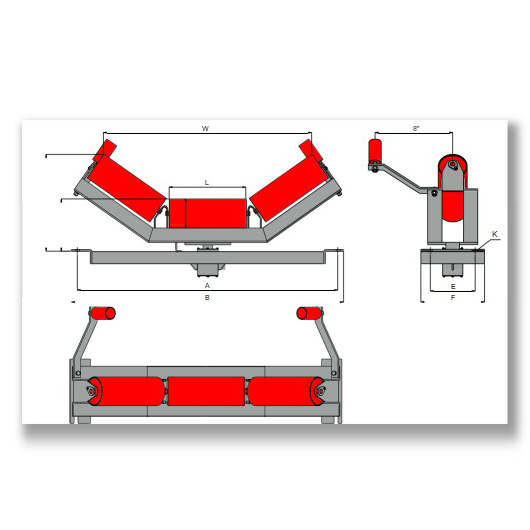
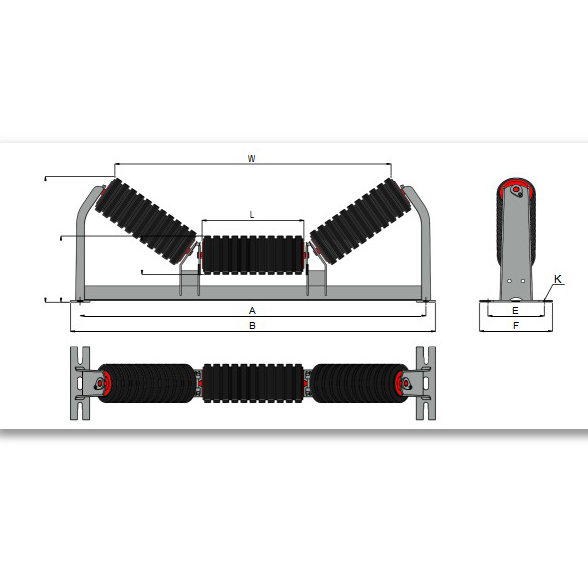
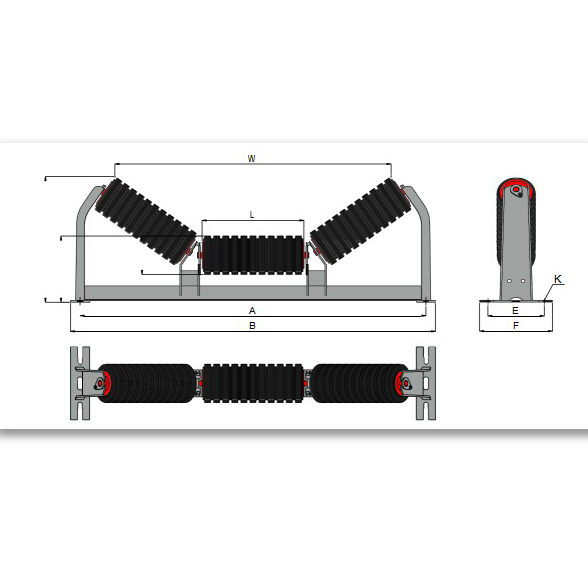
ZOOMRY CEMA B equal impact troughing idlers share the same frame geometry as CEMA B equal troughing idlers, with rubber cushion rings on each roller. Manufactured with 4-inch and 5-inch impact-rated roller configurations for belt widths from 18 to 48 inches. Suitable for light-duty CEMA B loading zones in mining, coal, cement, and aggregate conveyors:
|
|
4" Roller | 5" Roller |
|
||||||||||
|---|---|---|---|---|---|---|---|---|---|---|---|---|---|
| Angle | BW | A | B | L | H1 | H2 | W | H1 | H2 | W | E | F | K |
| 20° | 18 | 27 | 29 | 7 1/4 | 6 1/2 | 8 5/8 | 21 1/2 | 7 | 9 1/16 | 21 1/8 | 6 | 8 | 1/2 |
| 24 | 33 | 35 | 9 1/16 | 6 1/2 | 8 5/8 | 27 1/2 | 7 | 9 1/16 | 27 1/8 | 6 | 8 | 1/2 | |
| 30 | 39 | 41 | 11 1/8 | 6 1/2 | 8 5/8 | 33 1/4 | 7 | 9 1/16 | 32 7/8 | 6 | 8 | 1/2 | |
| 36 | 45 | 47 | 13 1/4 | 6 1/2 | 8 5/8 | 39 1/4 | 7 | 9 1/16 | 38 7/8 | 6 | 8 | 1/2 | |
| 42 | 51 | 53 | 15 7/16 | 7 | 9 1/16 | 45 1/4 | 7 1/2 | 9 9/16 | 44 7/8 | 7 1/2 | 9 1/2 | 5/8 | |
| 48 | 57 | 59 | 17 1/16 | 7 | 9 1/16 | 51 1/4 | 7 1/2 | 9 9/16 | 50 7/8 | 7 1/2 | 9 1/2 | 5/8 | |
| 35° | 18 | 27 | 29 | 7 1/4 | 6 1/2 | 10 3/16 | 19 1/2 | 7 | 10 9/16 | 19 1/16 | 6 | 8 | 1/2 |
| 24 | 33 | 35 | 9 1/16 | 6 1/2 | 10 3/16 | 25 1/4 | 7 | 10 9/16 | 24 7/8 | 6 | 8 | 1/2 | |
| 30 | 39 | 41 | 11 1/8 | 6 1/2 | 11 1/2 | 30 3/4 | 7 | 11 7/8 | 30 3/16 | 6 | 8 | 1/2 | |
| 36 | 45 | 47 | 13 1/4 | 6 1/2 | 11 1/2 | 36 5/8 | 7 | 11 7/8 | 36 1/16 | 6 | 8 | 1/2 | |
| 42 | 51 | 53 | 15 7/16 | 7 | 13 1/4 | 40 3/4 | 7 1/2 | 13 5/8 | 40 3/16 | 7 1/2 | 9 1/2 | 5/8 | |
| 48 | 57 | 59 | 17 1/16 | 7 | 13 1/4 | 46 3/4 | 7 1/2 | 13 5/8 | 46 3/16 | 7 1/2 | 9 1/2 | 5/8 | |
| 45° | 18 | 27 | 29 | 7 1/4 | 6 1/2 | 11 1/8 | 17 3/4 | 7 | 11 1/2 | 17 5/16 | 6 | 8 | 1/2 |
| 24 | 33 | 35 | 9 1/16 | 6 1/2 | 11 1/8 | 23 1/4 | 7 | 11 1/2 | 22 13/16 | 6 | 8 | 1/2 | |
| 30 | 39 | 41 | 11 1/8 | 6 1/2 | 12 13/16 | 28 3/8 | 7 | 13 1/16 | 27 13/16 | 6 | 8 | 1/2 | |
| 36 | 45 | 47 | 13 1/4 | 6 1/2 | 12 13/16 | 33 7/8 | 7 | 13 1/16 | 33 5/16 | 6 | 8 | 1/2 | |
| 42 | 51 | 53 | 15 7/16 | 7 | 15 1/16 | 37 3/4 | 7 1/2 | 15 3/8 | 37 3/16 | 7 1/2 | 9 1/2 | 5/8 | |
| 48 | 57 | 59 | 17 1/16 | 7 | 15 1/16 | 43 3/4 | 7 1/2 | 15 3/8 | 43 3/16 | 7 1/2 | 9 1/2 | 5/8 | |
Dimensions per CEMA B industry standards. Frame geometry matches CEMA B equal troughing idlers. Rubber cushion rings add approximately 1–2 inches to the effective roller diameter at the ring location. A=Frame width, B=Overall width, L=Roller length, H1=Base height, H2=Overall height, W=Center-to-center mounting width, E/F/K=Mounting dimensions. All dimensions in inches.
What Information Do We Need for Impact Idler Selection?
- Material type, maximum lump size, and drop height at the loading zone
- Belt width, belt speed, and conveyor capacity
- Loading zone location — crusher discharge, transfer chute, or feeder discharge
- Operating environment — dust, moisture, temperature range, and material abrasiveness
- Existing idler type, frame dimensions, and whether this is a retrofit or new installation
Related Solutions

Need Impact Idlers for Your Light-Duty Loading Zone?
Tell us your material lump size, drop height, and belt width — our engineers will recommend the optimal impact idler configuration with correct cushion ring spacing.
Request Impact Idler Recommendation →