 ZOOMRY

ZOOMRY has been deeply engaged in the bulk material handling equipment industry for many years, focusing on the R&D and production of complete sets of equipment such as belt conveyors, telescopic stackers, mobile ship loaders, and truck unloaders, as well as core components including idlers, rollers, and cleaning scrapers. Combining rich practical experience in serving global customers and internationally accepted standards, this article provides professional answers to high-frequency questions in the design, selection, and construction of belt conveyors, serving as a reference for project decision-makers and technical personnel worldwide. A FAQ summary table is available at the end of the article for quick browsing.
I. What Are the Common Types of Belts for Belt Conveyors?
-
Steel Cord Conveyor Belt (ST): Boasts the highest tensile strength among all belt types, capable of withstanding enormous tension in long-distance and high-capacity transportation. It is the preferred choice for international long-distance bulk material conveying projects, widely used in cross-regional port coal conveying lines, large-scale mine ore transportation systems, and other scenarios. With strong structural stability and extremely low elongation, it can meet the requirements of ultra-long-distance transportation exceeding 1000 meters.
-
Fabric Ply Conveyor Belt (EP/NN/CC): Using polyester (EP), nylon (NN), or cotton canvas (CC) as the core material, it has a relatively high elongation and is more suitable for short-distance transportation within 300 meters in factories. This type of belt features good flexibility and easy installation and maintenance, and is commonly used in short-distance feeding lines of small and medium-sized chemical enterprises in Europe, food processing plants in Southeast Asia, and domestic steel plants. The thickness of the cover rubber can be selected according to material characteristics.
-
Solid Woven Conveyor Belt (PVC/PVG): Adopting an integrally woven belt core, it possesses excellent flame-retardant and anti-static properties, making it a core choice for underground coal mine transportation and projects in high-dust environments, complying with international coal mine safety standards (such as relevant IEC specifications). The PVC type is suitable for normal temperature and dry environments, while the PVG type, with an added rubber cover layer, offers superior wear resistance and cold resistance, adaptable to alpine regions or humid working conditions.
-
Aramid Fabric Core Conveyor Belt (DPP): Reinforced with aramid fibers, it features high strength, light weight, and high temperature resistance. However, due to its high cost, its application is relatively limited globally, mainly used in niche scenarios with special requirements for equipment weight and temperature resistance, such as aerospace and high-end chemical industries.
In addition, according to the environmental requirements of international projects, ZOOMRY's belts can be customized with special properties such as wear resistance, cold resistance (below -40℃), heat resistance (above 120℃), flame retardancy, and acid-alkali resistance. Customized solutions can also be provided based on the climatic conditions and material characteristics of the customer's region.
II. Conveyor Gallery Related
What Are the Types of Conveyor Galleries?
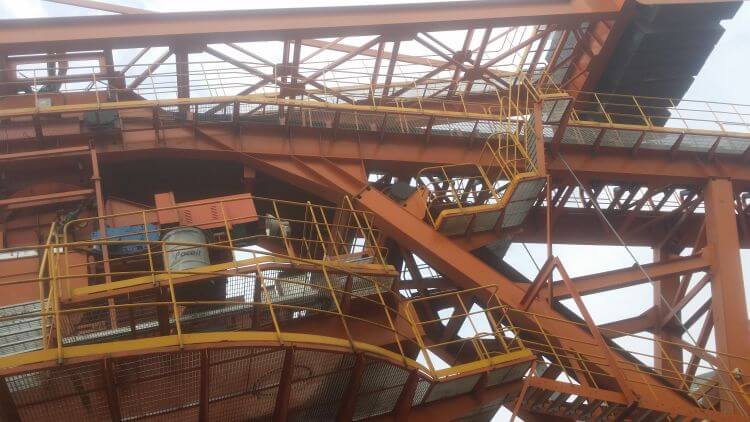
In newly-built projects worldwide, fully enclosed galleries have become the mainstream choice as they meet international environmental protection requirements for dust control and ecological protection. The truss structures are mainly divided into three types: upper-opening type, lower-opening type, and integrated type:
- Upper-opening truss: Facilitates equipment inspection and maintenance, and is widely used in plain area projects;
- Lower-opening truss: Has a low application rate due to limited maintenance space, only suitable for restricted sites with special terrain;
- Integrated truss: Adopts an integrally formed structure, featuring high load-bearing capacity, light weight, and excellent wind resistance. It is highly favored in coastal areas with strong winds and large-scale river-crossing or sea-crossing conveying projects. ZOOMRY has adopted this structure in multiple overseas port projects, effectively reducing gallery construction costs and later maintenance frequency.
The enclosure material of the gallery generally adopts a combination of profiled color steel plates and lighting panels, which not only ensures structural airtightness (reducing material dust emission) but also utilizes natural light to lower the lighting energy consumption inside the gallery. Some high-end projects will select anti-corrosion coated color steel plates to adapt to highly corrosive environments such as marine climates.
Width Standards for Inspection Passages in Conveyor Galleries
According to Chinese national standard (GB/T 10595-2023) and internationally accepted safety standards (such as ISO 5048), the minimum clear width of the inspection passage for belt conveyor galleries shall be ≥500mm, and the minimum clear width of the sidewalk shall be ≥700mm. For long-distance galleries with frequent personnel traffic, it is recommended to optimize the sidewalk width to more than 800mm, while reserving equipment transportation channels to ensure that large components can enter and exit smoothly during later maintenance.
Design Standards for Conveyor Turning Radius
The core influencing factors of conveyor turning radius include belt width, belt tension, turning angle, material characteristics, and operating environment. The internationally accepted design principles are as follows:
- Ordinary belt conveyor: The ideal turning radius is 1000 times the belt width. For example, for equipment with a 1m belt width, the turning radius should be ≥1000m, which can effectively reduce belt wear and extend service life;
- Pipe conveyor: Since the belt is transported in a tubular shape, the turning radius needs to be adjusted according to the belt type. The fabric ply belt requires ≥400 times the pipe diameter, and the steel cord belt requires ≥800 times the pipe diameter;
- Special scenarios: ZOOMRY has accumulated small-radius turning solutions in multiple terrain-restricted projects worldwide. However, from the perspective of equipment operation stability and maintenance costs, it is recommended to maximize the turning radius in accordance with international standards when site conditions permit, avoiding problems such as belt deviation and wear caused by uneven stress on the belt.
Reasonable Range of Gallery Span
The common span of belt conveyor galleries is 18m~30m, which requires targeted calculations based on the geological conditions, wind load, snow load, belt width, and conveying capacity of the project's location. A gallery with a span exceeding 30m is called a long-span gallery. Although it can meet the needs of crossing special terrains (such as rivers and railways), the truss structure has a large self-weight, resulting in significantly increased construction costs and higher requirements for construction technology. ZOOMRY once designed and constructed an 80m-span long-span truss for a large overseas mine project, but its cost is much higher than that of conventional spans. Therefore, it is only recommended when there is no alternative solution.
III. Safety Specifications and Layout
The safety design of belt conveyors must take into account core needs such as personnel evacuation and equipment protection, strictly complying with internationally accepted safety standards. The following are the specification requirements for key safety parameters:
How to Set Safety Exits in Galleries and Tunnels?
According to Chinese national standards and relevant specifications of the International Organization for Standardization (ISO), enclosed trestles and tunnels must be equipped with safety exits on the sidewalk side, and the distance between exits shall not exceed 150m. For long-distance tunnel projects, if dense safety exits cannot be set due to geological constraints, personnel shelters meeting emergency evacuation requirements can be installed in the tunnel. These shelters must be equipped with ventilation equipment, emergency lighting, and communication devices to ensure that personnel can take temporary refuge in emergencies.
Principle of Conveyor Turning Implementation
The smooth turning of belt conveyors is achieved through guidance by specialized deep trough idler groups in the arc section. ZOOMRY's independently developed idler groups adopt an inner-side elevated structure, which can effectively offset the inward displacement force during belt operation and prevent the belt from deviating from the conveying trajectory; at the same time, the stable operation of the belt is further enhanced by accurately setting the installation angle of the idler groups, avoiding deviation during turning. This technology has been applied in multiple long-distance turning conveying projects worldwide, adaptable to different turning angles and belt width requirements, ensuring stable operation of equipment in complex terrain.
Anti-Deviation and Safety Protection
In addition to the special design of the turning section, the conventional conveying section must be equipped with safety devices such as self-aligning idlers and deviation switches: self-aligning idlers can automatically correct minor belt deviations, and deviation switches trigger alarms or shutdowns when the belt deviation exceeds the limit, avoiding material leakage or equipment damage. In addition, emergency stop buttons must be installed in the gallery with a spacing of no more than 50m, ensuring that personnel can quickly stop the machine at any position, in line with international safety protection standards.
IV. Comparison Between Tunnel Corridors and Steel Structure Corridors
Applicability Comparison
- Steel structure corridor: High modularity, short construction period, low requirements for geological conditions, adaptable to most terrains such as plains, coastal areas, and hills. It also features convenient later maintenance and can be disassembled and relocated as needed, making it suitable for most standardized projects worldwide;
- Tunnel: Offers advantages of small floor space and minimal damage to surface ecology, suitable for terrain-restricted areas or projects with extremely high environmental protection requirements such as mountainous areas and urban core regions. However, construction is greatly affected by the construction period and surrounding rock properties. If the geological conditions are complex (such as soft soil foundations and broken rock formations), additional support engineering investment is required, increasing construction difficulty.
Cost Difference
Overall, the construction cost of tunnels is higher than that of steel structure corridors. The difference is mainly reflected in construction technology, surrounding rock treatment, and construction period costs: steel structure corridors have more advantages in cost due to standardized production and modular installation; tunnels, on the other hand, need to bear additional costs such as geological exploration, support, ventilation, and drainage, resulting in higher hidden costs. Based on the geological report, environmental protection requirements, and construction period plan of the customer's region, ZOOMRY can provide customized laying solutions to optimize costs while meeting project needs.
Foundation Type Selection
The foundation design of belt conveyors must be determined based on geological exploration results. The mainstream foundation types worldwide include:
- Raft-type reinforced concrete foundation: Features strong stability and high load-bearing capacity, suitable for projects with good geological conditions, and is the preferred foundation type for most belt conveyor projects globally;
- Pile foundation: Suitable for complex geological scenarios such as soft soil foundations and mountainous areas, divided into precast piles and cast-in-place piles: precast piles have fast construction speed and low cost, suitable for plain soft soil foundations; cast-in-place piles have stronger load-bearing capacity, adaptable to complex geology such as rock formations and fracture zones. ZOOMRY has mature pile foundation application cases in soft soil foundation projects in Southeast Asia and mountainous projects in the Americas.
V. Customized Solutions
Can Solar Panels Be Installed on Conveyor Galleries?
Installing solar panels on belt conveyor galleries has become an innovative direction for global energy-saving projects. ZOOMRY has participated in the integrated photovoltaic design of multiple overseas port and mine projects. Solar panels on the top of the gallery can convert solar energy into electrical energy, providing partial power for gallery lighting and equipment operation, in line with global carbon neutrality goals. However, it should be noted that the photovoltaic power generation scheme for long-distance linear projects needs to comprehensively evaluate the investment return rate based on the solar radiation conditions, electricity price policies, and investment costs of the project's location. It is recommended that customers conduct a special feasibility analysis in the early stage of the project.
Layout of Dischargers for Furnace Feeding in Steel Enterprises
Furnace feeding in steel enterprises requires accurate delivery of 4-5 types of materials. ZOOMRY has designed a programmed plow discharger layout scheme for this scenario:
- Core principle: According to the material switching time, the corresponding plow discharger is accurately triggered by the PLC control system to ensure that the material is unloaded into the designated silo. The action sequence of the discharger is precisely matched with the belt running speed to avoid material leakage;
- Key design: A sufficient gap must be reserved between different materials, and the gap length is adjusted according to the belt speed (usually 3-5 meters) to prevent mixing during material switching; at the same time, customized chutes and cleaning scrapers are equipped under the dischargers. The inner walls of the chutes are lined with wear-resistant plates to reduce material scouring, and the cleaning scrapers can remove residual materials on the belt surface to avoid cross-contamination.
VI. Core Components and Equipment Supporting
- Idlers and idler groups: Adopt high-precision bearings and wear-resistant bushings, with a service life far exceeding the industry average, adaptable to extreme environments of -40℃~60℃;
- Rollers: Divided into drive rollers, bend rollers, and other types, the surface is rubber-coated to enhance friction, and different diameters and materials can be selected according to the conveying capacity;
- Cleaning scrapers: Made of polyurethane or alloy materials, capable of efficiently removing residual materials on the belt surface and reducing equipment wear;
- Chutes: Custom-designed to adapt to the flow characteristics of different materials, avoiding material blocking and leakage.
In addition, ZOOMRY's product system also includes supporting equipment such as telescopic stackers, mobile ship loaders, and truck unloaders, which can form a complete bulk material handling solution to meet the integrated needs of global mining, port, steel, and other industries.
FAQ Quick Reference Table
| Question Category | Core Question | Key Answer |
|---|---|---|
| Core Component Selection | What are the common types and characteristics of belts? | Steel Cord (ST: highest tensile strength, preferred for long distances), Fabric Ply (EP/NN/CC: suitable for short distances), Solid Woven (PVC/PVG: flame-retardant and anti-static), Aramid (DPP: niche and high-end); customizable with wear/cold/heat resistance and flame retardancy |
| Gallery Type Design | What are the mainstream types and structures of conveyor galleries? | New projects mainly use fully enclosed galleries; trusses are upper-opening (commonly used), lower-opening (rarely used), or integrated (high load-bearing, light weight); enclosure material is profiled color steel plate + lighting panel |
| Safety Passage Specifications | What are the minimum clear widths of inspection passages and sidewalks? | Inspection passage ≥500mm, sidewalk ≥700mm (complying with Chinese national standards and ISO international standards) |
| Turning Parameter Design | What are the requirements for conveyor turning radius? | Ideal value for ordinary conveyors: 1000×belt width; pipe conveyors: fabric ply ≥400×pipe diameter, steel cord ≥800×pipe diameter; prioritize increasing radius to improve stability |
| Safety Exit Setup | How to arrange safety exits in galleries/tunnels? | Safety exits on the sidewalk side with spacing ≤150m; personnel shelters can be added if exits are difficult to set in tunnels |
| Gallery Span Selection | What are the common spans and long-span standards for conveyor galleries? | Common span: 18m~30m; >30m is long-span, requiring targeted calculation, avoided if possible (high cost, heavy weight) |
| Laying Method Comparison | Which is more suitable: steel structure corridor or tunnel? What is the cost difference? | Steel structure: fast construction, cost-effective, wide applicability; tunnel: small floor space, good environmental protection but higher cost with more hidden expenses |
| Innovative Application Feasibility | Can solar panels be installed on conveyor galleries? | Feasible (with mature cases); investment return rate needs to be evaluated based on solar radiation and electricity prices |
| Foundation Type Selection | What are the common foundation types for conveyor galleries? | Mainstream: raft-type reinforced concrete foundation; pile foundation (precast/cast-in-place) for complex geology |
| Turning Implementation Principle | How to achieve smooth turning of conveyors? | Special deep trough idler groups in the arc section (inner-side elevated to offset inward force) + idler installation angle design to prevent deviation |
| Special Scenario Layout | For furnace feeding in steel plants, how to arrange plow dischargers for 4-5 materials on one conveyor? | Programmed control of discharger sequence; reserve gaps between materials to avoid leakage; equip customized chutes and cleaning scrapers to prevent contamination |
The design, selection, and construction of belt conveyors must consider international standards, project working conditions, economic benefits, and safety protection. With years of experience in serving global projects, ZOOMRY can provide full-process services from preliminary scheme design and core equipment production to later installation and commissioning. Products comply with international quality standards and adapt to the climatic, geological, and environmental protection requirements of different regions worldwide. Whether it is a conventional short-distance conveying project or a special demand under long-distance, large-span, or complex terrain conditions, ZOOMRY can provide customized solutions to help customers improve conveying efficiency and reduce comprehensive costs. For further understanding of technical details or scheme design for specific projects, feel free to contact us for consultation.
