 ZOOMRY

Quick answer: A Conveyor Belt price per meter is driven by five variables, not one. Carcass type (steel cord vs fabric) sets a 30–50% baseline difference. ST or EP grade scales the price roughly linearly with breaking strength. Cover compound — abrasion, heat, flame, oil — adds 10–30%. Belt width and order volume adjust the per-meter number, often misleadingly. A 1,000 mm ST2000 steel cord belt typically lands at USD 55–120 per meter before freight and duty; the same width in EP400 fabric runs about 30–50% lower. The per-meter number alone tells you nothing about which belt is cheaper over the conveyor’s life.
Why “Price per Meter” Is a Misleading Number
Belt quotations are usually compared on a per-meter basis, but the per-meter number depends on what is being measured. A steel cord belt and a fabric belt of the same width are not the same product sold at different prices — they are different carcass constructions with different strength, splice efficiency, and wear life. Comparing them per meter is like comparing a truck tyre and a passenger tyre per kilogram.
The number that matters is the cost per ton of material conveyed over the belt’s life, not the invoice per meter. A belt that costs 40% more per meter but lasts twice as long and carries 50% more tension is the cheaper belt over the conveyor’s operating life. The per-meter comparison is a starting point for budgeting, not a basis for selection.
Driver 1 — Carcass Type: Steel Cord vs Fabric
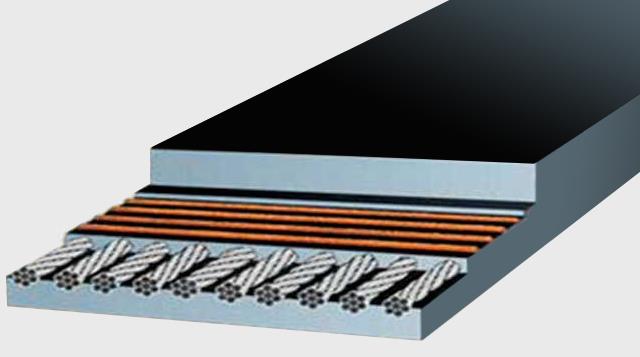
Steel cord belts carry higher tension per unit width because the steel cords do the load-bearing work. Fabric belts (EP/NN) use polyester-nylon plies, which are lighter and cheaper but carry less tension and lose more strength at the splice. The price difference is structural, not a supplier margin difference.
| Belt type | Typical price range (1,000 mm width) | Why |
|---|---|---|
| EP fabric (2-ply to 4-ply) | USD 25–60 per meter | Polyester-nylon carcass, lower tension, 60–80% splice efficiency |
| Steel cord (ST1000–ST2500) | USD 55–120 per meter | Steel cord carcass, higher tension, 90–100% splice efficiency |
| Steel cord (ST3150–ST4000) | USD 90–220 per meter | High-tensile cord, heavy cover, long-distance or high-tonnage duty |
Selection rule: below roughly 200 m of conveyor length at moderate tension, a fabric belt is usually the lower total cost — the steel cord premium buys splice efficiency and tension capacity that a short conveyor does not need. Above 500 m, or where the operating tension exceeds what a fabric belt can carry at a reasonable safety factor, the steel cord premium is justified by the splice efficiency and the reduced belt weight.
Driver 2 — ST or EP Grade: Price Scales With Breaking Strength
The ST number (for steel cord) or EP number (for fabric) is the nominal breaking strength. Price scales roughly linearly with the grade within a carcass type: an ST2500 belt costs more than an ST1600 belt of the same width because it uses more steel cord per meter. The same applies to EP grades — EP400 costs more than EP200.
The selection error is specifying a higher grade than the duty requires. A conveyor calculated at ST1600 operating tension does not need ST2500 because “it is stronger”. The higher grade adds cost without adding life — the belt is already designed with a safety factor, and a higher ST grade does not improve the safety factor if the operating tension is unchanged.
Selection rule: calculate the operating tension, apply the safety factor for the duty (9.5:1 for short feeders, 7.5:1 for high-capacity main lines), round up to the next standard grade, and stop there. Each step up in ST grade adds 10–20% to the price.
Driver 3 — Cover Compound: 10–30% of the Price, but It Determines Life
The cover compound is the part of the belt that touches the material. A standard abrasion-resistant cover costs less than a heat-resistant, flame-retardant, or oil-resistant compound. The price difference is 10–30% depending on the compound, but the cover is also the first component to wear out — a cheap cover on an abrasive duty can wear through and expose the carcass before the belt reaches half its design life.
| Cover grade | Price impact vs standard abrasion-resistant | When it pays back |
|---|---|---|
| Abrasion-resistant (DIN Y/W/X) | Baseline | Iron ore, granite, copper concentrate, abrasive aggregate |
| Heat-resistant (HR/SHR/UHR) | +10–20% | Clinker, sinter, coke, hot casting up to 200°C |
| Flame-retardant (ISO 340) | +15–25% | Underground coal, biomass, combustible dust |
| Oil-resistant | +20–30% | Oily grain, recycled material, oily scrap |
Selection rule: match the cover to the material, not to the price list. A $10/m saving on a standard cover that wears through in 18 months is a false economy if the heat-resistant cover would have lasted five years.
Driver 4 — Belt Width: The Per-Meter Number Hides the Real Cost
A wider belt costs more per meter because it uses more material. But the per-meter comparison across widths is misleading: a 1,400 mm belt at $80/m and a 1,000 mm belt at $60/m are not directly comparable — the wider belt carries more tonnage per meter of conveyor length, so the cost per ton conveyed may be lower.
The right comparison is cost per ton-kilometer, not cost per meter. A wider belt that carries 40% more tonnage at 20% higher price per meter is the cheaper belt per ton conveyed. This is why belt width selection should be driven by the required tonnage and the conveyor speed, not by the per-meter price.
Driver 5 — Order Volume and Lead Time
Belt production runs in batches. A 500 m order for a standard specification may be scheduled into an existing production slot and priced competitively. A 2,000 m order for a non-standard width and cover compound may require a dedicated run, a new calendering setup, and a longer lead time — all of which add to the price per meter.
The practical implication for a project buyer: the per-meter price quoted for a small trial order is not the price for the full conveyor. Confirm the price at the actual order volume and specification before using it for budgeting.
What the Belt Costs Over Its Life: Conveyor vs Truck
The belt is only one line in the conveyor’s operating cost, and the conveyor’s operating cost is only one option compared with truck haulage. For a mining operation moving material along a fixed route, the conveyor’s operating cost per ton-kilometer is roughly $0.10, against roughly $0.24 for truck haulage. The belt is a consumable within that $0.10 — the structure, drives, idlers, and maintenance make up the rest.
ZOOMRY’s 3,300 m Chengde iron ore conveyor (ST3150/1,400 mm steel cord belt, 2,000 t/h) reduced energy consumption per ton by 40% compared with truck haulage and cut annual maintenance costs by 50%. Those are conveyor-level savings, not belt-level savings — but they are the reason a steel cord belt that costs more per meter can still be the lower-cost choice for the project.
Frequently Asked Questions
How much does a conveyor belt cost per meter?
For a 1,000 mm wide belt: EP fabric belts typically run USD 25–60 per meter, steel cord ST1000–ST2500 belts USD 55–120 per meter, and ST3150–ST4000 belts USD 90–220 per meter, before freight and duty. The per-meter number depends on carcass type, grade, cover compound, and order volume.
Why is a steel cord belt more expensive than a fabric belt?
Steel cord belts use a steel cord carcass, which carries higher tension per unit width and retains 90–100% of strength at the splice. Fabric belts use polyester-nylon plies, which are cheaper but carry less tension and retain 60–80% at the splice. The price difference is 30–50% at the same width, reflecting the carcass construction, not a supplier margin difference.
Is a cheaper belt always the lower-cost choice?
No. The per-meter price is a starting point, not the total cost. A belt that costs 40% more per meter but lasts twice as long and carries more tension is the cheaper belt over the conveyor’s life. The right comparison is cost per ton conveyed over the belt’s service life, not cost per meter at the invoice.
How much does the cover compound add to the price?
Heat-resistant covers add 10–20% over standard abrasion-resistant, flame-retardant covers add 15–25%, and oil-resistant covers add 20–30%. The cover is the first component to wear, so the premium pays back when the material would otherwise wear through a standard cover before the carcass reaches its design life.
How does conveyor belt cost compare with truck haulage?
For a fixed route, conveyor operating cost is roughly $0.10 per ton-kilometer against roughly $0.24 for truck haulage. ZOOMRY’s 3,300 m Chengde iron ore conveyor reduced energy consumption per ton by 40% and annual maintenance costs by 50% compared with truck haulage. The belt is a consumable within the conveyor’s operating cost.
Related Products
ST630–ST4000, ISO 15236 scope, abrasion to heat-resistant covers
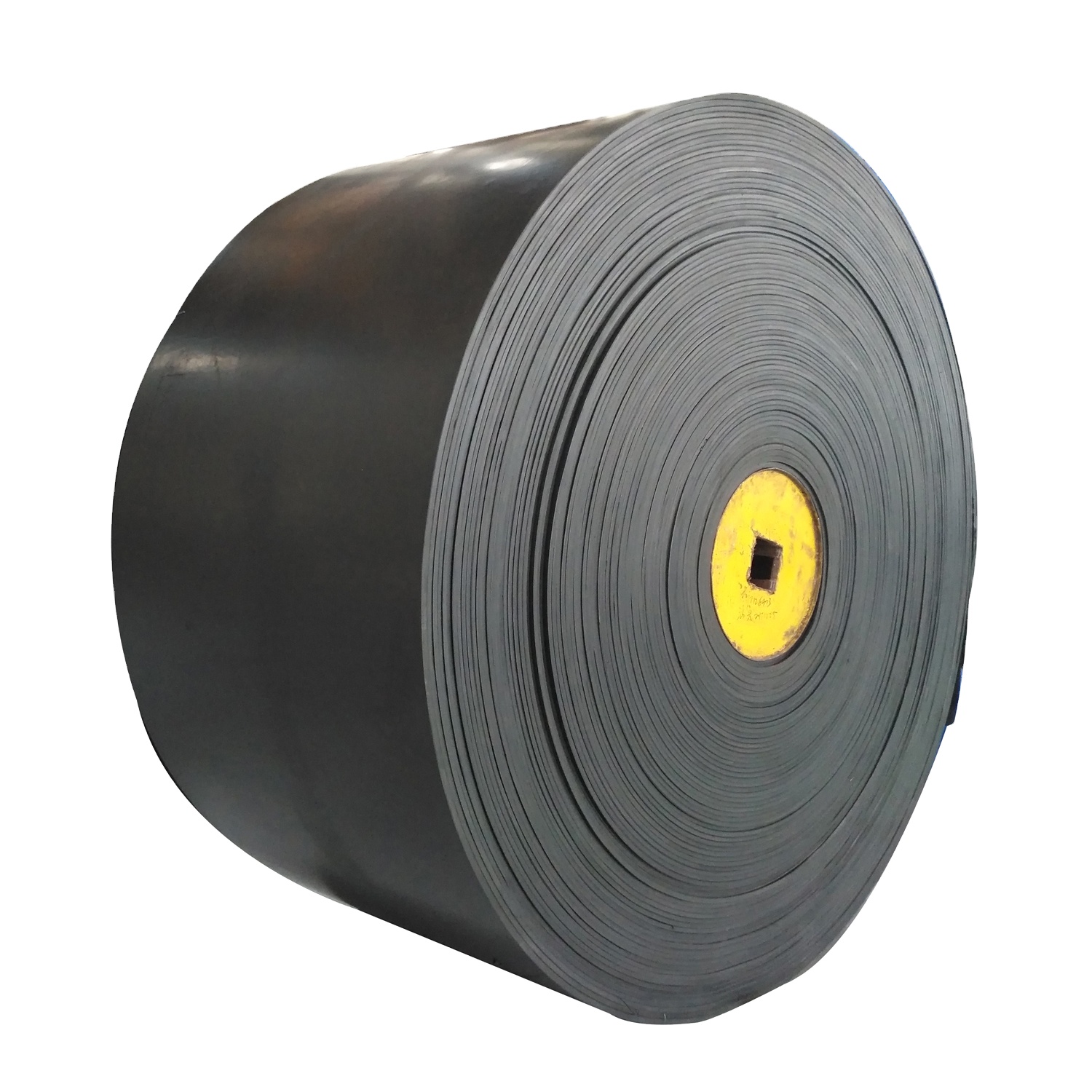
EP80–EP450, multi-ply construction, ISO 14890 scope
Related Reading
Safety factor by duty, splice efficiency, cover grade matching, rip protection
Certification scope, testing capability, production range, references
Budgeting a Conveyor Belt for a Bulk Handling Project?
Send us the material, tonnage, conveyor length, and operating conditions. ZOOMRY engineers will confirm the carcass type, ST or EP grade, cover compound, and belt width — and the cost range that follows from those specifications.
Contact Our Engineers →