 ZOOMRY

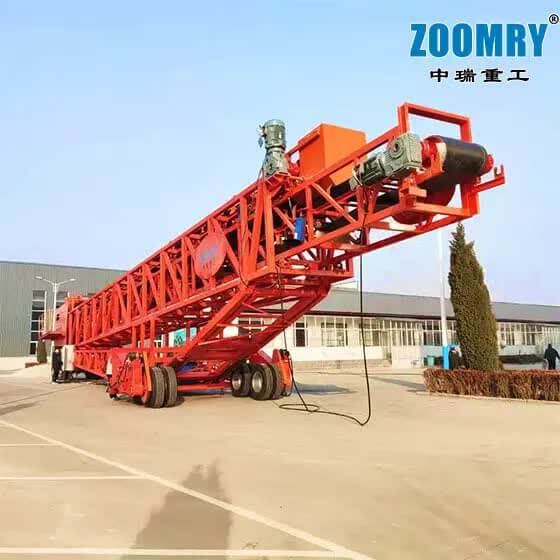
Quick answer: A telescopic conveyor for truck loading cuts dock loading and unloading time by roughly 50%, and operators handling more than three trailers per day typically see payback within 8–14 months. The selection hinges on three variables: boom extension reach (a 40 ft container needs 11.8–13.6 m reach, a 20 ft box truck needs 9.5 m), belt width and speed matched to throughput, and whether the unit is fixed at one door or traverses multiple dock positions. ZOOMRY telescopic conveyor systems cover 800–1,600 mm belt widths with hydraulic extension and 360° slewing for mobile configurations.
Why Truck Loading Is the Highest-ROI Application for a Telescopic Conveyor
A fixed conveyor stops at the dock edge. The operator still walks into the trailer, picks up the load, carries it to the stack, walks back. The conveyor moves material to the door; the manual handling inside the trailer is the bottleneck. A telescopic boom extends the belt into the trailer itself, so the operator stands at the boom tip and places material directly onto the stack. The walking and carrying disappear — the belt does the transport, the operator does the placement.
The time impact is not marginal. Caljan reports its telescopic conveyors cut truck loading and unloading times in half. Hedef Conveyor reports cuts of up to 60% in container loading. A regional distribution centre case documented by Sentao reduced loading time from 90 minutes to 28 minutes per trailer and cut labour per dock door by 50%. The mechanism is consistent: the conveyor replaces the operator’s walking and carrying with belt transport, and the operator’s role shifts to placement and stacking.
The financial return follows the time saving. FMH Conveyors reports payback periods of around 3 months for high-throughput operations. For distribution centres dispatching more than three trailers daily, Hedef estimates full payback within 8 to 14 months through labour savings and faster dock turnaround. Neo Conveyors reports ROI from labour saving alone typically in 6 to 9 months. The range varies with throughput and labour cost, but the direction is consistent: the equipment pays for itself within the first year at moderate volume.
Three Configurations for Truck Loading — and When Each Fits
The telescopic conveyor is not a single product. The undercarriage and mounting determine how the unit serves the dock, and the wrong configuration either wastes capital or fails to reach the trailer.
| Configuration | How it works | Best for | Limitation |
|---|---|---|---|
| Fixed telescopic conveyor | Mounted at one dock door, boom extends into the trailer from a fixed base. | Dedicated high-throughput doors, single-product or single-route loading. | Cannot serve a second door without moving the trailer. |
| Traversing telescopic conveyor | Mounted on a rail or floor track, slides laterally between dock doors. | Multi-door docks where one unit serves several loading positions. | Requires floor space and track infrastructure. |
| Mobile telescopic conveyor | Wheeled or tracked chassis, self-propelled or towable between locations. | Yards, temporary docks, multiple buildings, or sites without fixed dock infrastructure. | Lower throughput than a dedicated fixed unit; mobility hardware adds cost. |
Selection tip: if the dock has three or more doors and the loading schedule is staggered, a traversing unit often replaces two or three fixed units and pays back faster. If the site has no permanent dock or the loading point moves with the project, the mobile configuration is the only one that follows the work.
Boom Reach by Trailer Type — The Specification That Most Quotations Get Wrong
A telescopic conveyor that cannot reach the nose of the trailer leaves the operator walking the last few metres, and the time saving collapses. The required extension reach is determined by the trailer or container type, not by the conveyor’s maximum stroke. Hedef’s trailer compatibility matrix is a useful reference: a 20 ft container or box truck needs roughly 9.5 m reach; a standard 40 ft container needs 11.8–13.6 m; a mega trailer or deep loading bay needs 15.5 m or more. Caljan’s Classic range reaches up to 16 m. FMH’s MaxxReach extends from 14 to 95 feet (4.3–29 m) depending on the model.
| Trailer / container type | Required boom reach (from dock edge) | Typical application |
|---|---|---|
| 20 ft container / box truck | 9.5–11 m | Parcel, carton, sack loading |
| Standard 40 ft container | 11.8–13.6 m | Distribution centre outbound |
| 13.6 m semi-trailer | 13.6–15.5 m | High-volume logistics |
| Mega trailer / deep bay | 15.5 m+ | Double-stack or deep-cavity loading |
Selection tip: specify the reach against the longest trailer the dock will serve, not the average. A conveyor that reaches 12 m handles a 40 ft container but leaves a gap on a 13.6 m trailer; the operator walks the gap, and the ROI case weakens.
Five Specifications to Confirm Before Ordering
Beyond reach, the following five specifications determine whether the conveyor delivers the time saving in daily operation:
-
Belt width and speed matched to throughput. Parcel and carton loading typically runs 600–800 mm belt width at 0.3–0.7 m/s. Bulk or sack loading may need a wider belt and higher speed. Belt width and speed must be sized against the peak trailer rate, not the average shift rate.
-
Hydraulic elevation range. The boom tip must adjust to the trailer floor height and the stack height. Caljan elevates the entire conveyor up to 10°; Hedef’s hydraulic cylinders raise the boom tip up to 2.5 m. Confirm the elevation range covers the difference between your dock height and the trailer floor, plus the stack height at the end of the load.
-
Reversible belt direction. A truck loading conveyor that cannot reverse is a loading conveyor only. Reversible flow lets the same unit unload returns or inbound trailers. If the dock handles both outbound and inbound, specify reversible direction at the order stage — retrofitting is more expensive.
-
Safety devices for the trailer interior. An anti-collision bar at the boom tip stops extension on contact with the operator or the load. Trailer interiors are dark and cramped; LED boom-tip lighting is not optional for night or deep-container work. Confirm both are included, not accessories.
-
Dock integration and control. The conveyor must interface with the dock door, the dock leveller, and any upstream sorting or accumulation line. PLC control with remote diagnostics is the baseline for a multi-shift operation; a standalone push-button unit is adequate only for low-volume single-door sites.
What the Benefits Mean in Operational Terms
The commonly cited benefits of a telescopic conveyor — speed, labour reduction, safety, ergonomics, material protection — are real, but they are outputs of the same mechanism. The conveyor extends to the work point, the operator stops walking, and the belt moves the material. The table below translates the benefits into the operational metric each one affects.
| Benefit | Operational metric affected | Typical reported range |
|---|---|---|
| Faster loading and unloading | Trailer turnaround time per door | 50% reduction (Caljan) to 60% reduction (Hedef) |
| Labour reduction | Operators per dock door | 50% fewer per door in a documented distribution centre case |
| Ergonomic improvement | Absences and injury rates from manual handling | Reduced lifting, twisting, and carrying inside trailers |
| Material protection | Damage and spillage during transfer | Belt transport replaces repeated manual drops and re-handling |
| Space efficiency | Dock footprint when retracted | Retracted boom occupies the base unit only; extension happens only during loading |
Selection tip: the labour saving is usually the largest financial driver, not the time saving alone. A dock that cuts one operator per shift across two shifts recovers the equipment cost faster than a dock that saves minutes but keeps the same headcount.
Frequently Asked Questions
What is the difference between a telescopic conveyor and a fixed conveyor for truck loading?
A fixed conveyor delivers material to the dock edge; the operator still walks into the trailer to place it. A telescopic conveyor extends the belt into the trailer, so the operator works at the boom tip and the belt replaces manual carrying. The time saving comes from eliminating the walking and carrying, not from a faster belt.
How much time can a telescopic conveyor save in truck loading?
Caljan reports loading and unloading times cut in half; Hedef reports up to 60% reduction in container loading. The actual saving depends on the trailer type, the material, and the current manual method. A distribution centre case reduced loading from 90 minutes to 28 minutes per trailer.
What boom reach do I need for a 40 ft container?
A standard 40 ft container typically needs 11.8–13.6 m of extension reach from the dock edge, depending on the dock leveller gap and the container’s internal depth. A 20 ft container or box truck needs roughly 9.5 m. Specify reach against the longest trailer the dock will handle.
Can a telescopic conveyor both load and unload trucks?
Yes, if the belt direction is reversible. A loading-only conveyor cannot unload returns or inbound trailers. Specify reversible direction at the order stage; retrofitting a one-way unit is more expensive than ordering the reversible configuration initially.
What is the typical payback period for a truck loading telescopic conveyor?
Reported payback ranges from around 3 months for high-throughput operations to 8–14 months for distribution centres handling more than three trailers daily, and 6–9 months from labour savings alone in some installations. The range reflects throughput, labour cost, and how many shifts the dock runs.
Related Products
Extendable belt for truck loading and unloading, hydraulic elevation, reversible flow
Boom reach, belt width, and configuration selection for tight-space stacking and loading
Related Reading
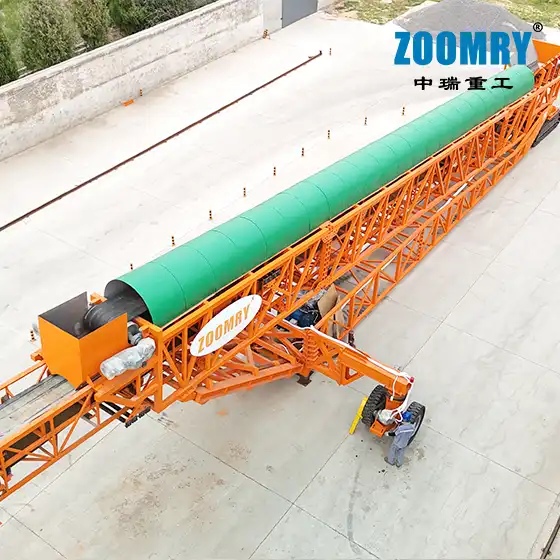
Original benefits overview — retained as a reference for general telescopic applications

Bulk material handling projects across ports, mines, and terminals
Specifying a Telescopic Conveyor for Truck Loading?
Send us your trailer types, dock layout, peak throughput, and whether the unit must serve one door or several. ZOOMRY engineers will confirm the boom reach, belt width, and configuration before you commit.
Contact Our Engineers →