 ZOOMRY

Selecting the right CEMA E idler for extra heavy-duty conveyor applications is critical — the wrong choice leads to premature belt wear, material spillage, and costly downtime. Two of the most commonly specified CEMA E configurations are V-return idlers for the return side and unequal troughing idlers for the carrying side — each designed for fundamentally different conveyor roles. Understanding the difference helps you specify the correct idler for each conveyor section, avoiding mismatched components that compromise system performance.
This guide compares V-return and unequal troughing designs across key selection factors — from operational location on the conveyor to load characteristics and belt width compatibility. Whether you're equipping a new mining conveyor or upgrading existing cement plant idler sets, the comparison below helps you make an informed decision.
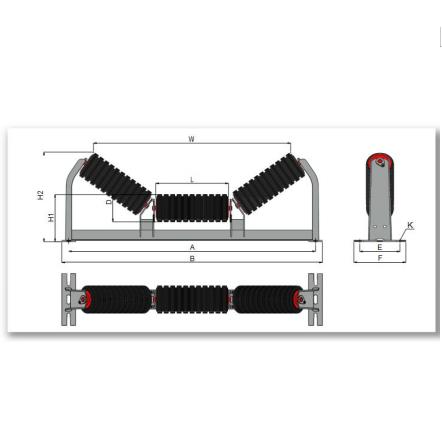
CEMA E V-return idler (left) and unequal troughing idler (right) — different conveyor roles, different roller configurations
V-Return vs Unequal Troughing: Core Difference
The fundamental distinction is straightforward: CEMA E V-return idlers work on the return side of the conveyor, while CEMA E unequal troughing idlers support the belt on the carrying side. This positional difference drives every design decision — from roller angle to frame structure to sealing requirements.
| Comparison | CEMA E V-Return Idler | CEMA E Unequal Troughing Idler |
|---|---|---|
| Conveyor Side | Return side (empty belt) | Carrying side (loaded belt) |
| Primary Function | Self-centering belt tracking, material shedding | Enhanced load support, improved belt alignment |
| Roller Configuration | V-shaped, 2 angled rollers (6" or 7") | 3 rollers — L1 (long center) + L2 (short wings) |
| Belt Width Range | 36" – 96" | 36" – 96" |
| Trough Angles | Fixed V-angle | 20°, 35°, 45° (customizable) |
| Key Benefit | Prevents belt wander, sheds carryback | Distributes material weight, reduces spillage |
When to Choose CEMA E V-Return Idlers?
CEMA E V-return idlers are the correct choice for the return side of extra heavy-duty conveyors where belt tracking and carryback control are critical. The V-shaped roller configuration creates a natural self-centering effect — the belt settles into the V groove, reducing edge wear by up to 40% compared to flat return idlers. This is especially valuable on long overland conveyors and high-speed systems where belt drift can cause catastrophic misalignment.
V-return idlers are ideal for port and terminal conveyors handling coal, grain, and fertilizer where carryback material can create environmental and fire hazards. The angled rollers naturally shed loose material, preventing build-up that causes roller imbalance and premature bearing failure. For mining conveyors transporting iron ore and copper concentrate, V-return idlers withstand abrasive conditions while maintaining belt alignment at speeds up to 6.5 m/s.
When to Choose CEMA E Unequal Troughing Idlers?
CEMA E unequal troughing idlers are designed for the carrying side of conveyors transporting coarse, irregularly sized materials. The offset roller configuration — with a longer center roller (L1) and shorter wing rollers (L2) — provides superior load distribution compared to equal troughing designs. This makes them the preferred choice for run-of-mine ore, crushed stone, and overburden where material size varies significantly throughout each load cycle.
In mining and quarry operations where conveyors run 24/7, unequal troughing idlers reduce edge wear by up to 30% compared to equal configurations. The longer center roller distributes the material load more evenly across the belt width, minimizing stress concentrations that lead to premature belt cracking at the idler junction points. Customizable trough angles of 20°, 35°, and 45° allow operators to match the idler geometry to their specific material characteristics and throughput requirements.
Can You Use Both on the Same Conveyor?
Yes — and in fact, most well-designed extra heavy-duty conveyors use both configurations. A typical CEMA E conveyor installation specifies unequal troughing idlers on the carrying side to manage loaded material, and V-return idlers on the return side to guide the empty belt back to the tail pulley. This combination maximizes both load capacity and belt longevity.
For conveyors with additional tracking requirements, Conveyor idlers such as self-aligning troughing and self-aligning return types can be added at strategic intervals to provide active belt tracking correction. ZOOMRY's engineering team can recommend the optimal idler arrangement based on your conveyor length, belt width, material type, and operating conditions.
Quick Selection Guide by Application
| Application | Carrying Side | Return Side |
|---|---|---|
| Iron Ore / Copper Mining | CEMA E Unequal Troughing | CEMA E V-Return |
| Cement / Limestone | CEMA E Unequal Troughing | CEMA E V-Return |
| Port Coal / Grain | CEMA E Unequal Troughing | CEMA E V-Return |
| Aggregate / Quarry | CEMA E Unequal Troughing | CEMA E V-Return |
Related Solutions
How to Select the Right CEMA E Idlers for Your Conveyor?
Tell us your conveyor layout, material type, and belt width — our engineers will recommend the optimal V-return and troughing idler configuration.
CEMA E Idler Selection Guide →