 ZOOMRY

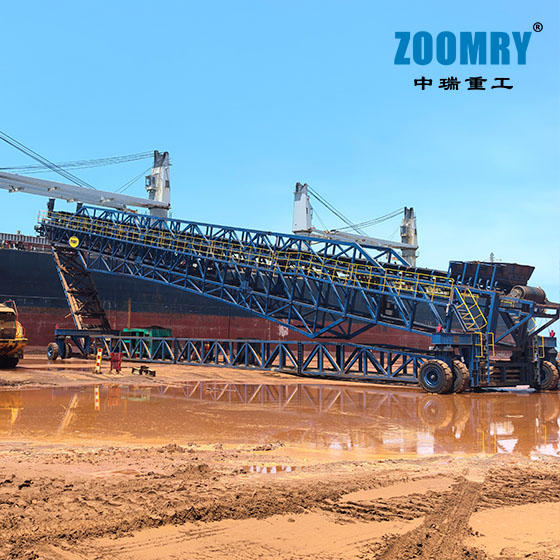
Mobile ship loading solutions are relocatable bulk-material loading systems that transfer dry bulk cargo from shore-side conveyors, hoppers, stockpiles, or truck-fed receiving systems into vessels. They are used at ports, terminals, and temporary quay locations where loading flexibility, phased investment, or reduced permanent infrastructure is important.
Why Mobile Ship Loading for Modern Terminals
Port terminals face increasing pressure to handle more cargo types, serve varying vessel sizes, and remain cost-competitive. Fixed ship loading infrastructure — rail-mounted loaders, dedicated loading towers, and permanent conveyor corridors — requires significant upfront investment and commits the terminal to a specific berth layout.
Mobile ship loading equipment addresses a different set of terminal needs:
- Terminals serving multiple loading positions without dedicated infrastructure at each location
- Ports handling seasonal or project-based export campaigns that do not justify permanent installations
- Inland waterway and river terminals where barge loading requires flexible positioning
- Operations transitioning from truck-to-crane loading to continuous conveyor loading
For these scenarios, mobile ship loaders can reduce the scope of permanent civil works compared with fixed loading infrastructure. Depending on the undercarriage, site access, transport plan, and local operating approvals, the equipment can be repositioned along the quay or redeployed to another project location.
Mobile vs Fixed Ship Loading Infrastructure
| Selection Factor | Mobile Ship Loader | Fixed Loading System |
|---|---|---|
| Upfront investment | Lower — no permanent rail, tower, or conveyor corridor required | Higher — includes civil works, structures, and dedicated conveyors |
| Deployment time | Can reduce permanent civil work scope; actual timeline depends on site readiness | Longer — design, civil construction, installation, and commissioning |
| Berth flexibility | Can serve multiple loading positions where quay layout, travel path, and operating approvals permit | Fixed to one loading position |
| Loading capacity | Project-specific — depends on cargo, conveyor configuration, vessel reach, and terminal interface | Can be engineered for very high continuous capacities |
| Vessel range | Barges to Capesize depending on configuration and vessel geometry | Designed for specific vessel classes |
| Best application | Flexible, phased, or multi-position operations | Dedicated high-volume export lines |
Mobile equipment is not automatically lower in total cost of ownership — utilization rate, cargo volume, and terminal operating pattern determine the economics. For terminals with stable, high-volume loading at a single berth, fixed infrastructure may provide better long-term efficiency. For flexible or phased operations, mobile ship loaders offer a practical path to loading capability without committing to permanent infrastructure.
Configurations for Different Terminal Needs
All-Travel Mobile Shiploader
The all-travel mobile shiploader travels along the quay on a project-specific wheeled or hydraulic undercarriage. It can move between loading positions and, where the travel route and vessel geometry allow, help operators access multiple hatches with less vessel repositioning. This configuration is suited to prepared quay surfaces and terminals that require flexible loading coverage along the berth.
Tracked Ship Loader
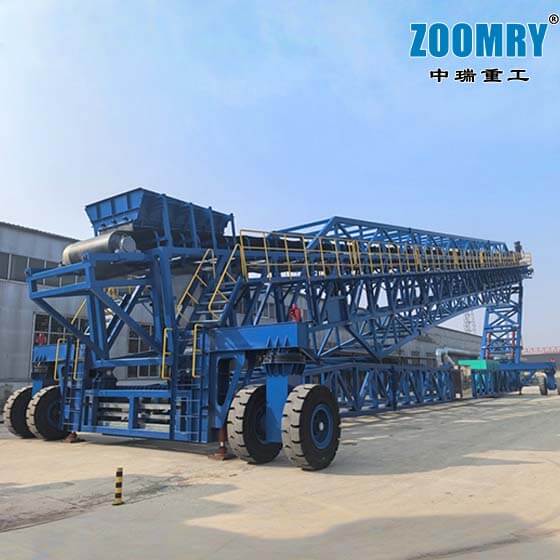
The tracked ship loader uses a crawler undercarriage for locations where ground conditions, access routes, or temporary operating arrangements are less suitable for wheeled travel. Tracks can distribute machine load over a larger contact area, but the quay or operating area must still be assessed for bearing capacity, stability, gradients, and local safety requirements.
Radial Telescopic Shiploader
The radial telescopic shiploader combines radial movement with a telescopic discharge boom. Within its designed operating envelope, it can improve access across vessel holds and help control discharge placement, reducing the frequency of machine or vessel repositioning in suitable berth arrangements.
Project Applications
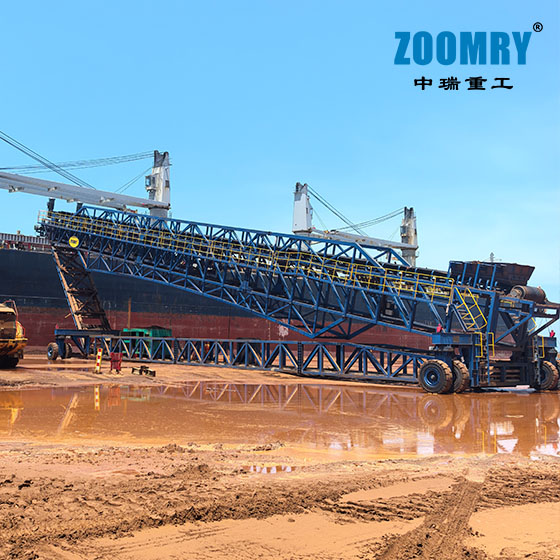
At Bintulu Port in Malaysia, ZOOMRY has presented a mobile ship loading solution for palm kernel expeller (PKE) and palm kernel shell (PKS) handling. The project discussion highlights requirements such as controlled material transfer, dust management, corrosion exposure, vessel access, and available quay space. Final equipment features and performance depend on the confirmed terminal layout and cargo-handling requirements.
Compared with a fully fixed loading installation, a mobile ship loading project can reduce the scope of permanent civil works and may shorten the route to operation when quay preparation, utility connections, cargo feed arrangements, approvals, and commissioning requirements are ready.
Selection Factors for Port Operators
Selecting a mobile ship loading configuration requires evaluating terminal-specific conditions:
- Quay surface condition: Paved quays support wheeled and all-travel configurations; unpaved or soft ground may favor tracked machines.
- Vessel size range: Barge and coaster loading has different reach and capacity requirements than Panamax or Capesize loading.
- Cargo type: Coal, grain, ore, and fertilizer each have specific dust control, wear protection, and corrosion requirements.
- Feed system interface: Truck unloaders, hopper feeders, or fixed conveyors must match the loader's receiving height and capacity.
- Environmental requirements: Dust suppression, enclosed chutes, and water management vary by terminal and local regulation.
- Vessel geometry and berth envelope: Hatch dimensions, vessel beam, air draft, freeboard variation, berth clearance, fender arrangement, and required loading coverage.
- Quay capacity and travel route: Ground bearing capacity, wheel or track loads, gradients, edge-distance limits, drainage, obstacles, and permitted travel path.
For terminals evaluating mobile ship loading, the key is matching configuration to operating pattern. A terminal with one paved quay and stable cargo flow has different requirements from a multi-position operation on unpaved ground. Working through these factors with a manufacturer experienced in port bulk handling helps avoid costly misconfiguration.
Mobile ship loading solutions provide port terminals with a flexible path to bulk cargo loading without committing to permanent infrastructure. All-travel, tracked, and radial telescopic configurations each address different quay conditions and operating patterns. For project-specific recommendations, compare mobile ship loader configurations and explore port terminal bulk handling solutions.
Frequently Asked Questions
Can mobile ship loaders handle Capesize vessels?
Selected configurations may be evaluated for Capesize vessels, subject to the vessel's air draft, hatch geometry, beam, berth clearance, loader reach, quay edge distance, loading-rate requirement, and local port restrictions. Vessel class alone is not sufficient for equipment selection.
What is the typical loading capacity of a mobile ship loader?
Mobile ship loader capacity is project-specific. It is determined by the cargo bulk density and flowability, required vessel loading rate, feed system capacity, conveyor width and speed, boom reach, and terminal operating conditions. Confirm the rated capacity against the selected model and complete loading system.
How long does it take to deploy a mobile ship loader?
Deployment time depends on site preparation, power supply, and feed conveyor interface. Compared with fixed loading infrastructure that requires months of civil construction, mobile equipment can often be positioned and commissioned within a shorter period once the quay surface, utilities, and cargo feed arrangements are ready.
What ground conditions are suitable for a tracked ship loader?
Tracked ship loaders may be selected for unpaved operating areas, temporary loading sites, or conditions where wheeled travel is less suitable. Ground bearing capacity, slope, drainage, stability, quay-edge loading limits, and travel route conditions must be reviewed before deployment.
Related Products
Relocatable bulk loading for ports and terminals
Multi-position loading along the quay without rail infrastructure
Crawler mobility for unpaved and temporary loading sites
Industry Applications
Mobile and fixed conveyor solutions for bulk terminals

Coal loading solutions for export terminals and power supply chains
Need a Mobile Ship Loading Solution for Your Terminal?
Share your cargo properties, target loading rate, vessel GA drawing or hatch dimensions, berth layout, quay bearing capacity, feed arrangement, and environmental requirements. ZOOMRY can help evaluate a suitable mobile ship loading configuration.
Contact Us →