 ZOOMRY

Quick answer: The shafted vs shaftless spiral conveyor decision is driven by the material, not by capacity. Free-flowing dry powders, granules, and small solids (cement, fly ash, grain, sugar) run on a shafted screw conveyor. Sticky, fibrous, stringy, or wet materials (sludge, biomass, wet ash, clay) need a shaftless spiral because the material cannot bridge across a centre pipe. Separately, a spiral conveyor — shafted or shaftless — fits short-to-medium, sealed, low-to-moderate tonnage transfers; for long horizontal runs or steep inclines, an en-masse chain conveyor is the stronger choice. ZOOMRY SSC series shaftless spiral scraper conveyors cover 100–2,000 t/h with 500–800 mm spiral diameters.
Why Spiral Conveyor Selection Starts With the Material, Not the Tonnage
Most spiral conveyor enquiries begin with a capacity figure. That is the second question. The first question is whether the material can be conveyed by a spiral at all — and if so, whether it needs a centre pipe. A shafted screw conveyor has a spiral flight welded to a centre pipe, supported by hanger bearings along the length. A shaftless spiral is a single helicoid with no centre pipe and no hanger bearings inside the trough. The geometry difference decides which materials each design can move.
A shafted conveyor handles free-flowing material well because the material rests in the trough and the flight pushes it forward. A shaftless conveyor handles material that would otherwise wrap around or bridge across the centre pipe — sticky, fibrous, stringy, or wet material that clings to a shaft and blinds the flight. The selection is a material test first, and an equipment comparison second.
Shafted vs Shaftless: The Material-Driven Decision
| Factor | Shafted screw conveyor | Shaftless spiral conveyor |
|---|---|---|
| Material type | Free-flowing dry powders, granules, small solids — cement, fly ash, lime, grain, sugar, sand | Sticky, fibrous, stringy, wet, or sluggish materials — sludge, biomass, wet ash, clay, screenings |
| Why | Material flows in the trough; centre pipe and hanger bearings are not a blockage point | No centre pipe for material to wrap around or bridge across; no hanger bearings to blind the flight |
| Torque capacity | Higher — the centre pipe carries the torsional load | Lower — the spiral alone carries torque, so diameter and flight thickness are sized up |
| Length limit | Longer runs feasible with hanger bearings | Shorter runs; beyond a point the unsupported spiral deflects |
| Wear point | The shaft and flight wear first | The trough liner wears first; the spiral is often the harder component |
| Maintenance | Hanger bearings inside the trough are a maintenance point | No internal bearings; the trough liner is the replaceable wear part |
Selection tip: if the material is dry and free-flowing, the shafted design is lower cost and higher torque capacity. Do not specify shaftless for a free-flowing powder — it gives up torque and length capability without solving a problem the material does not have.
When a Spiral Conveyor Beats an En-Masse Chain Conveyor — and When It Doesn’t
The spiral conveyor is one option among several enclosed transfer methods. The comparison that matters in bulk handling is spiral vs en-masse chain (also called drag or tubular chain conveyor). Both are enclosed, both handle dusty material, and both can run horizontally or on a slight incline. The boundary between them is distance, tonnage, and angle.
| Duty | Spiral conveyor | En-masse chain conveyor |
|---|---|---|
| Run length | Short to medium — metres to tens of metres | Long horizontal legs — up to 100–300 ft in one machine |
| Tonnage | Low to moderate per unit; sealed and metered | High tonnage; lower speed, lower degradation |
| Incline | Horizontal or gentle incline | Steeply inclined or vertical |
| Sealing | Good — enclosed trough or tube | Good — fully enclosed chain path |
| Material | Powders, granules, sticky or fibrous material (shaftless) | Fragile, friable, or high-tonnage bulk where degradation matters |
| Typical use | Metering, short sealed transfer, sanitary or dusty duty | Long horizontal transfer, silo discharge, high-capacity enclosed conveying |
Selection tip: if the duty is short, horizontal, sealed, and low-to-moderate tonnage, the spiral conveyor is the simpler and often lower-cost choice. If the run is long, the tonnage is high, or the route needs a steep incline, the en-masse chain conveyor owns that duty and the spiral will be undersized for the distance.
ZOOMRY SSC Series: Shaftless Spiral Scraper Configuration
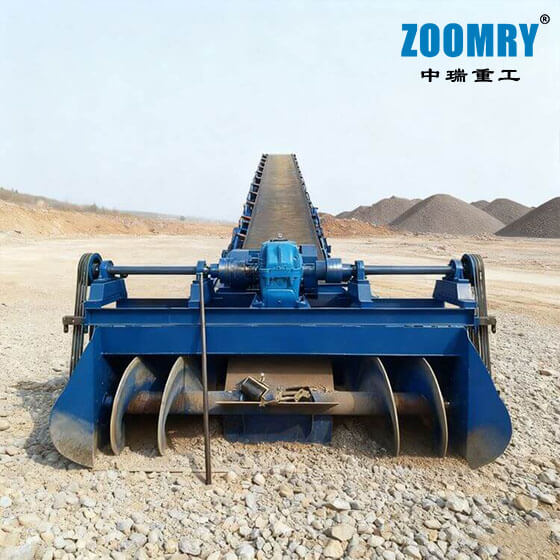
ZOOMRY’s SSC series is a shaftless spiral scraper conveyor for enclosed bulk handling. The range covers 100–2,000 t/h with spiral diameters of 500–800 mm and belt widths of 800–1,400 mm. The shaftless geometry suits sticky, fibrous, and fine materials that would bridge on a shafted design — the applications where a conventional screw conveyor blinds and stalls.
| Configuration | Capacity | Spiral diameter | Application |
|---|---|---|---|
| SSC-ST (standard) | 100–2,000 t/h | 500–800 mm | Fixed installations for powders and granules |
| SSC-TR (tracked) | 100–2,000 t/h | 500–800 mm | Complex terrain, mobile receiving points |
| SSC-GR (grain) | 100–2,000 t/h | 500–800 mm | Low-damage grain handling |
| SSC-LD (loading) | 100–2,000 t/h | 500–800 mm | Loading-optimised discharge |
Selection tip: the SSC-GR grain configuration is specified when crystal or kernel damage matters; the standard SSC-ST is for general powders and granules where breakage is not a constraint. The shaftless geometry is the common thread — it is what allows the SSC series to handle materials that would stall a shafted screw.
Selection Checklist
-
Material first. Free-flowing dry powder or granule → shafted. Sticky, fibrous, stringy, or wet → shaftless.
-
Run length and angle. Short and horizontal → spiral. Long horizontal or steep incline → en-masse chain.
-
Tonnage per unit. Metering and sealed short transfer → spiral. High-tonnage long transfer → chain.
-
Wear part strategy. Shafted: shaft and flight wear. Shaftless: trough liner wears — confirm the liner material and replacement procedure.
-
Sanitary or food-grade requirement. Confirm stainless contact surfaces and cleanable design if the material is food or feed.
-
Explosive dust. Enclosed spiral conveyors handling sugar, flour, or other combustible dust need ATEX-rated construction for the internal atmosphere.
Frequently Asked Questions
When should I choose a shaftless spiral conveyor instead of a shafted screw conveyor?
When the material is sticky, fibrous, stringy, or wet — sludge, biomass, wet ash, clay, or screenings. These materials wrap around the centre pipe of a shafted conveyor or bridge across it, blinding the flight. A shaftless spiral has no centre pipe and no internal hanger bearings, so the material cannot clog the same way.
Can a spiral conveyor handle the same tonnage as an en-masse chain conveyor?
Not at the same run length. A spiral conveyor is suited to short-to-medium runs at low-to-moderate tonnage per unit. An en-masse chain conveyor handles long horizontal legs — up to 100–300 ft in one machine — at high tonnage and low speed. The spiral is the simpler choice for short sealed transfers; the chain owns long and high-tonnage duty.
What is the capacity range of a ZOOMRY SSC series spiral conveyor?
The SSC series covers 100–2,000 t/h with spiral diameters of 500–800 mm and belt widths of 800–1,400 mm. The range spans standard, tracked, grain, and loading configurations.
Is a shaftless spiral conveyor better than a shafted one?
Neither is universally better. Shafted has higher torque capacity and longer length capability for free-flowing material. Shaftless handles sticky and fibrous material that would clog a shafted unit. The material decides which design applies; specifying shaftless for a free-flowing powder gives up torque and length without solving a problem.
Can a spiral conveyor run on an incline?
A spiral conveyor runs horizontally or on a gentle incline. For steeply inclined or vertical duty, an en-masse chain conveyor is the appropriate enclosed transfer method. Specifying a spiral for a steep incline leads to material fallback and reduced capacity.
Related Products
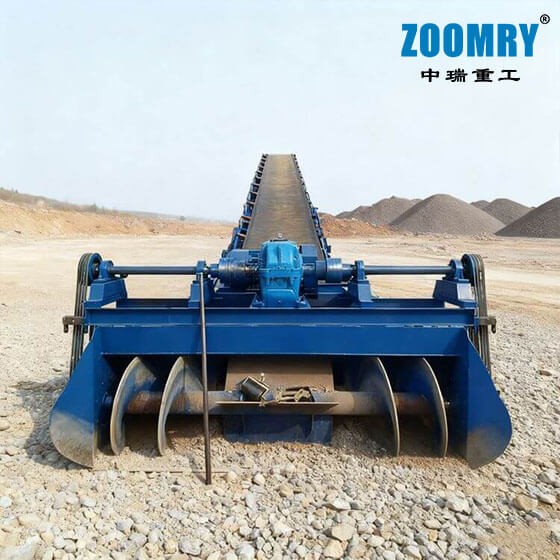
SSC series shaftless spiral, 100–2,000 t/h, 500–800 mm spiral diameter
Application guide for low-damage enclosed conveying of fragile and fine materials
Related Reading
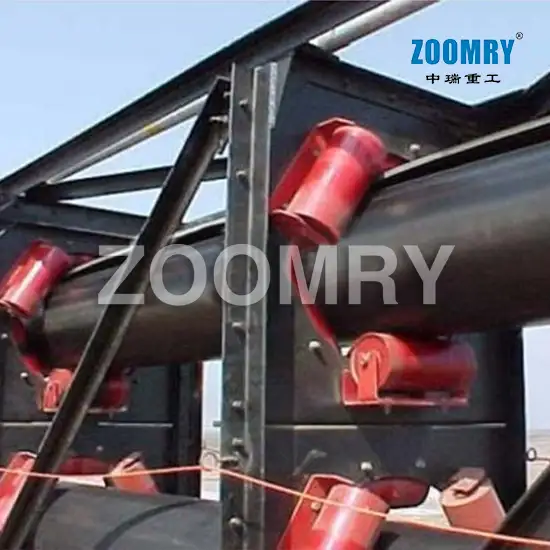
Enclosed conveying selection for dust compliance and complex terrain

Bulk material handling projects across ports, mines, and terminals
Not Sure Whether a Spiral Conveyor Fits Your Material?
Send us the material type, particle size, moisture content, run length, and required tonnage. ZOOMRY engineers will confirm whether a shafted or shaftless spiral is the right fit — or whether an en-masse chain conveyor is the stronger choice for the duty.
Contact Our Engineers →