 ZOOMRY

Quick answer: A hopper feeder is sized by two numbers that are not the same: buffer capacity (how many truckloads it can absorb in a burst) and feed rate (the steady tonnage it delivers to the downstream conveyor). Buffer capacity should cover two to three truckloads in succession — the standard used in ROM hopper design — so trucks do not wait while the feeder catches up. Feed rate should match the station’s target average throughput, not the truck unloader’s peak. ZOOMRY covers 5–24 m³ hopper capacity and 800–3,000 TPH across four configurations: Heavy Duty, Low Feed, Tracked, and Static.
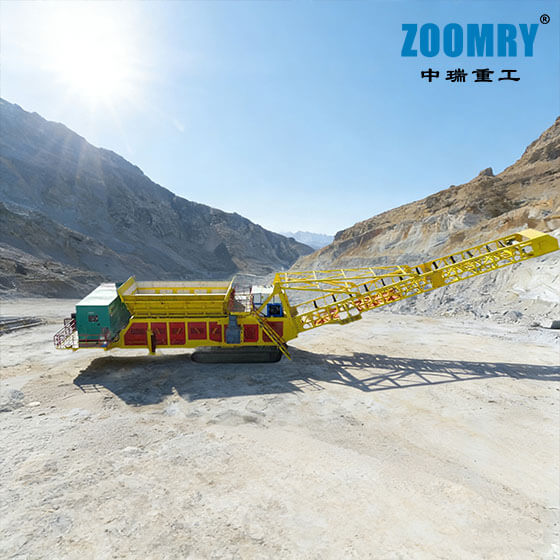
Why Hopper Feeder Selection Is a Buffer Problem, Not a Throughput Problem
Most hopper feeder discussions start with “how many tonnes per hour?” That is the second question. The first question is “how much material arrives at once, and how fast can the downstream conveyor accept it?” A receiving station sits between two processes with different rhythms. Trucks arrive in batches — two or three in a queue, then a gap. The conveyor downstream runs continuously and cannot stop and start with each truck. The hopper feeder is the buffer that decouples the batch rhythm from the continuous rhythm.
If the hopper is too small, the truck cannot complete its dump before the hopper fills, and the next truck waits. If the feeder is too slow, the hopper fills faster than it empties, and the same queue forms. If the feeder is oversized relative to the downstream conveyor, the conveyor becomes the bottleneck and the hopper backs up again. The sizing is a chain — hopper volume, feeder rate, conveyor capacity — and the weakest link sets the station throughput.
Buffer Capacity: How Many Truckloads Should the Hopper Hold?
The standard used in run-of-mine (ROM) hopper design is to size the hopper to receive two to three truckloads in succession. That buffer allows one truck to dump while a second is positioning, without the first truck waiting for the feeder to clear space. The exact volume depends on the truck payload and the material bulk density, but the principle is consistent: the hopper must absorb the arrival burst, not just the average flow.
| Hopper capacity | Truckloads absorbed (approx.) | Typical application |
|---|---|---|
| 5–7 m³ | 1 small dump truck | Low-feed yards, biomass, light aggregate |
| 7–12 m³ | 1–2 trucks | Quarry stockyards, small receiving stations |
| 12–24 m³ | 2–3 trucks | Mining crusher feed, high-volume aggregate plants |
| 24 m³+ (custom) | 3+ trucks | High-throughput port and mine receiving |
Selection tip: size the hopper against the largest single truck payload and the expected arrival pattern, not the average daily tonnage. A hopper that holds exactly one truckload forces the second truck to wait for the first to be fully fed out — the queue is built into the design.
Feed Rate: Match the Conveyor, Not the Unloader
The feeder’s rated capacity and the truck unloader’s rated capacity are measured on different bases. The unloader’s rating is the peak rate at which it can empty a truck. The feeder’s rating is the steady rate it delivers to the downstream conveyor. Sizing the feeder to the unloader’s peak over-specifies the conveyor and wastes capital. Sizing it below the station’s target average starves the conveyor between trucks.
ZOOMRY’s hopper feeder range spans 800–3,000 TPH across the four configurations. The Heavy Duty unit reaches 3,000 TPH with a 12–24 m³ hopper, the Tracked and Static units reach 1,000 TPH, and the Low Feed unit reaches 800 TPH. The headline number matters less than whether the feeder’s steady rate matches the conveyor’s design capacity at the operating hours the station actually runs.
| Configuration | Hopper capacity | Max feed rate | Mobility | Best for |
|---|---|---|---|---|
| Heavy Duty | 12–24 m³ | 3,000 TPH | Fixed or wheeled | Mining crusher feed, high-volume aggregate |
| Tracked | 7–15 m³ | 1,000 TPH | Self-propelled crawler | Multi-berth ports, soft ground, heap leach |
| Static | 5–15 m³ | 1,000 TPH | Fixed installation | Cement plants, fixed conveyor lines |
| Low Feed | 7–12 m³ | 800 TPH | Wheeled (towable) | Wheel loader feeding, low-height sites |
Selection tip: if the downstream conveyor is rated at 1,200 t/h and the station runs 10 hours a day, a 1,000 TPH feeder is adequate for the average — but it will fall behind during the peak arrival burst. The buffer capacity absorbs that gap, not the feeder rate.
Mobility: When the Hopper Feeder Needs to Move
The four configurations differ mainly in how they are mounted, and that determines where they can operate.
-
Static hopper feeder: bolted to a foundation, connected to a fixed conveyor line. The lowest capital cost and the simplest maintenance, but it cannot move. Suits cement plants, fixed quarry stockyards, and permanent receiving stations.
-
Wheeled (Low Feed / Heavy Duty): towable between locations, but repositioning needs a site tractor. Suits sites that move the receiving point occasionally — a few times a month — rather than daily.
-
Tracked: self-propelled crawler, repositions independently in minutes. Suits multi-berth terminals where the receiving point moves between vessels, heap leach pads where the stacking sequence shifts, and unpaved port yards where wheeled equipment cannot operate.
Selection tip: if the receiving point moves more than once a week, the tracked unit pays for itself in relocation time and avoided ground preparation. If the point is fixed for the project life, the static unit is the lower-cost choice and the mobility premium buys nothing.
Material Compatibility: What the Hopper and Feeder Can Handle
The feeding mechanism and wear protection are selected by material, not by capacity. ZOOMRY’s Heavy Duty hopper feeder offers belt or chain plate feeding; the chain plate option handles particle sizes up to 250 mm and abrasive ores where a belt feeder would wear prematurely. The Tracked and Static units use EP 500 belt feeding for particle sizes up to 150–200 mm. Wear-resistant lining (Hardox or ceramic) is specified for abrasive materials — iron ore, granite, copper concentrate — and standard lining for coal, aggregate, and grain.
Selection tip: if the material is abrasive and the particle size exceeds 200 mm, specify chain plate feeding and Hardox lining at the order stage. Retrofitting a belt feeder with wear protection after the first season is more expensive than specifying the right mechanism initially.
Frequently Asked Questions
How do I size a hopper feeder for a truck receiving station?
Size the hopper to absorb two to three truckloads in succession, and size the feeder rate to the downstream conveyor’s target average throughput — not to the truck unloader’s peak rate. The hopper provides the buffer; the feeder provides the steady flow. Sizing either one without the other moves the bottleneck rather than removing it.
What is the difference between a hopper feeder and a surge bin?
A hopper feeder combines a receiving hopper with a metering device (belt or chain plate feeder) that discharges onto a conveyor. A surge bin is a storage vessel that buffers material between two processes, typically with a separate reclaim feeder underneath. In a truck receiving station, the hopper feeder is the compact version that receives, buffers, and meters in one unit.
How many truckloads should a receiving hopper hold?
The standard used in ROM hopper design is two to three truckloads in succession. That buffer lets one truck dump while a second positions, without the first truck waiting for the feeder to clear space. The exact volume depends on truck payload and material bulk density.
When should I choose a tracked hopper feeder instead of a static one?
When the receiving point moves more than once a week — multi-berth terminals, heap leach pads with shifting stacking sequence, or unpaved yards where a wheeled unit cannot operate. A static unit is lower cost for a receiving point that stays fixed for the project life.
What capacity range does ZOOMRY cover for hopper feeders?
ZOOMRY hopper feeders cover 5–24 m³ hopper capacity and 800–3,000 TPH across four configurations: Heavy Duty (12–24 m³, 3,000 TPH), Tracked (7–15 m³, 1,000 TPH), Static (5–15 m³, 1,000 TPH), and Low Feed (7–12 m³, 800 TPH).
Related Products
Heavy Duty, Low Feed, Tracked, and Static — 5–24 m³, 800–3,000 TPH
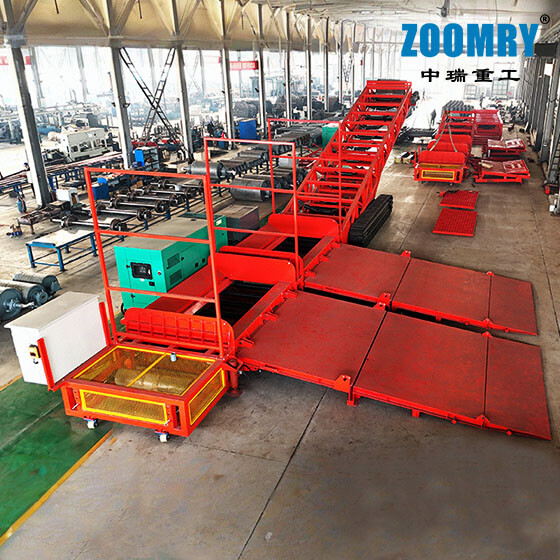
How the unloader and feeder pair to remove the loader bottleneck
Related Reading
Four-configuration selection framework by capacity, mobility, and feed height

Bulk material handling projects across ports, mines, and terminals
Sizing a Hopper Feeder for a Receiving Station?
Send us your truck payload, arrival pattern, downstream conveyor capacity, and whether the receiving point moves. ZOOMRY engineers will confirm the hopper volume, feeder rate, and configuration before you order.
Contact Our Engineers →