 ZOOMRY

Quick answer: Choose a Pipe conveyor for mining when the route crosses residential or environmentally sensitive areas requiring dust emission ≤5 mg/m³, when the terrain needs tight 3D curves (radius down to 150 m) without transfer towers, or when the 10-year total cost of ownership matters more than the 20–35% higher upfront equipment cost. For high-capacity, dust-tolerant materials on straight or gently curved routes, an open trough conveyor remains the more economical choice.
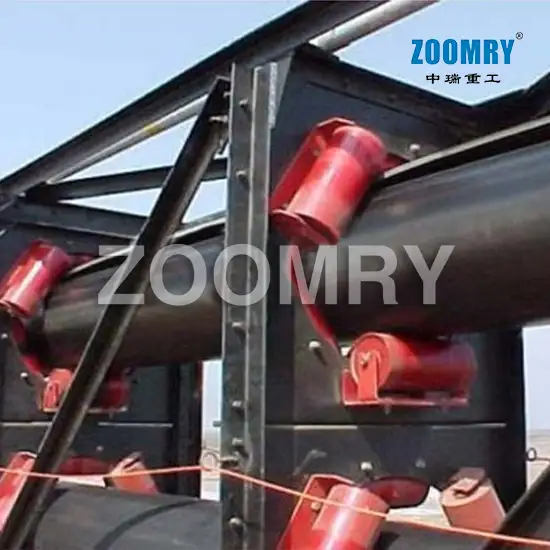
Why the Pipe Conveyor Decision Is Not About "Better or Worse"
A pipe conveyor and an open trough conveyor are not competing technologies in the same application. They solve different problems. A trough conveyor maximizes capacity per belt width on straight or gently curved routes. A pipe conveyor contains the material completely, follows tight 3D curves without transfer points, and protects the material from rain, wind, and contamination.
For a mining project, the decision usually comes down to three hard constraints: dust compliance, terrain complexity, and total cost of ownership over the project life. If none of these constraints are binding, a trough conveyor is almost always the lower-cost choice. If one or more are binding, the pipe conveyor is often the only compliant option.
Decision Factor 1 — Dust Compliance: When the Emission Limit Is the Binding Constraint
Open trough conveyors typically emit 20–30 mg/m³ of dust at transfer points and along exposed sections. Covers and Rain Covers can reduce this, but they do not eliminate leakage, and they add structural cost and maintenance burden. A pipe conveyor encloses the belt into a tubular shape from loading point to discharge point. ZOOMRY's sealed pipe conveyor systems achieve dust emission ≤5 mg/m³ without secondary dust collection equipment.
Project evidence — Shandong coal pipe conveyor: The coal yard is close to residential areas, and the route crossed existing plant facilities with limited space for transfer points. After commissioning, dust emission at the discharge point dropped from 35 mg/m³ to 7.5 mg/m³. The 3D curve capability also eliminated two transfer points that would have been required with a trough conveyor. The system runs 1,568 m at 1,800 t/h through a 400 mm diameter pipe.
Selection tip: If the project is in a residential area, near a water body, or in a jurisdiction with tightening particulate regulations, the pipe conveyor is usually not a "nice to have" — it is the only design that can meet the permit conditions without adding secondary dust suppression infrastructure.
Decision Factor 2 — Terrain Complexity: When Transfer Towers Are Not an Option
Every transfer tower on an open trough conveyor adds $200,000–$500,000 in civil and structural cost, plus a permanent dust generation point and a maintenance access requirement. A pipe conveyor navigates horizontal and vertical curves without transfer points. The sealed belt passes through hexagonal idler panels that maintain the tubular shape while guiding the belt through turns with a radius as tight as 150 m and inclines up to 30°.
Project evidence — Vietnam cement pipe conveyor: A major cement producer replaced an open conveyor with a ZOOMRY pipe belt conveyor. The enclosed design eliminated an annual $120,000 dust suppression water treatment cost and recovered approximately 800 tons of cement dust per year that had previously been lost as airborne particulate.
Selection tip: If the route crosses hills, waterways, roads, or existing plant infrastructure, and the terrain forces more than one or two curves, the pipe conveyor's ability to eliminate transfer towers often makes it the lower-total-cost option even though the belt and idler equipment cost more per meter.
Decision Factor 3 — Total Cost of Ownership: When the 10-Year Number Matters More Than the Invoice
The equipment cost per meter for a pipe conveyor is typically 20–35% higher than an equivalent trough conveyor, because the belt requires reinforced edges and the idler arrangement uses hexagonal panels rather than standard three-roller sets. But that comparison ignores what the pipe conveyor eliminates: transfer towers, dust suppression systems, water treatment, covered galleries, spillage cleanup, and the land acquisition cost of a wider right-of-way.
When those eliminated costs are accounted for, mining projects with two or more curves, environmentally sensitive materials, or steep terrain often show a 15–25% lower total installed cost for pipe conveyors, and a 30–50% lower 10-year operating cost due to the elimination of transfer point maintenance, spillage cleanup, and regulatory compliance expenses.
Selection tip: Do not compare the equipment quotation. Compare the total installed cost including civil works, transfer towers, dust control, and the 10-year operating cost including maintenance, spillage cleanup, and compliance. The pipe conveyor usually wins on the 10-year number in complex-terrain mining projects, and loses on the first invoice.
When a Trough Conveyor Is Still the Right Choice for Mining
The pipe conveyor is not a universal upgrade. For high-capacity, dust-tolerant materials on straight or gently curved routes, the trough conveyor remains more economical. ZOOMRY's 3,300 m iron ore trough conveyor in Chengde (1,400 mm belt, 2,000 t/h, ST3150 steel cord belt, 140 m lift) has operated at 99.3% equipment availability since commissioning, with three horizontal curves handled by self-aligning idler sets. The material is abrasive but not highly dust-sensitive, and the higher capacity per belt width favored the trough design.
Similarly, the 8,617 m curved trough conveyor at Wuxue Southeast Mining (1,200 mm belt, 2,500 t/h, 9 horizontal curves up to 36°) uses self-aligning idlers and a belt turnover device, with unit power consumption around 1.0 kWh/t since 2018. Sand and gravel do not require enclosure, and the capacity requirement favored the open belt.
Selection tip: If the material is not dust-sensitive, the route is straight or has only gentle curves, and the required capacity favors the higher capacity per belt width of a trough conveyor, do not pay for enclosure you do not need. The pipe conveyor premium is justified by constraints, not by default preference.
Quick Selection Checklist
| Condition | Pipe conveyor | Trough conveyor |
|---|---|---|
| Dust emission limit ≤5–10 mg/m³ | Required | Not sufficient without heavy enclosure |
| Route needs tight 3D curves | Radius down to 150 m, no transfer towers | Each curve may need a transfer tower |
| Material is hygroscopic or food-grade | Fully protected | Requires covered gallery (adds 40–60% structural cost) |
| Capacity is the primary constraint | Lower capacity per belt width | Higher capacity per belt width |
| Material is dust-tolerant and route is straight | Over-specification | Lower total cost |
| Project life >10 years with complex routing | 15–25% lower total installed cost, 30–50% lower 10-year operating cost | Higher long-term operating cost |
Frequently Asked Questions
What is the maximum capacity of a ZOOMRY pipe conveyor for mining?
ZOOMRY's pipe conveyor range covers pipe diameters from 100 mm to 850 mm, with belt widths from 430 mm to 3,100 mm. The largest standard configuration handles up to 3,000–4,000 m³/h depending on material bulk density, belt speed, and fill factor. For a specific mining project, the capacity is confirmed against the material's bulk density and particle size distribution.
Can a pipe conveyor handle the same capacity as a trough conveyor at the same belt width?
No. Because the belt is folded into a tube, the pipe conveyor has lower capacity per belt width. To match a trough conveyor's capacity, a pipe conveyor typically requires a larger belt width and pipe diameter. This is the main trade-off: enclosure and curve capability come at the cost of capacity per belt width.
What is the maximum incline for a pipe conveyor in mining?
ZOOMRY pipe conveyors handle inclines up to 30°, compared with approximately 18° for a standard open trough conveyor. This steeper angle shortens the conveyor length and reduces structural steel, civil works, and land acquisition for quarry-to-plant routes with significant elevation change.
Does a pipe conveyor require more maintenance than an open belt system?
Not necessarily. The sealed design protects idlers and bearings from material contamination, often resulting in longer component life. However, accessing the belt for inspection or replacement requires more specialized procedures. For operations with a trained maintenance team, the lower frequency of spillage cleanup and transfer point maintenance often offsets the higher skill requirement.
When should a mining project not choose a pipe conveyor?
When the material is not dust-sensitive (sand, gravel, iron ore), the route is straight or has only gentle curves, and the required capacity favors the higher capacity per belt width of a trough conveyor. In those cases, the pipe conveyor's enclosure premium is not justified by any binding constraint, and the trough conveyor offers a lower total cost.
Related Products
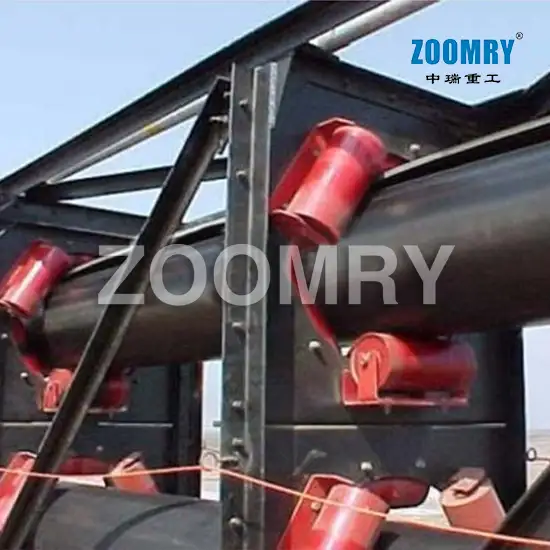
JKGD series, 100–850 mm pipe diameter, dust emission ≤5 mg/m³
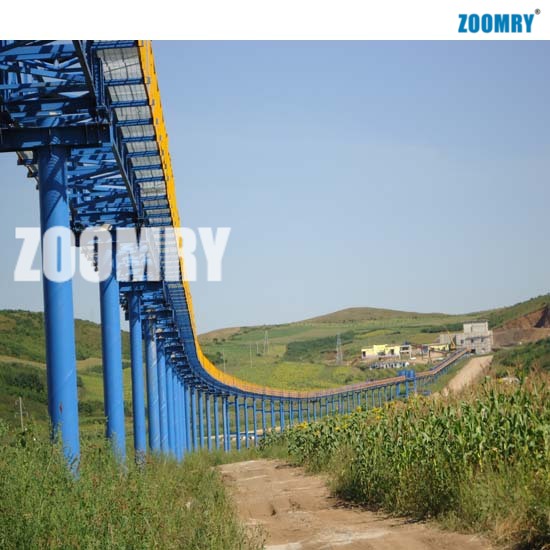
Open trough alternative for dust-tolerant materials on curved routes
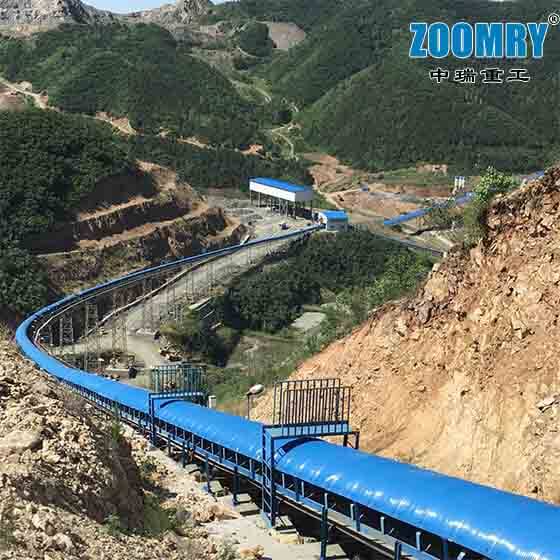
180° curve capability, 400–2,400 mm belt width
Related Reading
Three ZOOMRY installations compared — Shandong coal, Hubei aggregate, Chengde iron ore
Enclosed vs open belt systems, total cost comparison

Bulk material handling projects across ports, mines, and terminals
Not Sure Whether Your Mining Route Needs a Pipe Conveyor?
Send us the material type, capacity, route layout, and dust emission limit. ZOOMRY engineers will confirm whether a pipe conveyor or a trough conveyor is the lower-cost compliant option for your project.
Contact Our Engineers →