 ZOOMRY

Quick answer: A spiral scraper conveyor is an enclosed bulk handling system for fine powders, granules, and fragile materials that open belt conveyors cannot handle without dust loss or breakage. It suits sugar, silica sand, grain, cement, and fly ash, with capacities of 100–2,000 t/h, spiral diameters of 500–800 mm, and belt widths of 800–1,400 mm. The choice between standard, tracked, grain-grade, and loading configurations depends on material sensitivity and site mobility.
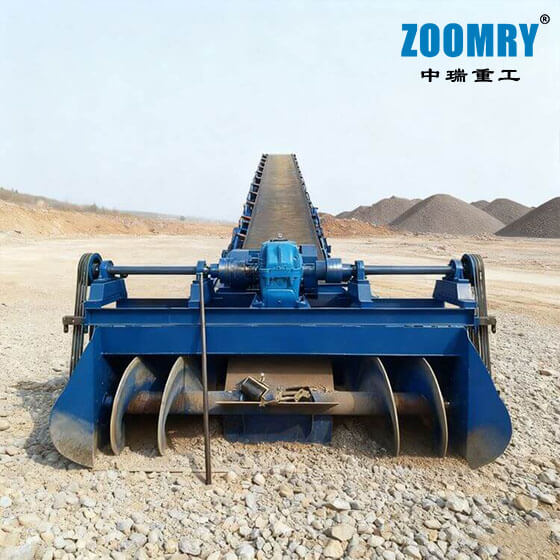
Why Fine Powders and Fragile Materials Need a Different Conveyor
Open belt conveyors work well for coal, ore, and aggregate, but they are a poor fit for three material types:
- Fine powders: cement, fly ash, and mineral powders escape at transfer points and create dust that fails environmental limits.
- Fragile materials: sugar crystals, grain, and food granules break down when dropped or compressed between belt and idler.
- Materials that must stay clean: food-grade and chemical powders cannot be exposed to weather, contamination, or cross-contact.
A spiral scraper conveyor addresses all three by moving material inside a closed trough with a rotating spiral, rather than on an exposed belt. The material is scraped and conveyed along the trough floor, so dust stays enclosed and the material is not dropped between transfer points.
How a Spiral Scraper Conveyor Works
The conveyor uses a rotating spiral (auger) inside an enclosed trough. Material enters through an inlet, is pushed along the trough by the spiral, and discharges at the outlet. The trough can run horizontally or at a slight incline, and the discharge height is set by the outlet position.
ZOOMRY spiral scraper conveyors cover four configurations:
| Model | Type | Capacity (t/h) | Spiral Diameter (mm) | Belt Width (mm) | Typical Use |
|---|---|---|---|---|---|
| SSC-ST | Standard | 100–2,000 | 500–800 | 800–1,400 | Fixed installations for powders and granules |
| SSC-TR | Tracked | 100–2,000 | 500–800 | 800–1,400 | Complex terrain, temporary sites, frequent relocation |
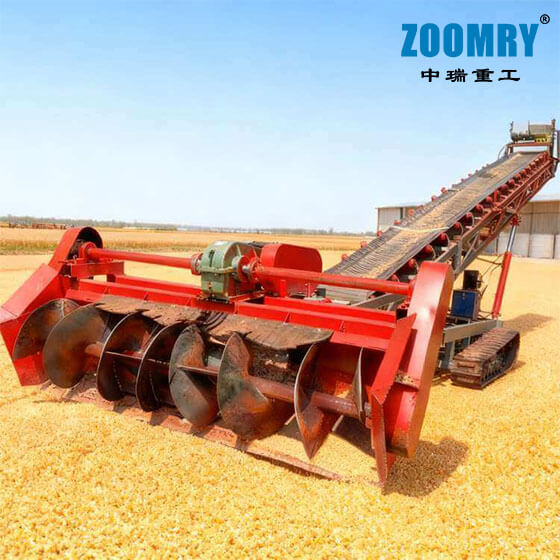
| SSC-GR | Grain-grade | 100–2,000 | 500–800 | 800–1,400 | Low-damage grain handling (wheat, corn, rice) |
| SSC-LD | Loading | 100–2,000 | 500–800 | 800–1,400 | Truck, barge, and stockpile loading |
The tracked configuration runs on crawlers at ≤12 m/min with ground pressure ≤80 kPa. The loading configuration discharges at up to 4.0 m, and the product page range extends to 5.1 m for specific configurations. For model-level detail, see the spiral scraper conveyor page.
Sugar and Grain: Low-Damage Handling
Sugar crystals and grain kernels are fragile. Every drop, impact, or compression point in a conveyor breaks a fraction of the material, and broken crystals or cracked grain reduce the saleable grade.
The grain-grade configuration (SSC-GR) is designed for low-damage handling of wheat, corn, and rice, with a maximum particle size of ≤50 mm. It uses food-grade materials and a polished conveying surface to reduce friction and breakage. For food-grade compliance, the configuration can be specified with EU EC 1935/2004 and FDA-compliant materials, with PTFE anti-stick coating on contact surfaces.
For sugar mills and grain terminals, the spiral scraper conveyor is typically used at the intake, between storage silos, and at the load-out point — the three places where open conveyors cause the most breakage and dust. See the sugar handling page for the broader material handling context.
Silica Sand and Fine Powders: Enclosed and Dust-Free
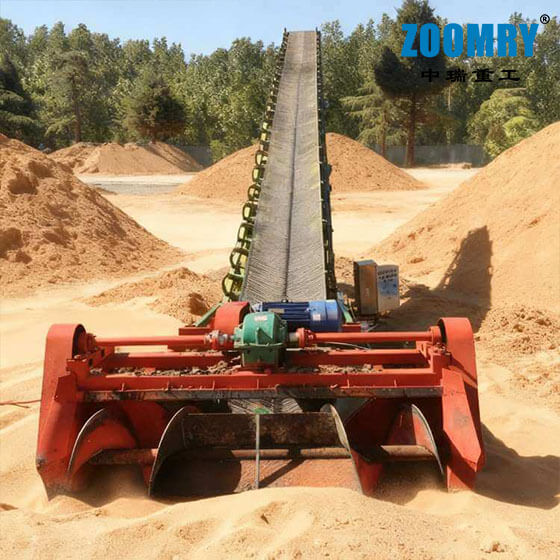
Silica sand is abrasive and dusty. An open conveyor releases respirable crystalline silica at every transfer point, which is both an environmental compliance issue and a worker health issue. A spiral scraper conveyor keeps the material inside a closed trough from inlet to outlet, so the dust stays contained.
The same principle applies to cement, fly ash, and mineral powders. The enclosed trough eliminates the transfer-point dust that open conveyors generate, and the spiral design handles fine, free-flowing materials without the spillage that occurs when a belt is overloaded or mistracked.
For abrasive materials like silica sand, the trough and spiral can be specified with wear-resistant liners. The exact liner material depends on the silica content and particle size, and should be confirmed per project.
Spiral Scraper vs Belt Conveyor vs Pipe conveyor
The three enclosed or semi-enclosed options serve different material and layout requirements:
| Factor | Spiral Scraper Conveyor | Belt Conveyor | Pipe Conveyor |
|---|---|---|---|
| Enclosure | Fully enclosed trough | Open, or covered with Rain Cover | Fully enclosed tubular belt |
| Best material | Fine powders, fragile granules, food-grade materials | Coal, ore, aggregate, general bulk | Powders and bulk that need dust control over long distance |
| Material breakage | Low — no drop between transfer points | Higher — drop and compression at each transfer | Low to moderate |
| Typical capacity | 100–2,000 t/h | Up to 17,000 m³/h | Up to 17,000 m³/h |
| Distance | Short to medium | Short to very long (up to 15 km single flight) | Medium to long |
| Best for | Sugar, grain, silica sand, cement, fly ash | General bulk handling where dust is manageable | Long-distance dust-controlled transport |
For a detailed comparison of pipe and open belt conveyors, see the pipe conveyor vs open belt conveyor article. For the pipe conveyor selection guide, see the enclosed vs open belt systems guide.
Configuration Checklist
| Item | Options / Range |
|---|---|
| Configuration | Standard (SSC-ST), tracked (SSC-TR), grain-grade (SSC-GR), loading (SSC-LD) |
| Capacity | 100–2,000 t/h |
| Spiral diameter | 500–800 mm |
| Belt width | 800–1,400 mm |
| Max particle size | ≤200 mm standard; ≤50 mm grain-grade |
| Discharge height | Up to 4.0 m (loading configuration); up to 5.1 m on specific builds |
| Mobility | Static or tracked (≤12 m/min, ground pressure ≤80 kPa) |
| Power | Project-specific, 380V/50Hz or 440V/60Hz |
| Food-grade option | EU EC 1935/2004 and FDA-compliant materials; PTFE anti-stick coating |
| Remote control | Wireless remote up to 100 m on tracked configurations |
Frequently Asked Questions
What materials are best suited to a spiral scraper conveyor?
Fine powders, fragile granules, and food-grade materials: sugar, grain, silica sand, cement, fly ash, and mineral powders. It is less suitable for large lump sizes or very long conveying distances, where a belt or pipe conveyor is the better fit.
Can a spiral scraper conveyor handle food-grade materials?
Yes. The grain-grade configuration (SSC-GR) can be specified with EU EC 1935/2004 and FDA-compliant materials, plus PTFE anti-stick coating on contact surfaces. Confirm the specific compliance requirement for your market before ordering.
What is the maximum capacity of a ZOOMRY spiral scraper conveyor?
ZOOMRY spiral scraper conveyors cover 100–2,000 t/h across the standard, tracked, grain-grade, and loading configurations, with spiral diameters of 500–800 mm and belt widths of 800–1,400 mm.
Does the tracked version work on soft ground?
Yes. The tracked configuration (SSC-TR) runs on crawlers at ≤12 m/min with ground pressure ≤80 kPa, which suits soft ground, unpaved yards, and temporary sites requiring frequent relocation.
How does a spiral scraper conveyor reduce material breakage?
Material moves along the trough floor by the rotating spiral rather than being dropped between transfer points. Fewer drops and less compression mean less breakage, which matters for sugar crystals, grain, and other fragile materials.
Related Equipment
Related Reading
For sugar handling applications, see sugar conveyor systems. For woodchips and sawdust, see woodchips and sawdust handling. For the broader comparison of enclosed systems, read pipe conveyor vs open belt conveyor. For integrated bulk handling projects, explore the ZOOMRY EPC project case library.
Handling Fine, Fragile, or Food-Grade Materials?
Share your material type, particle size, capacity, and site layout. ZOOMRY engineers will recommend the spiral diameter, configuration, and food-grade options for your application.
Contact Our Engineers →