 ZOOMRY

Quick answer: A Bucket Wheel Stacker Reclaimer handles 500–3,000 m³/h with 8–12 bucket wheels and reclaiming deviation ≤2%, best for fixed or rail-mounted high-capacity stockyards. A radial telescopic stacker handles 500–3,500 m³/h with 10–22 m telescopic boom and 360° slewing, best for flexible stockpiling across multiple piles. Choose bucket wheel for continuous reclaiming; choose radial telescopic for mobile stacking without reclaiming.
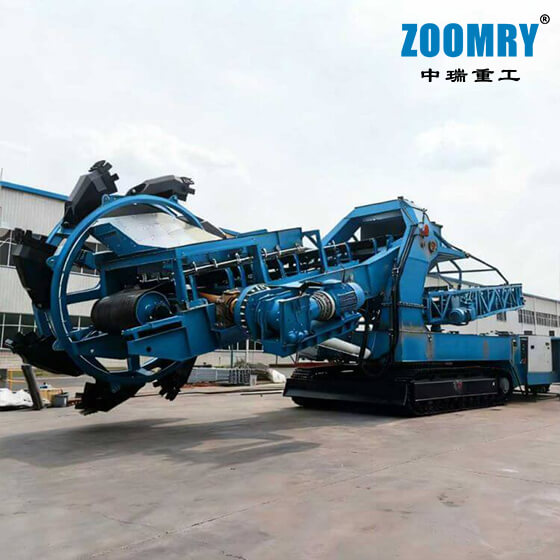
What is a Bucket Wheel Stacker Reclaimer?
A bucket wheel stacker reclaimer is a rail-mounted or fixed machine that stacks bulk material onto a stockpile and reclaims it back to the conveyor system using a rotating bucket wheel. ZOOMRY's BW-SR series covers 500–3,000 m³/h with 8–12 bucket wheels, single bucket capacity 0.25–0.71 m³, and slewing range ±65–360°. Reclaiming deviation stays within 2% with load-adaptive torque control.
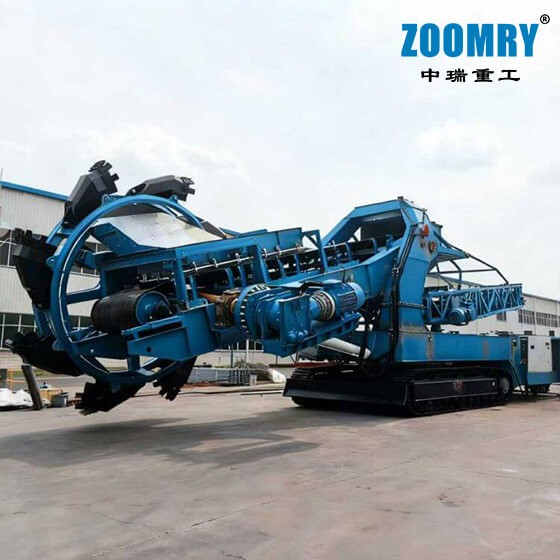
| Parameter | BW-SR (Stacker Reclaimer) | BW-R (Reclaimer) | BW-E (Excavator) |
|---|---|---|---|
| Capacity | 500–3,000 m³/h | 500–3,000 m³/h | 500–3,000 m³/h |
| Bucket wheels | 8–12 | 8–12 | 8–12 |
| Single bucket | 0.25–0.71 m³ | 0.25–0.71 m³ | 0.25–0.71 m³ |
| Installed power | 166–1,410 kW | 75–1,100 kW | 166–1,410 kW |
| Mobility | Fixed / rail-mounted | Tracked | Tracked mine-site |
| Reclaiming deviation | ≤2% | ≤2% | Project-specific |
Selection tip: If the stockyard has a fixed rail layout and the operation needs both stacking and reclaiming from the same machine, BW-SR is the default. If reclaiming precision matters more than stacking flexibility, BW-R is the lighter option.
What is a radial telescopic stacker?
A radial telescopic stacker is a wheeled or tracked stacker with a hydraulic telescopic boom and 360° radial slewing. ZOOMRY's ZR-SF series covers 500–3,500 m³/h with belt widths 800–1,600 mm, telescopic stroke 10–22 m, and stacking height up to 20 m. It stacks but does not reclaim — material is discharged onto the pile and handled separately.
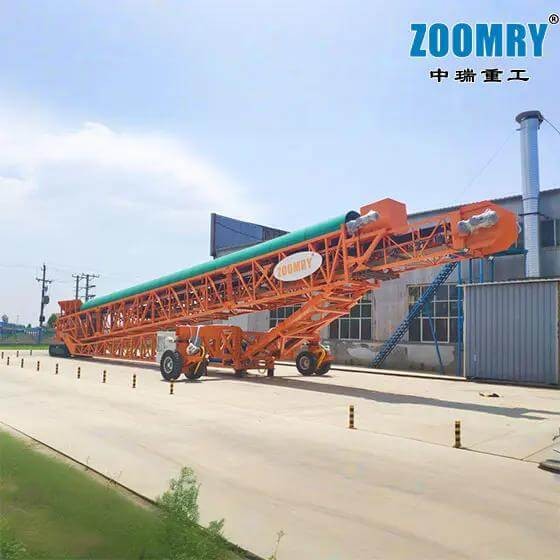
| Model | Belt width | Capacity | Telescopic stroke | Incline |
|---|---|---|---|---|
| ZR80SF | 800 mm | 500 m³/h | 10–22 m | 18° |
| ZR100SF | 1,000 mm | 850 m³/h | 10–22 m | 18° |
| ZR120SF | 1,200 mm | 1,500 m³/h | 10–22 m | 18° |
| ZR140SF | 1,400 mm | 2,100 m³/h | 10–22 m | 18° |
| ZR160SF | 1,600 mm | 3,500 m³/h | 10–22 m | 18° |
Selection tip: If the stockpile layout changes with production and the site needs to move between piles without rail infrastructure, the ZR-SF series is the fit. It does not reclaim, so pair it with a separate reclaimer or wheel loader if reclaiming is required.
Head-to-head comparison
| Factor | Bucket wheel stacker reclaimer | Radial telescopic stacker |
|---|---|---|
| Primary function | Stacking + reclaiming | Stacking only |
| Capacity range | 500–3,000 m³/h | 500–3,500 m³/h |
| Mobility | Fixed or rail-mounted | Wheeled or tracked, 360° slewing |
| Footprint | Large, needs rail or fixed foundation | Compact, no rail required |
| Material | Coal, iron ore, limestone | Coal, ore, aggregate, grain |
| Typical site | Port stockyard, power plant, cement plant | Quarry, mine, temporary stockpile |
| Reclaiming precision | ≤2% deviation | Not applicable |
| CAPEX | Higher (rail + foundation) | Lower (no rail) |
When to choose bucket wheel
Scenario 1: Port stockyard with fixed rail layout. A coal or iron ore terminal that needs continuous stacking and reclaiming from the same machine, with reclaiming deviation under 2%, fits the BW-SR series. The rail layout is fixed, so mobility is not a requirement.
Scenario 2: Power plant coal yard with layered reclaiming. A coal-fired power plant that blends coal from different stockpiles needs precise layered reclaiming. The BW-R tracked reclaimer handles 500–3,000 m³/h with ≤2% deviation and 75–1,100 kW drive power.
Scenario 3: Large-scale mining stockyard. A mine that needs continuous excavation and overburden removal at high capacity uses the BW-E tracked excavator with 0.25–0.71 m³ bucket capacity and tungsten carbide coating for hard rock.
When to choose radial telescopic
Scenario 1: Quarry with changing stockpile layout. A quarry that moves between piles as production shifts needs a wheeled or tracked stacker with 360° slewing. The ZR-SF series covers 500–3,500 m³/h with 10–22 m telescopic stroke.
Scenario 2: Temporary stockpile at a construction site. A construction or civil engineering project that needs to stack aggregate on unpaved ground without rail infrastructure uses the tracked radial stacker with low ground pressure (≤80 kPa).
Scenario 3: Port or terminal without rail. A port that handles multiple berths and needs to reposition the stacker between vessels uses the wheeled radial stacker with 360° slewing and no fixed foundation.
Project evidence
Russia stacker project (8 units ZR-SF): ZOOMRY supplied 8 telescopic stackers to a Russian coal transport group, customized for -35°C operation with low-temperature steel and specialized lubrication. This is a radial telescopic application, not bucket wheel, because the site needed mobile stacking across changing stockpiles.
Wuxue Southeast Mining (8,617 m curved conveyor): The 8,617 m curved conveyor project in Hubei uses a fixed discharge point. Any stacking equipment at the discharge end was outside ZOOMRY's conveyor scope. The project is included here because it shows the fixed-layout pattern where a bucket wheel stacker reclaimer would be the natural fit if reclaiming were added.
Bintulu Port PKE/PKS (Malaysia): The Bintulu Port project uses mobile ship loading with dust suppression, not a stacker reclaimer. This is a port loading application, not a stockyard application — included here to show that not every port project needs a stacker reclaimer.
Selection tip: The project evidence above shows a pattern: fixed rail layout → bucket wheel; mobile or changing layout → radial telescopic. If the site has rail and needs reclaiming, bucket wheel. If the site has no rail and only needs stacking, radial telescopic.
FAQ
Can a radial telescopic stacker reclaim material?
No. A radial telescopic stacker stacks material onto a pile but does not reclaim it. Reclaiming requires a separate reclaimer, wheel loader, or bucket wheel stacker reclaimer. If the site needs both stacking and reclaiming from one machine, choose a bucket wheel stacker reclaimer.
What is the capacity difference between bucket wheel and radial telescopic?
Bucket wheel stacker reclaimers cover 500–3,000 m³/h. Radial telescopic stackers cover 500–3,500 m³/h. The upper range of radial telescopic is slightly higher because the ZR160SF model reaches 3,500 m³/h with a 1,600 mm belt, while the bucket wheel upper range is 3,000 m³/h.
Which one has a lower CAPEX?
Radial telescopic stackers generally have lower CAPEX because they do not require rail infrastructure or a fixed foundation. Bucket wheel stacker reclaimers need rail or a fixed base, which adds civil works and installation cost. For a site without rail, radial telescopic is the lower-cost option.
Can a bucket wheel stacker reclaimer handle grain?
Bucket wheel stacker reclaimers are typically used for coal, iron ore, and limestone. Grain is usually handled by radial telescopic stackers, spiral scraper conveyors, or mobile ship loaders, because grain needs gentler handling and dust control. For grain, choose a radial telescopic stacker or a spiral scraper conveyor.
What is the reclaiming deviation of a bucket wheel stacker reclaimer?
ZOOMRY's BW-SR and BW-R series achieve ≤2% reclaiming deviation with load-adaptive torque control. This means the machine can blend material from different layers with high precision, which is important for power plant coal blending and cement raw meal preparation.
Not Sure Which Stacker Fits Your Stockyard?
Send us your stockpile layout, material type, capacity, and whether reclaiming is required. ZOOMRY engineers will recommend the right configuration and confirm the parameter envelope.