 ZOOMRY

Quick answer: Sugar conveyor systems must solve four problems that general bulk conveyors do not: crystal breakage, combustible dust, moisture ingress, and food-grade hygiene. The right configuration depends on the stage — enclosed spiral scrapers for gentle in-plant transfer, Pipe conveyors for dust-free long-distance transport, and mobile ship loaders with enclosed chutes for terminal loading. No single conveyor type covers the whole chain.
What Makes Sugar Different From Other Bulk Materials
Sugar looks like a free-flowing granular material, but it behaves unlike coal, ore, or aggregate on a conveyor. Four properties change the equipment selection:
- Crystal fragility: raw and refined sugar crystals crack and fracture on impact, and broken crystals reduce the saleable grade. Every transfer point, drop, and compression zone is a potential breakage source.
- Combustible dust: sugar dust is explosive. Inside enclosed conveying lines, the atmosphere can fall into ATEX Zone 20 — the highest dust hazard category — requiring equipment rated for continuous presence of combustible dust.
- Moisture sensitivity: sugar absorbs moisture and cakes. An open conveyor in a humid climate or a rainy port exposes the product to caking and quality loss.
- Food-grade hygiene: contact surfaces must meet food-safety standards, and the conveyor must be cleanable. Standard industrial conveyor materials are not automatically acceptable.
These four requirements rule out a single generic conveyor for the whole chain. The practical answer is a staged system: different conveyor types for different stages.
Stage 1 — Mill Intake and In-Plant Transfer: spiral scraper conveyor
The first stage moves sugar from receiving (truck, rail, or ship unloader) into storage and between processing steps. This is where crystal breakage does the most damage, because the sugar passes through multiple transfer points before it reaches the final silo.
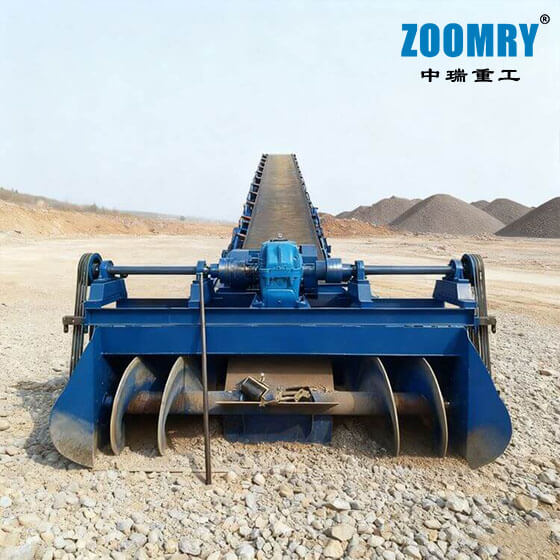
A spiral scraper conveyor moves material along a trough floor with a rotating spiral, rather than dropping it between belt transfer points. Fewer drops means less breakage. ZOOMRY's spiral scraper conveyor for sugar uses food-grade contact materials and an easy-clean design to support HACCP compliance, with a fully enclosed trough that keeps dust in and moisture out.
The capacity range is 100–2,000 tph, with spiral diameters of 500–800 mm. For sugar, the large-diameter spiral runs at low speed to minimize impact, and the enclosed design addresses the ATEX Zone 20 requirement inside the conveying line.
For model-level detail, see the spiral scraper conveyor and the loading configuration pages.
Stage 2 — Long-Distance Transport: Pipe Conveyor
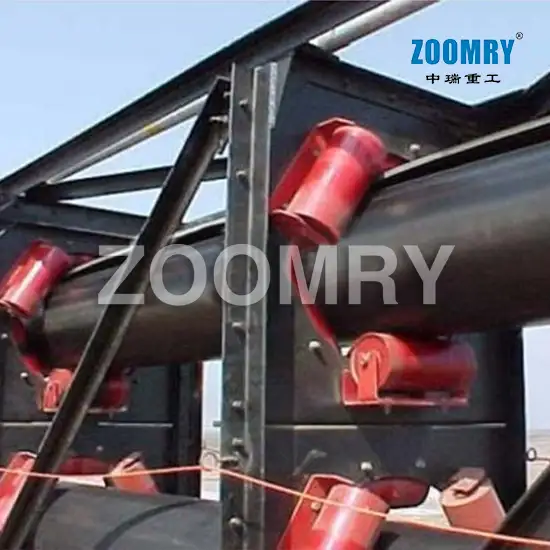
Where sugar must move from a refinery to a storage facility, or across a port or industrial site, the pipe conveyor becomes the better fit. The belt forms a closed tube, so the sugar is fully enclosed from inlet to outlet — no dust escape, no moisture ingress, no spillage on curves.
The tubular design also handles tight horizontal and vertical curves, which matters for refineries built around existing structures. A pipe conveyor can navigate around buildings and over roads without the transfer towers an open belt would require, removing transfer points and therefore removing breakage opportunities.
ZOOMRY pipe conveyors cover 100–850 mm pipe diameters, with the belt width and pipe diameter selected according to capacity and material. For sugar, the enclosed belt also satisfies the dust-containment requirement without needing a separate gallery or enclosure.
For the pipe conveyor range, see the pipe conveyor page. For a comparison of enclosed and open systems, read Pipe Conveyor vs Open belt conveyor.
Stage 3 — Terminal Loading: Mobile Ship Loader With Enclosed Chute
The final stage is vessel loading at an export terminal. Sugar terminals typically load at 250–1,000 t/h, with larger terminals reaching 1,200 t/h or more depending on vessel size and berth arrangement. At this stage, the priority shifts from breakage to dust control and hatch coverage.
A mobile ship loader with a telescopic boom and radial slewing can trim multiple hatches from a single berth position, without moving the vessel. The loading chute is the critical component: an enclosed telescopic chute with dust extraction captures the dust generated at the loading point and prevents it from escaping into the hold or the terminal air.
ZOOMRY mobile ship loaders cover 100–3,500 t/h and serve vessels from barge to Capesize, with enclosed loading chutes and dust suppression. For a sugar terminal, the chute is specified with food-grade contact surfaces and a dust-collection connection, so the same machine that handles the loading rate also handles the hygiene and emission requirement.
For the loader range, see the mobile ship loader page. For the chute component, see the ship loader chute page.
Matching the Conveyor to the Stage: A Comparison
| Stage | Primary requirement | Recommended conveyor | Why |
|---|---|---|---|
| Mill intake and in-plant transfer | Minimal crystal breakage, hygiene, dust containment | Spiral scraper conveyor | No drop between transfer points; enclosed trough; food-grade materials |
| Long-distance transport | Dust-free, moisture-proof, route flexibility | Pipe conveyor | Fully enclosed tube; handles tight curves; eliminates transfer towers |
| Terminal loading | Loading rate, hatch coverage, dust capture | Mobile ship loader + enclosed chute | Radial and telescopic reach; enclosed chute with dust extraction |
There is no single conveyor that covers all three stages well. A spiral scraper is too slow and too short for long-distance transport; a pipe conveyor is not a loading machine; a ship loader cannot perform in-plant transfer. The practical system is a staged combination, selected against the dominant requirement at each stage.
Food-Grade and Explosion-Proof Compliance: What to Specify
Sugar conveying equipment sold into export markets must satisfy two compliance regimes at once:
- Food contact: contact surfaces should meet FDA requirements and EU Regulation EC 1935/2004. For spiral scrapers and chutes, this means food-grade contact materials and a cleanable design; for belts, it means food-grade belt compounds where the belt contacts the sugar.
- Dust explosion: enclosed conveying lines handling sugar dust fall into ATEX Zone 20, requiring equipment rated for that zone. This applies to the conveyor interior, the drive components in the dust atmosphere, and any electrical equipment in the enclosure.
These requirements are not interchangeable. A conveyor can be food-grade and not ATEX-rated, or ATEX-rated and not food-grade. For a sugar terminal, both must be specified on the same equipment. ZOOMRY's sugar handling configurations combine food-grade contact materials with ATEX-rated options; the exact combination is confirmed per project against the terminal's zoning and the destination market's food-safety regulator.
Frequently Asked Questions
What conveyor is best for sugar handling?
There is no single best conveyor. Spiral scraper conveyors suit in-plant transfer because they minimize crystal breakage; pipe conveyors suit long-distance transport because they are fully enclosed; mobile ship loaders suit terminal loading because they combine reach with dust-controlled chutes. The selection depends on the stage.
How do you prevent sugar crystal breakage on a conveyor?
Reduce the number of transfer points and the drop height at each point. A spiral scraper conveyor moves material along a trough rather than dropping it, and a pipe conveyor removes transfer towers by following curves. At the loading point, an enclosed chute with a controlled discharge reduces impact on the sugar stream.
Is sugar dust explosive on a conveyor?
Yes. Sugar dust is combustible, and the interior of an enclosed sugar conveyor can fall into ATEX Zone 20. Equipment for that zone must be rated for continuous presence of combustible dust. Open conveyors avoid the enclosed-atmosphere problem but release dust into the workplace, which is a separate hazard and a compliance issue.
What food-grade standards apply to sugar conveyors?
Contact surfaces should meet FDA requirements and EU Regulation EC 1935/2004. Belts that contact sugar should be food-grade. The conveyor should also be cleanable to support HACCP compliance at the plant level.
What loading rate does a sugar terminal ship loader need?
Sugar terminals typically load at 250–1,000 t/h, with larger terminals reaching 1,200 t/h or more. The required rate depends on vessel size, berth arrangement, and the terminal's target turnaround time. ZOOMRY mobile ship loaders cover 100–3,500 t/h, so the loading rate is selected within that range per project.
Related Products
Low-breakage enclosed transfer for sugar and fragile materials
Fully enclosed long-distance transport with tight curve capability

100–3,500 t/h terminal loading with dust-controlled chute
Related Reading
Selection guide for enclosed low-breakage conveying
Dust control and terrain comparison for enclosed systems

Bulk material handling projects across ports, mines, and terminals
Designing a Sugar Handling System?
Share your stage (mill intake, long-distance transport, or terminal loading), material condition (raw or refined), target capacity, and destination market compliance requirements. ZOOMRY engineers will recommend the conveyor combination for each stage.
Contact Our Engineers →