 ZOOMRY

1. Product Overview
ZOOMRY CEMA B self-aligning troughing idlers provide automatic belt tracking correction on the carrying side via a pivot-mounted frame with side guide rollers. Engineered to CEMA B standards for mining and light industrial conveyors up to 36-inch belt width, these troughing idlers detect belt drift and pivot the entire roller assembly to steer the belt back to center — helping significantly reduce edge wear and material spillage without sensors or external power. Available in 20°, 35°, and 45° trough angles with 4-inch and 5-inch diameter rollers.
Self-aligning idlers are essential for light-duty conveyors in aggregate and sand handling applications where narrow belts and irregular feeding make mistracking a common problem. The pivot mechanism operates continuously — no sensors, no actuators, no operator intervention — making it a practical tracking solution for small to medium conveyor systems.
2. How Pivot-Mounted Self-Alignment Works
On light-duty conveyors with narrow belts, even small frame misalignments or unbalanced feeding can cause the belt to drift laterally. Over time, the belt edge rubs against fixed idler brackets — causing progressive fraying and material spillage along the conveyor path.
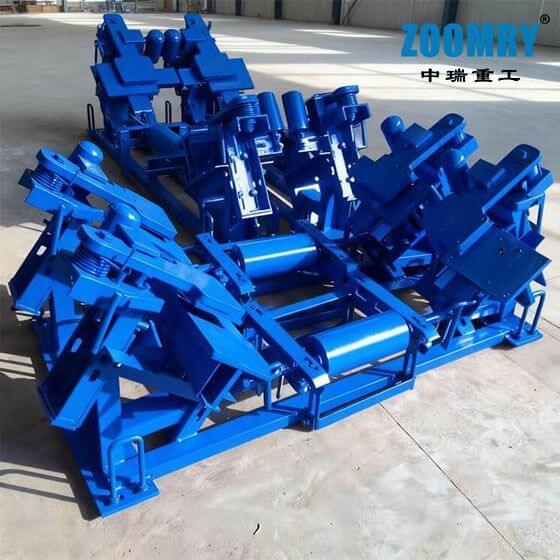
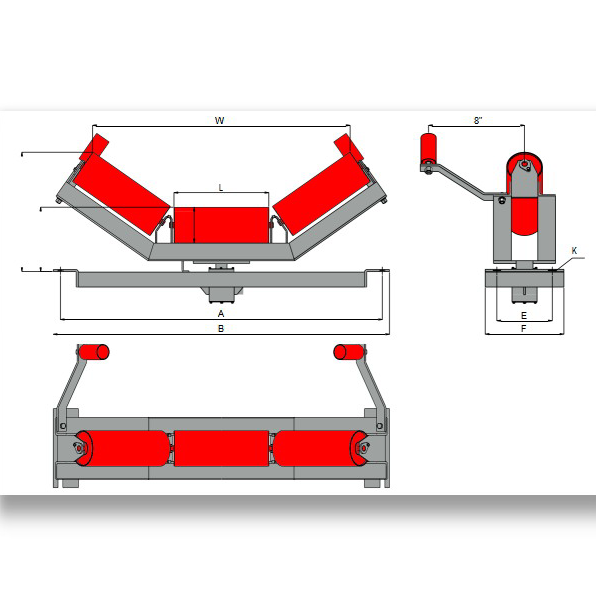
The CEMA B self-aligning troughing idler solves this with a center-pivot frame and two side-mounted guide rollers. When the loaded belt drifts to one side, the corresponding guide roller contacts the belt edge and rotates the entire three-roller assembly — steering the belt back to center within a few belt revolutions. The mechanism is purely mechanical, requiring zero power and minimal maintenance beyond standard bearing lubrication. For cement and light industrial conveyors, this passive correction is often sufficient to maintain tracking without the complexity of powered alignment systems.
3. Key Features
Pivot-Mounted Three-Roller Assembly — Entire troughing set rotates around a center pivot when guide rollers detect belt drift, helping significantly reduce carrying side edge wear compared with standard fixed troughing idlers.
Side Guide Rollers — Vertical rollers at both belt edges act as mechanical sensors — no electronic components to fail in dusty or high-vibration environments common in coal and aggregate handling.
CEMA B Light-Duty Rating — 4-inch and 5-inch diameter rollers engineered for belt widths up to 36 inches — suitable for small to medium conveyors in mining and industrial applications.
Three Trough Angles — Available in 20°, 35°, and 45° to match existing carrying idler geometry, ensuring seamless integration into standard CEMA B conveyor structures.
Fully Passive Operation — No sensors, no actuators, no wiring — purely mechanical pivot design for continuous tracking correction without external power or operator attention.
4. Self-Aligning Troughing vs Standard Troughing (CEMA B)
| Feature | CEMA B Self-Aligning Troughing (B2) | CEMA B Equal Troughing (B7) |
|---|---|---|
| Frame Type | Center-pivot with guide rollers | Fixed rigid frame |
| Belt Tracking | Active automatic correction | Passive — frame alignment dependent |
| Edge Wear | Significantly reduced | Baseline — no corrective action |
| Installation Spacing | Every 25–40 m on longer conveyors | Standard 1–1.2 m spacing |
| Best For | Narrow belts, irregular feeding, mistracking-prone sections | Standard straight conveyor sections |
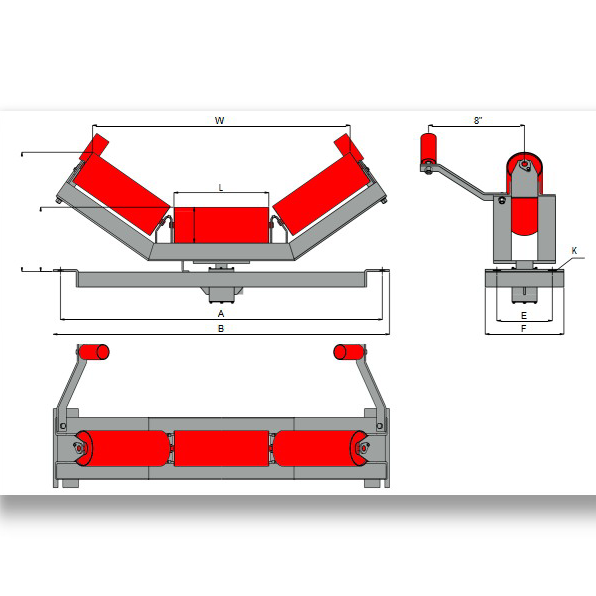
5. Dimensions – CEMA B Self-Aligning Troughing 20° / 35° / 45°
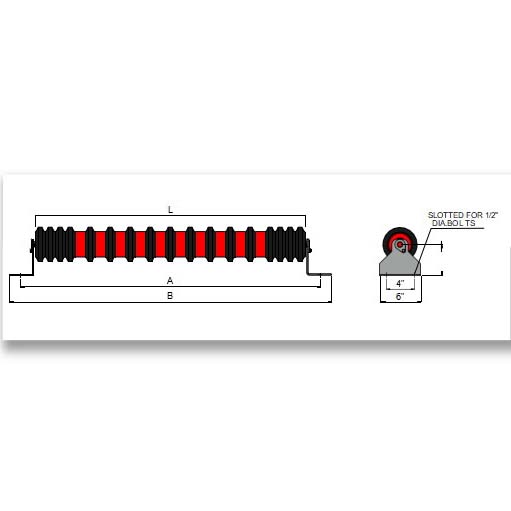
ZOOMRY CEMA B self-aligning troughing idlers are manufactured with 4-inch and 5-inch roller configurations for belt widths from 18 to 36 inches at all three standard trough angles. Suitable for light-duty CEMA B carrying sections in mining, aggregate, cement, and industrial conveyors:
|
|
4" Roller | 5" Roller |
|
||||||||||
|---|---|---|---|---|---|---|---|---|---|---|---|---|---|
| Angle | BW | A | B | L | H1 | H2 | W | H1 | H2 | W | E | F | K |
| 20° | 18 | 27 | 29 | 6 3/4 | 7 1/2 | 9 15/16 | 20 11/16 | 8 | 10 7/16 | 20 3/8 | 6 | 11 | 5/8 |
| 24 | 33 | 35 | 9 1/16 | 8 7/8 | 12 1/8 | 27 11/16 | 9 3/8 | 12 9/16 | 27 3/8 | 6 | 11 | 5/8 | |
| 30 | 39 | 41 | 11 1/8 | 8 15/16 | 12 7/8 | 33 7/16 | 9 7/16 | 13 5/16 | 33 1/8 | 6 | 11 | 5/8 | |
| 36 | 45 | 47 | 13 1/4 | 8 15/16 | 13 9/16 | 39 3/16 | 9 7/16 | 14 | 38 7/8 | 6 | 11 | 5/8 | |
| 35° | 18 | 27 | 29 | 6 3/4 | 7 1/2 | 11 7/16 | 15 15/16 | 8 | 11 7/8 | 18 3/8 | 6 | 11 | 5/8 |
| 24 | 33 | 35 | 9 1/16 | 8 7/8 | 14 1/8 | 25 1/16 | 9 3/8 | 14 11/16 | 24 11/16 | 6 | 11 | 5/8 | |
| 30 | 39 | 41 | 11 1/8 | 8 15/16 | 15 5/16 | 30 13/16 | 9 7/16 | 15 7/8 | 30 | 6 | 11 | 5/8 | |
| 36 | 45 | 47 | 13 1/4 | 8 15/16 | 16 7/16 | 36 7/16 | 9 7/16 | 17 | 35 1/4 | 6 | 11 | 5/8 | |
| 45° | 18 | 27 | 29 | 6 3/4 | 7 1/2 | 12 5/8 | 17 1/4 | 8 | 12 15/16 | 16 9/16 | 6 | 11 | 5/8 |
| 24 | 33 | 35 | 9 1/16 | 8 7/8 | 15 9/16 | 23 5/16 | 9 3/8 | 15 15/16 | 22 3/4 | 6 | 11 | 5/8 | |
| 30 | 39 | 41 | 11 1/8 | 8 15/16 | 17 | 28 9/16 | 9 7/16 | 17 3/8 | 27 5/8 | 6 | 11 | 5/8 | |
| 36 | 45 | 47 | 13 1/4 | 8 15/16 | 18 3/8 | 33 11/16 | 9 7/16 | 18 3/4 | 33 | 6 | 11 | 5/8 | |
Dimensions per CEMA B industry standards. A=Frame width, B=Overall width (including guide rollers), L=Roller length, H1=Base height, H2=Overall height, W=Center-to-center mounting width, E/F/K=Mounting dimensions. B values are larger than standard fixed troughing idlers due to pivot frame and guide roller assembly. All dimensions in inches.
What Information Do We Need for Self-Aligning Idler Selection?
- Belt width, conveyor length, and current tracking issues
- Material type, loading pattern, and mistracking severity
- Trough angle and idler spacing requirements
- Operating environment — dust, moisture, and temperature range
- Existing idler type, frame dimensions, and whether this is a retrofit or new installation
Related Solutions

Need Self-Aligning Idlers for Your Light-Duty Conveyor?
Tell us your belt width, conveyor length, and tracking issues — our engineers will recommend the optimal self-aligning idler placement and configuration.
Request Tracking Idler Recommendation →