 ZOOMRY

Wondering which hopper feeder configuration fits your 2026 project? ZOOMRY manufactures four distinct hopper feeder types — Heavy Duty, Low Feed, Tracked, and Static — spanning 5 to 24 m³ capacity and 800 to 3,000 TPH. Each type addresses a fundamentally different operational challenge: maximum throughput, low-height accessibility, mobile multi-berth flexibility, or permanent fixed installation. This guide provides a structured selection framework comparing each type by capacity, mobility, feed height, and application scenario to help you match the right equipment to your specific operating conditions.
A hopper feeder serves as the critical interface between front-end loading equipment and back-end conveying systems. In a typical mining operation, the feeder receives material from wheel loaders, excavators, or grab cranes and transfers it at a controlled rate to belt conveyors, telescopic stackers, or mobile ship loaders. The wrong choice leads to either over-investment in unnecessary mobility features or under-sizing that creates production bottlenecks costing thousands per hour in lost throughput.
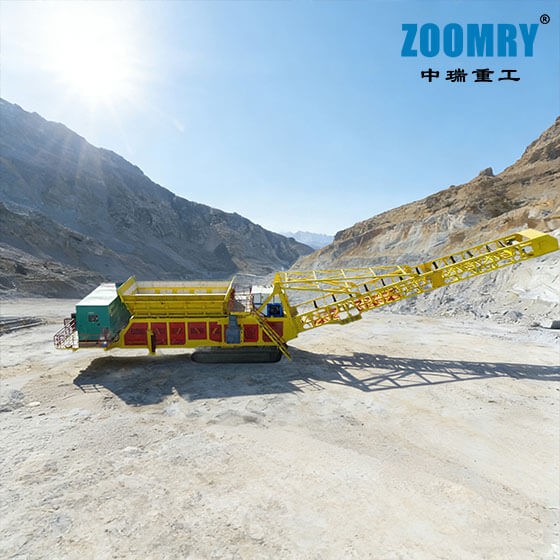
ZOOMRY Hopper Feeder Series — Four Configurations for Different Bulk Material Reception Scenarios
Hopper Feeder Type Comparison at a Glance
| Decision Factor | Heavy Duty | Low Feed | Tracked | Static |
|---|---|---|---|---|
| Max Capacity | 3,000 TPH | 800 TPH | 1,000 TPH | 1,000 TPH |
| Hopper Range | 12–24 m³ | 7–12 m³ | 7–15 m³ | 5–15 m³ |
| Min Feed Height | Standard | 1.2–1.5 m | Standard | Standard |
| Mobility | Wheeled / Crawler | Wheeled (towable) | Self-propelled Crawler | Fixed / Wheeled |
| Feeding Mechanism | Belt / Chain Plate | EP 500 Belt | EP 500 Belt | EP 500 Belt |
| Max Particle Size | ≤ 250 mm | ≤ 200 mm | ≤ 150 mm | ≤ 200 mm |
| Tilting Arm | 15–24 m | 20–28 m | 15–28 m | N/A (fixed connection) |
| Special Feature | Chain plate for abrasives | Rear loading, wide inlet | 360° slewing optional | MTBF > 8,000 hrs |
| Ideal Application | Large mines, deep-water ports | Underground, biomass yards | Multi-berth ports, quarries | Cement plants, fixed lines |
When Should You Choose a Heavy Duty Hopper Feeder?
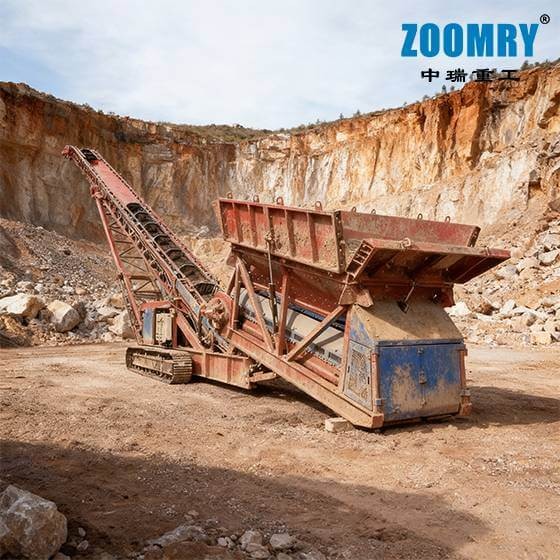
Heavy Duty Hopper Feeder — 12–24 m³ Capacity, 3,000 TPH for Iron Ore, Granite, and Coal
The Heavy Duty Hopper Feeder is engineered for operations where high throughput and maximum durability are non-negotiable. With a 12–24 m³ hopper and 3,000 TPH capacity, it handles iron ore, granite, and coal with particle sizes up to 250 mm without additional crushing pretreatment. The dual feeding options represent a critical specification decision: heavy-duty EP 800 belt (1,400 mm wide, 5-layer, 8mm+2mm construction) for medium-wear materials like coal and cement clinker — or 8 mm hardened steel chain plate with ceramic-lagged drive rollers for highly abrasive ores where belt life would otherwise be measured in months.
This model is the correct choice when: your operation runs 24/7 in large-scale mining environments; you need to feed multiple downstream conveyors simultaneously from a single receiving point; or your material characteristics (high abrasion, large particle size, impact loading from heavy dump trucks) would destroy standard feeder belts. The 15–24 m tilting arm with lattice-type or folded-plate heavy-duty framework reaches discharge heights of 5.5–8.2 m, matching large stacker-reclaimers and ship loaders at deep-water berths.
Low Feed vs Static: Which Feeder Matches Your Fixed-Plant Requirements?
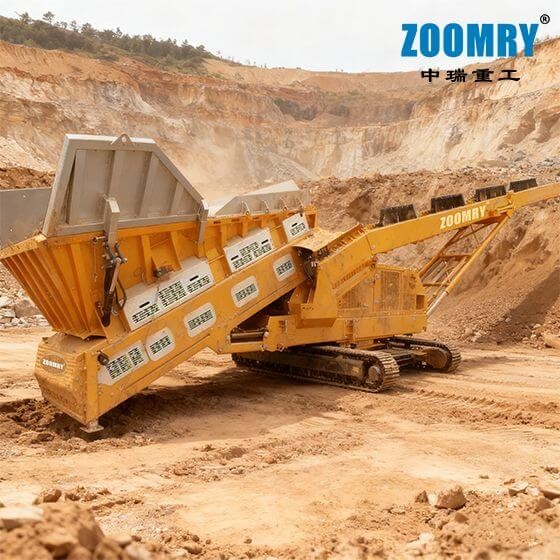
Low Feed Hopper Feeder — 1.2 m Feed Height with Wide Rear Inlet
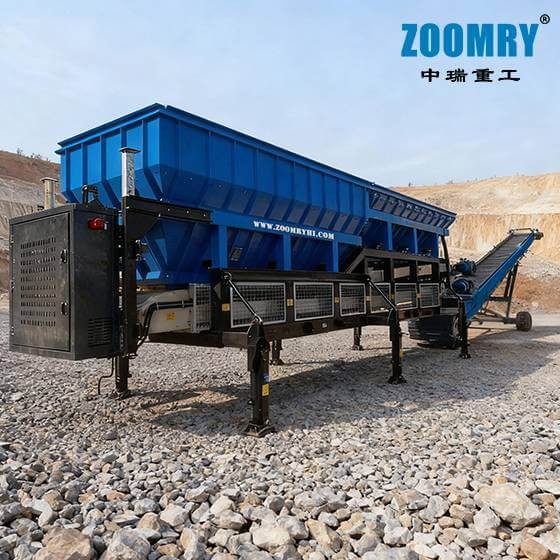
Static Hopper Feeder — Fixed or Wheeled, MTBF > 8,000 Hours
For operations with limited vertical clearance — underground mine roadways with 2.5–3 m clear height, low-ceilinged workshops, or biomass yards using 20–30 ton class wheel loaders — the Low Feed Hopper Feeder solves a critical accessibility problem. Its 1.2–1.5 m feed height allows small/medium loaders to discharge directly without ramps or lifting equipment. The 3.5–4.2 m wide rear-feeding inlet means loaders don't need precise alignment — a practical advantage that reduces per-cycle dumping time by 30–40% compared to narrow-inlet hoppers. With a 20–28 m tilting arm reaching discharge heights of 9.1–13.4 m, it feeds grasshopper conveyors and mobile ship loaders directly.
In contrast, the Static Hopper Feeder is optimized for permanent installations where the feeder stays in one location for years — cement plants, fixed aggregate quarry crushing lines, and processing facilities. The static direct-drive design eliminates redundant transmission components, pushing mean time between failures (MTBF) beyond 8,000 hours. With a 5–15 m³ hopper (expandable to 6.3–18 m³ in stacked configuration) and 1,000 TPH capacity, it delivers variable-frequency-controlled feeding speed with error within ±5% for precise batching applications. The IP65-rated electrical system withstands high-dust and high-humidity environments without additional enclosure costs.
What Makes a Tracked Hopper Feeder the Right Choice for Multi-Location Operations?

Tracked Hopper Feeder — Self-Propelled Crawler, Optional 360° Rotation, 1,000 TPH
When your operation spans multiple berths, stockpile zones, or irregular terrain, the Tracked Hopper Feeder provides self-contained mobility that eliminates the need for towing equipment or crane relocation. The tracked undercarriage delivers ground contact pressure as low as 0.08 MPa across a 2.8 m² contact area — stable on gravel slopes up to 15° and soft port ground where wheeled equipment would sink. Hydraulic adjustable jack outriggers stabilize the unit during operation, then retract for track-driven movement with a minimum turning radius of 3.5 m — tight enough for narrow port terminal corridors and underground mine passages.
The optional 360° central slewing bearing transforms the operational envelope: a single tracked feeder covers a 30–50 m diameter range (depending on tilting arm length), feeding multiple ship holds or stockpile zones without repositioning the chassis. This capability is particularly valuable in port terminals where one unit can service sequential vessel loading operations. Dual track options — steel for hard abrasive mine ground, rubber for protecting concrete quayside surfaces — provide flexibility without compromising mobility.
Decision Framework: How to Pick the Right Feeder in 4 Steps
Step 1 — Confirm throughput and material: Calculate required TPH based on downstream equipment capacity. For >1,500 TPH of heavy ore, the Heavy Duty with chain plate is the only viable option. For <1,000 TPH of aggregates or biomass, Low Feed, Tracked, or Static models all qualify — move to Step 2.
Step 2 — Assess site constraints: Measure vertical clearance at the feeding point. If <2.5 m (underground, low-ceiling buildings), the Low Feed is required. If ground is unpaved, sloped, or soft, the Tracked model's crawler chassis prevents sinking and slippage. For flat, paved, permanent sites, Static or Heavy Duty wheeled configurations are more cost-effective.
Step 3 — Evaluate mobility needs: Will the feeder serve one fixed location for years, or move between positions daily/weekly? Fixed operations favor Static (lowest maintenance, highest MTBF). Frequent relocation favors Tracked (self-propelled, no towing). Occasional repositioning favors wheeled Heavy Duty or Low Feed configurations.
Step 4 — Match feeding mechanism to material abrasiveness: Non-abrasive to medium-abrasive materials (coal, clinker, aggregates) work well with EP 500/EP 800 belt feeders. Highly abrasive materials (iron ore, granite, quartzite) require the hardened steel chain plate option available on the Heavy Duty model. Selecting the wrong mechanism leads to either premature belt failure or unnecessary chain plate investment.
Related Industry Solutions
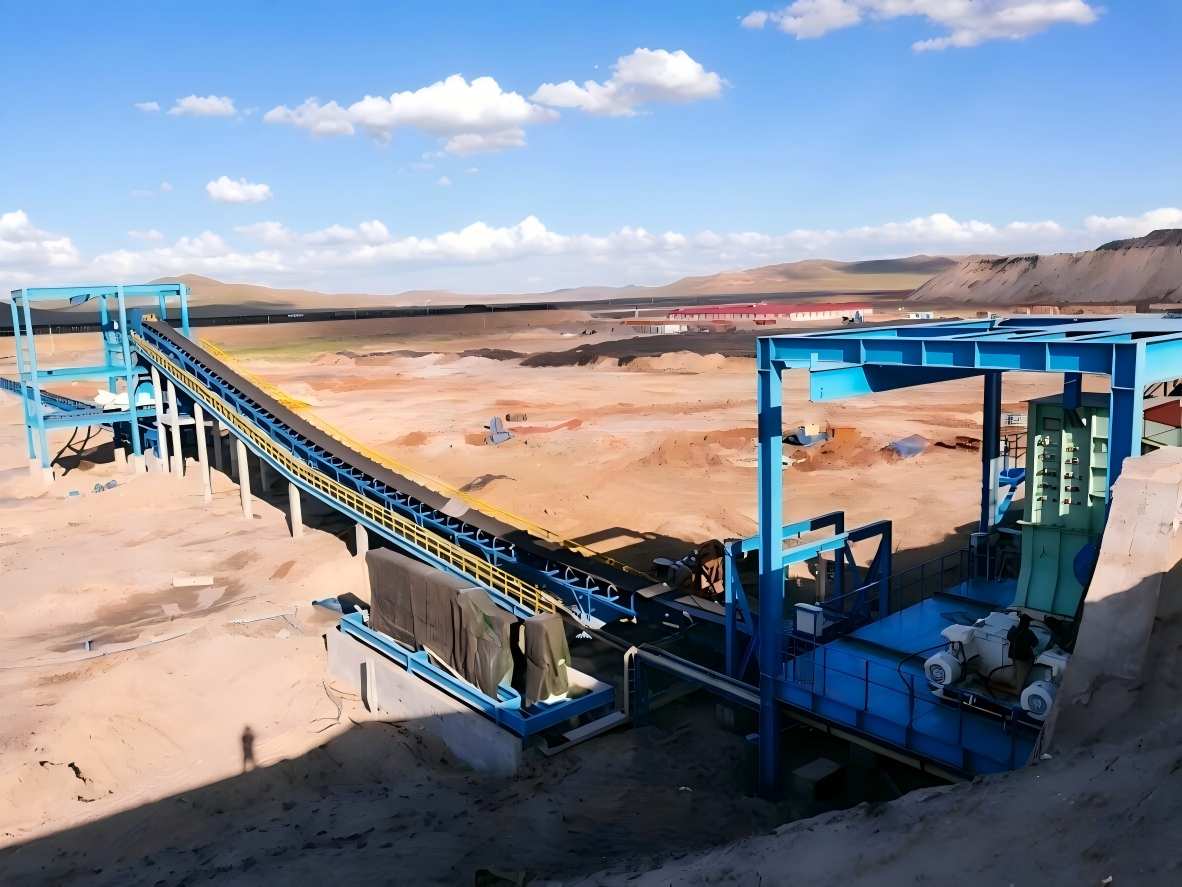
Mining Conveyor Systems
Heavy-duty conveyor systems for surface and underground mining — long-distance curved belt conveyors, Pipe conveyors, and hopper feeders for abrasive ores and 24/7 operation.
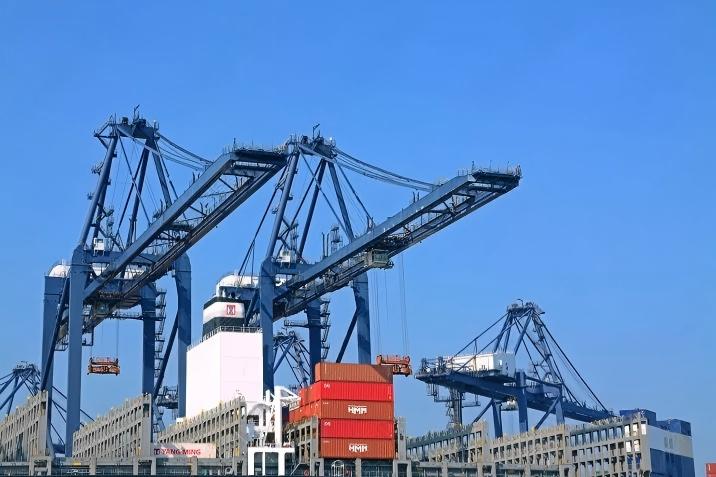
Ports & Terminals Conveyor Solutions
Complete mobile and fixed conveyor solutions for ports and inland terminals — ship loaders, hopper feeders, link conveyors and integrated systems for efficient bulk material handling.
Need Help Selecting the Right Hopper Feeder?
Contact our engineering team for a customized hopper feeder selection based on your material characteristics, throughput requirements, and site conditions.
Contact Us WhatsApp