 ZOOMRY

Quick answer: A drive-over truck unloading system eliminates the wheel loader from the receiving process. Trucks drive onto a low-profile hopper, discharge directly through a floor grille onto a conveyor, and depart — 2–3 minutes per truck instead of 8–10 minutes with loader-assisted dumping. At a Southeast Asia port terminal, replacing a static hopper with a tracked drive-over unit cut truck turnaround from 18 minutes to 11.7 minutes (−35%) and removed the loader bottleneck entirely. ZRLS (wheeled) and ZRLD (tracked) series cover 200–1,800 t/h, belt widths 1,400–1,800 mm, hopper widths 3.5–5.7 m.
Why the Wheel Loader Is the Bottleneck in Most Truck Receiving Stations
A static receiving hopper requires a wheel loader to push material into the discharge zone. The truck dumps beside or near the hopper, the loader pushes the pile into the opening, and the truck waits for the loader to clear space before the next dump. The receiving rate is set by the loader cycle, not by the truck or the conveyor. During peak hours, trucks queue — 18 minutes at the Southeast Asia terminal before the drive-over unit was installed. The loader also operates in the same tight space as queuing trucks, which is a safety exposure as well as a throughput constraint.
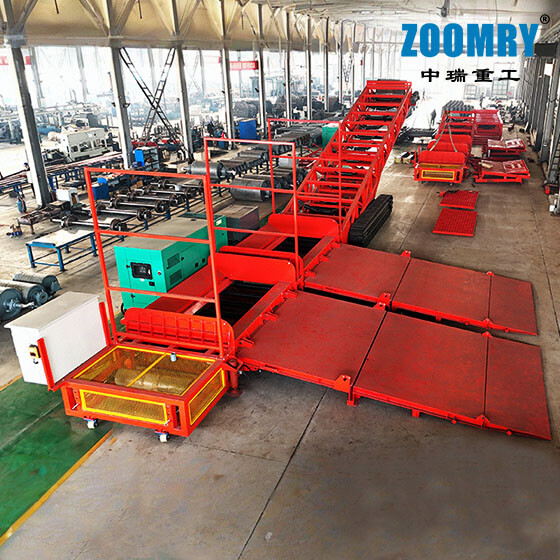
A drive-over system removes the loader from the receiving step. The hopper is low-profile and designed for the truck to drive over it. The truck positions on the hopper, opens the tailgate, and material flows by gravity through a floor grille onto the receiving belt. The truck drives off. The loader is no longer part of the unloading cycle — it may still manage stockpiles elsewhere, but it does not gate the receiving rate.
The Three Components That Determine Whether the System Actually Removes the Bottleneck
A drive-over hopper alone does not guarantee faster turnaround. The receiving hopper, the feeder, and the discharge conveyor must be sized as one system, or the bottleneck simply moves downstream.
| Component | Function | Sizing rule | What goes wrong if undersized |
|---|---|---|---|
| Receiving hopper | Accepts the truck discharge without overflow or bridging | Hopper width 3.5–5.7 m to match trailer and ramp configuration; volume sized to the largest single dump | Material backs up, truck cannot complete discharge, second dump waits |
| Feeder | Regulates flow from hopper to discharge conveyor | Belt or apron feeder matched to peak receiving rate, not average | Surge loads hit the downstream conveyor; controlled feed collapses |
| Discharge conveyor | Moves material to the next stage (stockpile, ship loader, processing) | Belt width and speed matched to feeder output plus a margin for surge | Conveyor becomes the new bottleneck; hopper fills and truck waits again |
Selection tip: the feeder is the component most often undersized. A hopper that accepts the truck dump in 30 seconds but feeds out at half the receiving rate simply moves the queue from the hopper to the conveyor. Size the feeder against the peak truck arrival rate, not the shift average.
Wheeled vs Tracked: The Undercarriage Decision
The receiving hopper and conveyor design are the same across both configurations. The undercarriage determines where the unit can operate and how fast it relocates.
| Factor | Wheeled (ZRLS series) | Tracked (ZRLD series) |
|---|---|---|
| Ground condition | Paved or compacted surfaces — quarry floors, concrete pads, fixed stockyards | Soft, uneven, or unpaved ground — mining benches, quayside yards, temporary sites |
| Relocation | Towable; repositioning typically needs a site tractor, 10–15 minutes | Self-propelled crawler; repositions independently in under 5 minutes |
| Ground pressure | Higher; requires surface preparation for soft ground | Lower; distributes weight across crawler tracks |
| Typical site | Fixed receiving station with graded access | Multi-berth terminal, changing receiving zones, unpaved port yard |
Selection tip: if the receiving point moves between berths or pits, the tracked unit pays for itself in relocation time. If the station is fixed and the ground is prepared, the wheeled unit is the lower-cost configuration.
Capacity and Throughput: What the Numbers Mean in Practice
ZOOMRY ZRLS/ZRLD truck unloaders cover 200–1,800 t/h standard, with belt widths 1,400–1,800 mm and hopper widths 3.5–5.7 m. The 1,800 mm belt models (ZRLS-TU1800 / ZRLD-TU1800) are the heavy-duty receiving units; the 1,400 mm models (ZRLS-TU1400 / ZRLD-TU1400) suit lower-throughput receiving stations. Custom configurations up to 3,000 t/h are available for high-volume terminals.
The capacity that matters is not the belt’s maximum rate — it is the rate at which the system accepts truck dumps without queuing. A 1,800 t/h conveyor behind a hopper that only accepts one truck at a time may still queue if the truck arrival rate exceeds the dump-and-go cycle. The ramp count (2-ramp vs 4-ramp) and the hopper volume determine how many trucks can be in the receiving zone simultaneously. A 4-ramp layout with a larger hopper reduces the probability that a second truck arrives before the first has cleared.
What the Project Data Shows
At the Southeast Asia port terminal, the before-and-after comparison is direct:
| Metric | Static hopper + wheel loader | ZRLD-TU1800 drive-over |
|---|---|---|
| Truck turnaround time | 18.0 minutes | 11.7 minutes (−35%) |
| Receiving method | Loader-assisted dump | Drive-over direct discharge |
| Wheel loader role | Continuous, in the receiving zone | Eliminated from receiving |
| Downstream protection | None — surge loads | 15 m³ hopper feeder buffer |
The 35% reduction is the measured outcome, not a modelled estimate. The mechanism is straightforward: the loader cycle no longer gates the truck dump. The 15 m³ hopper feeder downstream absorbed the surge from faster truck dumping, which kept the ship loader feed stable and removed a second bottleneck that would otherwise have appeared after the unloader was installed.
What to Specify Before Ordering
-
Ramp count and layout. 2-ramp for lower capital, 4-ramp for higher simultaneous truck positions. The ramp layout must match the truck fleet — side-dump, end-dump, or belly-dump — and the site’s traffic pattern.
-
Hopper width and volume. Width 3.5–5.7 m to accept the trailer discharge. Volume sized to the largest single load so the truck can complete the dump without the material backing up.
-
Feeder type and rate. Belt feeder for most bulk materials; apron feeder for abrasive or heavy lump material. The feeder rate must exceed the peak receiving rate, not the shift average.
-
Discharge height and conveyor interface. Discharge up to 5.8 m standard, up to 6.3 m optional. Confirm the discharge conveyor or hopper feeder interface height matches the downstream equipment.
-
Dust control. Enclosed or partially enclosed hopper, rubber seals and curtains at the dump pocket, and water spray or dry-fog timed with dumping. For coal and fine materials, the receiving hopper is a dust generation point and must be specified with the same attention as the discharge point.
-
Mobility and relocation. Tracked if the receiving zone moves; wheeled if the station is fixed. Confirm the relocation method (self-propelled vs towable) and the time per move against the site’s operating pattern.
Frequently Asked Questions
What is the difference between a drive-over truck unloader and a static hopper with a wheel loader?
A static hopper requires a wheel loader to push material into the discharge zone; the truck waits for the loader cycle. A drive-over unit lets the truck discharge directly through a floor grille onto a conveyor, eliminating the loader from the receiving process. At a Southeast Asia terminal, this reduced turnaround from 18 minutes to 11.7 minutes.
How fast can a truck unload with a drive-over hopper?
The dump-and-go cycle is typically 2–3 minutes per truck, compared with 8–10 minutes when a wheel loader handles the same volume. The actual time depends on the hopper volume, the number of ramps, and the truck configuration.
Should I choose a wheeled or tracked truck unloader?
Wheeled units suit fixed receiving stations on paved or compacted surfaces; they are towable but need a site tractor to reposition. Tracked units handle soft, uneven, or unpaved ground and can relocate independently in under 5 minutes. If the receiving point moves between berths or pits, the tracked configuration is the practical choice.
What capacity range does ZOOMRY cover?
ZRLS (wheeled) and ZRLD (tracked) series cover 200–1,800 t/h standard, with belt widths 1,400–1,800 mm and hopper widths 3.5–5.7 m. Custom configurations up to 3,000 t/h are available for high-volume terminals. The model determines the standard range; the project’s truck arrival rate and peak dump size determine the actual required capacity.
Does a truck unloader eliminate the wheel loader entirely?
It eliminates the wheel loader from the receiving process. The loader may still be needed for stockpile management or material recovery elsewhere on site, but it no longer gates the truck discharge rate. That is the source of the turnaround reduction — the loader cycle is removed from the critical path.
Related Products
ZRLS/ZRLD series, 200–1,800 t/h, wheeled and tracked drive-over configurations

2- or 4-ramp layout, 200–1,800 t/h, dump-and-go receiving
Related Reading
ZRLD-TU1800 + HF-TR hopper feeder cut turnaround from 18 to 11.7 minutes

Bulk material handling projects across ports, mines, and terminals
Receiving Station Bottleneck?
Send us your truck type, arrival rate, receiving zone layout, and downstream equipment. ZOOMRY engineers will confirm whether a wheeled or tracked drive-over unit removes the loader bottleneck — and whether a hopper feeder is needed to protect the next stage.
Contact Our Engineers →