 ZOOMRY

A radial stacker conveyor is more than just a belt on wheels — it is an engineered system where boom length, slewing radius, undercarriage type, and drive configuration all interact to determine stockpile capacity, mobility, and operating cost. Whether you are specifying a tracked radial stacker conveyor for soft-ground mining sites or a wheeled radial conveyor for rapid relocation between quarry stockpile zones, understanding the key design parameters helps you avoid costly mis-specifications.
This article breaks down radial stacker conveyor design into four core elements — undercarriage, boom geometry, drive system, and control options — and explains how each choice impacts your operational performance and total cost of ownership.
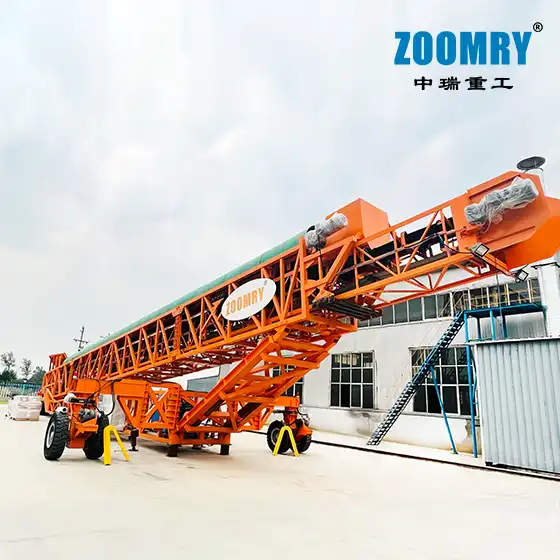
ZOOMRY Tracked Radial Stacker Conveyor — 360° Slewing Design with Diesel Hydraulic Drive
Undercarriage Design: Tracked vs Wheeled Radial Stacker Conveyors
The undercarriage determines where and how your radial stacker conveyor can operate. This choice affects site preparation costs, travel speed between stockpile zones, and long-term maintenance requirements — making it the most consequential decision in radial stacker conveyor design.
| Design Factor | Tracked Radial Stacker | Wheeled Radial Stacker |
|---|---|---|
| Ground Pressure | Low — suitable for soft, muddy, uneven terrain | Higher — requires compacted or prepared surfaces |
| Travel Speed | Slower — typically 0.5-1.0 km/h on site | Faster — towable or self-propelled at higher speeds |
| Site Preparation | Minimal — operates on raw ground | Moderate — needs graded access roads |
| Maintenance Cost | Higher — track undercarriage requires regular tensioning and component replacement | Lower — standard tyre and axle maintenance |
| Best Application | Undeveloped mine sites, remote quarries, soft ground | Established sites with prepared surfaces, multi-zone operations |
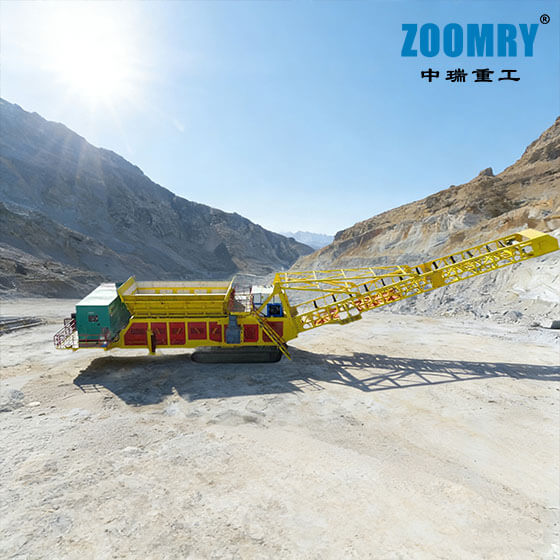
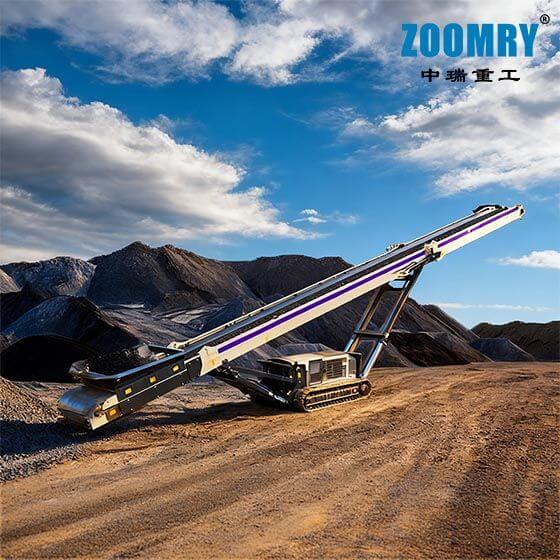
ZOOMRY offers both configurations: the Tracked Radial Stacker with diesel hydraulic drive and crawler tracks for challenging terrain, and the Wheel Radial Stacker for high-volume storage operations on prepared surfaces. Both radial stacker conveyor models feature 360° radial movement and telescopic boom options.
Boom Geometry: What Determines Stockpile Capacity in Radial Conveyor Design?
The boom length and luffing angle of a radial stacker conveyor directly determine the volume and shape of the stockpile it can build. A longer boom creates wider conical piles without repositioning — critical for operations where yard space is limited or where material segregation must be minimized through layered stacking.
Key radial stacker conveyor design parameters affecting stockpile capacity:
- Boom Length: ZOOMRY radial stackers offer telescopic booms from 15m to 55m. Each additional metre of boom length adds approximately 7-10% to the stockpile radius — a critical radial conveyor design consideration for space-constrained yards.
- Luffing Angle: Hydraulic cylinders adjust the boom inclination up to 20°. Higher angles produce taller, narrower piles — ideal for maximizing storage per square metre.
- Belt Width and Speed: Conveyor Belts from 800mm to 1,600mm with speeds up to 4.0 m/s determine throughput — from 450 m³/h on compact radial conveyor models to 2,400 m³/h on high-capacity units.
- Slewing Arc: 360° continuous rotation enables扇形 stockpiling from a single feed point, maximizing yard utilization by up to 30% compared to fixed-direction stacking.
Drive System Configuration: Diesel Hydraulic vs Electric
The drive system powers both the conveyor belt and the undercarriage. Your choice affects fuel consumption, noise levels, and compatibility with site infrastructure — all important radial stacker conveyor design factors.
- Diesel Hydraulic (Standard): Self-contained power unit eliminates dependency on site electrical infrastructure. Ideal for remote mining sites and temporary stockpile operations. ZOOMRY's Superior Tracked Radial Stacker uses this configuration for maximum autonomy.
- Electric Drive (Optional): Lower operating cost per ton, zero on-site emissions, and quieter operation. Best suited for permanent installations with reliable grid power, such as cement plants and port terminals.
Control and Automation: From Manual to Autonomous Stacking
Modern radial stacker conveyor design incorporates graduated levels of control — from basic wireless remote operation to fully automated stockpile management systems integrated with plant SCADA.
- Wireless Remote Control (Standard): 100m range for full machine control — travel, slew, telescoping, and inclination from a safe distance.
- PLC-Based Auto-Stacking (Optional): Pre-programmed layering patterns with automatic boom positioning for consistent pile formation and segregation control.
- Laser/Radar Volume Monitoring (Optional): Real-time stockpile measurement enables automated sequencing and inventory tracking.
Complementary Equipment for a Complete Stockpiling System
Related Industry Solutions
Need a Custom Radial Stacker Conveyor?
Contact ZOOMRY for a radial stacker conveyor designed to your specific material, capacity, and site conditions — backed by 20+ years of bulk material handling expertise.
Contact Us Today