 ZOOMRY

Quick answer: A mining conveyor roller manufacturer is only as reliable as its worst-documented metric. Before ordering, verify five things: the CEMA class and load rating actually match your belt width and speed; the bearing and seal are specified as one system (not a bearing code with an unstated seal); radial runout is ≤0.4 mm and rotation resistance ≤2 N under 250 N radial load; the factory has dimensional and dynamic testing, not just visual inspection; and the supplier can name mining projects where rollers have run past 40,000 hours. ZOOMRY publishes all five — CEMA B through E, 6204–6310 bearings, IP66 labyrinth sealing, ≤2 N rotation resistance, and 50,000+ hour design life.
Why “Manufacturer” Searches Need a Different Page Than “Roller Guide” Searches
Someone searching “mining conveyor rollers” is usually learning: what types exist, how they differ, which suits which material. Someone searching “mining conveyor rollers manufacturer” has already decided to buy. They need to know which supplier can deliver a roller that survives the loading zone, the washdown, and the 40,000-hour mark without turning into a maintenance line item.
Those are different questions. This page is built for the second one. The five checks below are the same sequence ZOOMRY engineers use in a pre-order review with mining and EPC buyers.
Check 1 — CEMA Class and Load Rating: Does the Roller Match the Belt, or Just the Catalogue?
CEMA B/C/D/E is not a quality grade. It is a load and dimensional classification tied to belt width and roller diameter. A CEMA C roller is not “better” than a CEMA B roller — it is rated for a different load envelope. The failure mode is a supplier quoting a CEMA C price on a conveyor that actually needs CEMA D or E at the head end, then the roller failing early under load it was never rated for.
| CEMA class | Roller diameter | Belt width range | Typical mining duty |
|---|---|---|---|
| B | 4"–5" (101–127 mm) | 18"–48" (457–1,219 mm) | Light-duty yard and auxiliary conveyors |
| C | 4"–5" (101–127 mm) | 18"–60" (457–1,524 mm) | Medium-duty plant conveyors |
| D | 5"–6" (127–152 mm) | 24"–72" (610–1,829 mm) | Heavy-duty mining and quarry main lines |
| E | 6"–7" (152–178 mm) | 36"–96" (914–2,438 mm) | Extra heavy-duty overland, port, high-tonnage |
What to verify: ask the manufacturer to state the CEMA class for each roller position (carrying, impact, return) against your actual belt width and belt speed. If they quote one class for the whole conveyor without asking about the loading zone, they are pricing a catalogue item, not engineering a roller.
Selection tip: the loading zone almost always needs one class higher than the carrying run. Impact rollers at the transfer point carry the same static load as carrying rollers plus the dynamic energy of the material drop. A CEMA D carrying roller paired with a CEMA C impact roller is a common underspecification.
Check 2 — Bearing and Seal as One System: The Spec That Most Quotations Leave Out
A bearing code alone does not tell you whether the roller will survive a mining environment. 6205 and 6305 are bearing sizes, not sealing specifications. The same 6305 bearing can run 40,000 hours behind a multi-stage labyrinth seal, or fail in one wet season behind a single lip seal. The bearing-seal combination is the system that determines life.
ZOOMRY mining rollers use 6204 through 6310 bearings paired with IP66 multi-stage labyrinth and contact seals. The seal is not an add-on — it is specified with the bearing housing and the shaft tolerance as one assembly. CEMA E return idlers, for example, carry the same IP66 labyrinth + contact seal arrangement used across the heavy-duty range.
What to verify: ask for the seal type and ingress rating, not just the bearing number. “6205” is not a seal specification. “6205 with IP66 multi-stage labyrinth and contact seal, tested for dust and washdown” is. If the quotation cannot state the seal system, the bearing code is the only thing that was actually selected.
Selection tip: in washdown or wet-coal applications, the seal matters more than the bearing size. A slightly smaller bearing behind a proven labyrinth seal will outlast a larger bearing behind a basic lip seal in a wet environment.
Check 3 — Radial Runout and Rotation Resistance: The Two Numbers That Separate Precision From Appearance
Two rollers can look identical and have different runout and resistance. Radial runout is how much the roller shell deviates from a perfect circle as it turns. High runout means the belt runs over a slightly eccentric surface at every rotation — noise, vibration, and accelerated belt cover wear. Rotation resistance is the force needed to turn the roller; high resistance means the drive motor is working against the roller itself on every metre of belt.
ZOOMRY publishes radial runout ≤0.4 mm and rotation resistance ≤2 N under 250 N radial load. The national standard requirement for rotation resistance is ≤3 N under the same load; ZOOMRY’s enterprise standard is ≤2 N, which reduces the driving force the conveyor motor must supply across the whole belt length. CEMA guidance points to radial runout below 0.35 mm for quiet running at belt speed, and a resistance coefficient below 0.010 for low friction in the bearing-seal arrangement.
What to verify: ask for the measured radial runout and rotation resistance values, not a “precision bearing” claim. If the manufacturer cannot state a runout figure in millimetres and a resistance figure in newtons, the roller has not been dimensionally tested — it has been assembled and painted.
Selection tip: rotation resistance compounds with roller count. A 2 N difference per roller across a 3 km conveyor with thousands of rollers is a continuous energy penalty that never appears on the purchase order.
Check 4 — Testing Capability: What the Factory Measures Before the Roller Ships
A manufacturer that only inspects visually is not testing the two metrics that determine life. The minimum testing set for mining rollers is dimensional (shell diameter, length, shaft tolerance), dynamic (rotation resistance under radial load), and sealing (ingress or washdown verification). Material traceability from the steel mill certificate through to the finished roller is the difference between a quality system and a quality claim.
ZOOMRY’s roller production runs on automated lines with 100% concentricity and rotation resistance testing, backed by a quality inspection centre with chemical, hardness, roller performance, mechanical, and metrology labs. The rollers are not sampled — the critical metrics are checked on the line.
What to verify: ask which metrics are tested 100% versus sampled, and whether the test data travels with the shipment. A supplier who tests rotation resistance on a sample and ships the rest unmeasured is offering a probability, not a specification.
Selection tip: if the factory cannot describe its sealing test, assume the seal is a visual check. In mining, the seal is the first component to fail and the hardest to inspect after installation.
Check 5 — Documented Project Life: Who Else Has Run These Rollers Past 40,000 Hours
A 50,000-hour design life is a claim until it is attached to a project. The final check is whether the manufacturer can name mining or port installations where its rollers have operated long enough to validate the life figure, and whether those installations match your material and duty.
ZOOMRY’s roller references include the 3,300 m Chengde iron ore conveyor (2,000 t/h, ST3150 steel cord belt, 99.3% equipment availability) and the 36-conveyor Luanping iron mine system (600–3,200 t/h, belt widths up to 2,200 mm). Those projects use the same CEMA D/E heavy-duty roller range specified for mining main lines, not a light-duty catalogue substitute.
What to verify: ask for the project name, material, belt width, and approximate operating hours. “Used in mining” is not a reference. “3,300 m iron ore conveyor, 2,000 t/h, operating since 2018” is. If the reference list stops at “cement plant, 2019” with no hours or tonnage, the life claim is not yet documented.
Supplier Evaluation Checklist
| Check | What a paper-spec supplier provides | What a verified manufacturer provides |
|---|---|---|
| CEMA class | One class for the whole conveyor | Class per position, with loading zone upsized |
| Bearing + seal | Bearing code only | Bearing + IP66 labyrinth/contact seal as one system |
| Runout / resistance | “Precision bearing” | ≤0.4 mm radial runout, ≤2 N rotation resistance |
| Testing | Visual inspection | 100% concentricity and rotation resistance testing, material traceability |
| Project life | “Used in mining” | Named project, material, belt width, operating hours |
Frequently Asked Questions
What is the difference between a CEMA C and CEMA D roller for mining?
CEMA C and D are load classifications, not quality grades. CEMA C covers medium-duty plant conveyors up to 60" belt width with 4"–5" rollers. CEMA D covers heavy-duty mining main lines up to 72" belt width with 5"–6" rollers. The correct class depends on belt width, belt speed, and the load at each roller position — not on a general preference for “heavier duty”.
Does bearing size alone determine conveyor roller life?
No. The bearing-seal system determines life. A 6305 bearing behind a multi-stage IP66 labyrinth seal will outlast the same bearing behind a basic lip seal in a dusty or wet mining environment. The seal is specified with the bearing housing and shaft tolerance as one assembly, not added after the bearing is chosen.
What radial runout should a mining conveyor roller have?
ZOOMRY specifies radial runout ≤0.4 mm. CEMA guidance points to below 0.35 mm for quiet running at belt speed. High runout causes vibration, noise, and accelerated belt cover wear. If a manufacturer cannot state a runout figure in millimetres, the roller has not been dimensionally tested.
Why does rotation resistance matter on a long conveyor?
Rotation resistance is the force the drive motor must overcome to turn each roller. ZOOMRY specifies ≤2 N under 250 N radial load, against a national standard requirement of ≤3 N. On a 3 km conveyor with thousands of rollers, the difference between 2 N and 3 N per roller is a continuous energy penalty that does not appear on the equipment quotation.
What should I ask a conveyor roller manufacturer before ordering?
Five things: the CEMA class per roller position against your belt width and speed; the bearing plus seal system as one specification; measured radial runout and rotation resistance; which metrics are tested 100% versus sampled; and named projects where the rollers have run past 40,000 hours. A supplier who cannot answer all five is offering a catalogue item, not an engineered component.
Related Products
Steel, HDPE, impact, return, spiral, and garland rollers. ≤2 N rotation resistance, 50,000+ hour life.
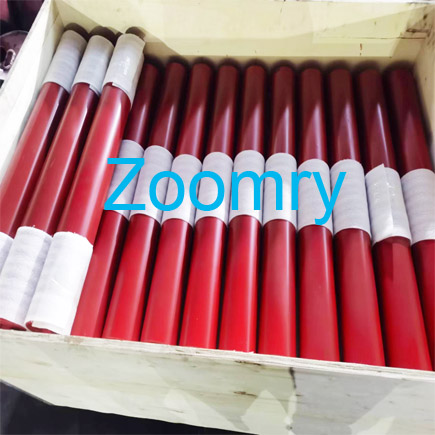
Heavy-duty Q235 shell, 500–2,400 mm belt widths, carrying/return/impact configurations.
Related Reading
Type selection, shell material, and sealing systems by ore type

Bulk material handling projects across ports, mines, and terminals
Evaluating a Roller Supplier for a Mining Project?
Send us your belt width, belt speed, material, and the roller positions you are sourcing. ZOOMRY engineers will confirm the CEMA class per position, the bearing-seal system, and the measured runout and rotation resistance values — before you place the order.
Contact Our Engineers →