 ZOOMRY

Quick answer: Choose a tracked stacker for soft, uneven, or unpaved ground where wheeled equipment loses traction. Choose a wheeled stacker for prepared surfaces where fast road transport between sites matters. Choose a telescopic stacker when layered stacking is required to reduce segregation and dust, regardless of undercarriage. Capacity range across ZOOMRY configurations: 100–3,500 t/h, belt width 800–1,600 mm, stacking height up to 20 m.
Why Mining Stacker Selection Starts With the Ground, Not the Capacity
Most stacker selection conversations begin with “what capacity do I need?” That is the second question. The first question is “what ground will the machine operate on, and how often will it move?” Ground condition determines the undercarriage. Relocation frequency determines whether a wheeled or tracked chassis makes sense. Capacity comes after those two filters are applied.
A 3,500 t/h telescopic stacker that cannot reach the stockpile because the ground is soft is less useful than a 1,000 t/h tracked stacker that can. ZOOMRY’s mining stacker range covers 100–3,500 t/h across three undercarriage types, but the range is not a menu — it is a set of configurations matched to site conditions.
Tracked Stacker: When the Ground Is the Constraint
A tracked stacker uses a crawler undercarriage that distributes machine weight across a larger contact area. ZOOMRY’s tracked radial stacker (ZR series) operates at ground pressure ≤80 kPa, suitable for soft, uneven, or unpaved surfaces where wheeled equipment would require ground preparation or lose traction.
Typical mining scenarios: quarry floors, mine benches, heap leach pads, and unpaved stockyards. On a heap leach pad, the tracked undercarriage is the primary reason the stacker can operate at all — wheeled units sink or require graded access roads.
Capacity envelope: ZR800, ZR1000, and ZR1200 cover 100–1,000 t/h with belt widths 800–1,200 mm, 20 m conveyor length, 7 m stack height, and 360° radial slewing. Travel speed is ≤20 m/min — slower than a wheeled unit, but the machine does not need a road to move.
Selection tip: If the site cannot guarantee a graded, compacted surface along the entire travel path, do not specify a wheeled stacker. The cost of ground preparation often exceeds the price difference between wheeled and tracked undercarriages.
Wheeled Stacker: When Relocation Speed Matters
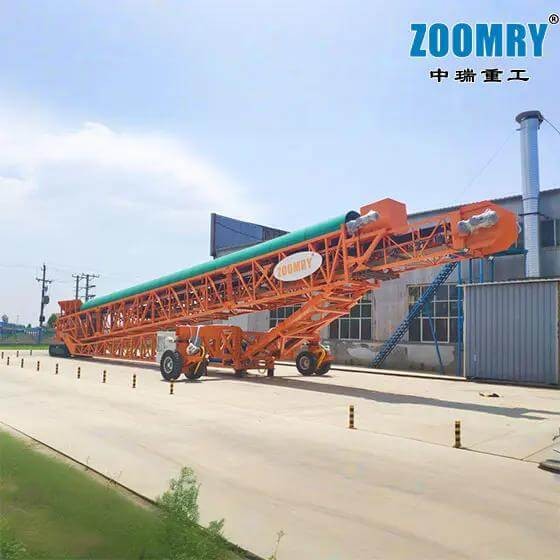
A wheeled stacker moves faster on prepared surfaces and can be towed or driven between sites without a lowboy trailer. ZOOMRY’s wheeled telescopic stacker uses an 8-tyre chassis with hydraulic lifting, capable of self-adapting to 2° natural slopes, with optional anti-slip tracks for muddy conditions.
Typical mining scenarios: sites with graded haul roads, compacted stockyard surfaces, or operations that relocate the stacker between pits or product piles on a weekly or monthly basis. Wheeled stackers are also the practical choice when the machine must move between distant sites on public roads.
Capacity envelope: The ZR-SF wheeled telescopic series covers 500–3,500 m³/h with belt widths 800–1,600 mm, telescopic stroke 10–22 m, and stacking height up to 20 m. Travel speed is higher than tracked units, and the machine can be road-towed without disassembly.
Selection tip: If the site already maintains graded haul roads for trucks and loaders, the wheeled undercarriage is usually the lower-cost choice. If the roads are temporary or poorly maintained, the tracked undercarriage is the safer specification.
Telescopic Boom: When Segregation and Dust Are the Constraints
The telescopic boom is an independent selection axis from the undercarriage. A stacker can be tracked and telescopic, or wheeled and telescopic. The boom extends and retracts during operation, lowering the discharge point as the pile grows. This builds the stockpile in horizontal layers rather than a single conical pile, reducing segregation and dust generation.
When layered stacking matters: aggregate operations producing multiple size fractions, coal stockpiles where dust emission limits are tightening, and any material where coarse particles rolling to the pile toe causes quality inconsistency. ZOOMRY’s ZR140SF, for example, uses a level detector linked to the hydraulic telescopic device to automatically adjust discharge distance (0.5–3 m range) based on pile height, reducing dust from height differential and material breakage.
Selection tip: If the material is homogeneous and dust is not a regulated constraint, a non-telescopic radial stacker is lower cost. The telescopic premium is justified by segregation control and dust reduction, not by capacity.
Configuration Comparison
| Factor | Tracked stacker | Wheeled stacker | Telescopic boom (either undercarriage) |
|---|---|---|---|
| Ground condition | Soft, uneven, unpaved | Prepared, firm, or paved | Independent of undercarriage |
| Ground pressure | ≤80 kPa | Higher, requires compaction | Same as undercarriage |
| Relocation speed | Slow (≤20 m/min on site) | Fast, road-towable | Same as undercarriage |
| Typical relocation frequency | Daily or weekly within one site | Weekly or monthly, including between sites | Not applicable |
| Capacity range (ZOOMRY) | 100–1,000 t/h | 500–3,500 m³/h | 500–3,500 m³/h (ZR-SF series) |
| Stacking height | Up to 7 m | Up to 20 m | Up to 20 m |
| Segregation control | Conical pile unless paired with telescopic | Conical pile unless paired with telescopic | Layered stacking, reduced segregation |
| Dust control | Depends on discharge height | Depends on discharge height | Discharge height auto-adjusted, lower dust |
Project Evidence: Configuration Choices in Practice
Russia coal stacker project (8 units ZR-SF, -35°C): A Russian coal transport group required stacking across changing stockpiles in extreme cold. ZOOMRY supplied 8 wheeled telescopic stackers with low-temperature steel and specialized lubrication. The wheeled undercarriage was selected because the site maintained graded haul roads; the telescopic boom was specified for layered stacking to control dust in a cold, dry climate.
Hebei Chengde iron ore (3,300 m conveyor + stacker): The 3,300 m curved trough conveyor at Chengde operates on a fixed route with a fixed discharge point. The stacking equipment at the discharge end operates on a prepared surface, so a wheeled or fixed radial configuration is the natural fit. The conveyor project itself achieved 99.3% equipment availability, and the stacker selection followed the same principle: match the undercarriage to the ground, not to a generic “mining” label.
Heap leach application (tracked radial): On heap leach pads, the ground is soft and uneven by design. The tracked radial stacker is the primary ore placement machine because wheeled equipment cannot operate without ground preparation that would compact the pad and reduce percolation. This is a case where the ground condition single-handedly determines the undercarriage choice.
Selection tip: The project evidence above shows a pattern: prepared road → wheeled; raw ground → tracked; segregation or dust constraint → telescopic boom. The capacity range narrows after those three filters are applied.
Frequently Asked Questions
What is the difference between a tracked stacker and a wheeled stacker in mining?
A tracked stacker uses a crawler undercarriage for soft, uneven, or unpaved ground with ground pressure ≤80 kPa. A wheeled stacker uses tyres for prepared surfaces and road transport, with higher travel speed but requiring compacted or graded ground. The choice depends on ground condition and relocation frequency, not on capacity alone.
When should I choose a telescopic stacker instead of a radial stacker?
Choose telescopic when layered stacking is required to reduce material segregation or dust emission. The telescopic boom lowers the discharge point as the pile grows, building horizontal layers instead of a conical pile. For homogeneous, dust-tolerant materials on straight stockpiles, a radial stacker without telescopic boom is lower cost.
What capacity range does ZOOMRY cover for mining stackers?
ZOOMRY mining stacker configurations cover 100–3,500 t/h (or 500–3,500 m³/h for the ZR-SF telescopic series), with belt widths 800–1,600 mm and stacking height up to 20 m. The exact capacity for a project is confirmed against material bulk density, belt speed, and stockpile volume requirement.
Can a tracked stacker operate on a heap leach pad?
Yes. The tracked radial stacker is the primary ore placement machine on most heap leach pads because the crawler undercarriage distributes weight and operates on soft, uneven ground without compacting the pad surface. Wheeled equipment would require ground preparation that could reduce leach pad permeability.
How often should a mining stacker be relocated?
There is no fixed rule, but the relocation frequency informs the undercarriage choice. Daily or weekly relocation within one site favors tracked mobility. Weekly or monthly relocation including between sites favors wheeled mobility. If relocation is less frequent than monthly, a fixed radial or semi-permanent configuration may be more economical.
Related Products
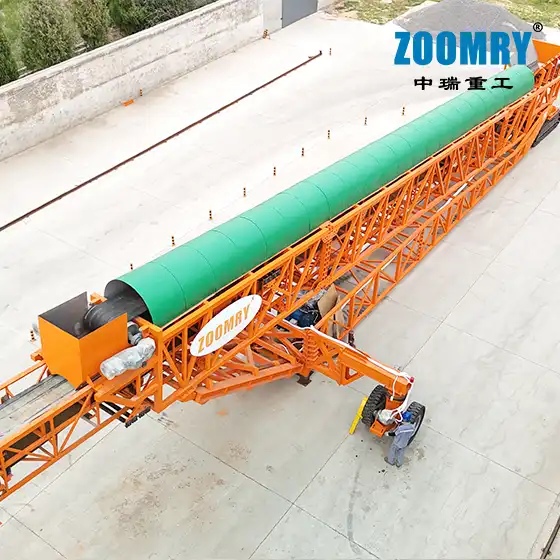
ZR-SF series, 500–3,500 m³/h, 10–22 m telescopic stroke
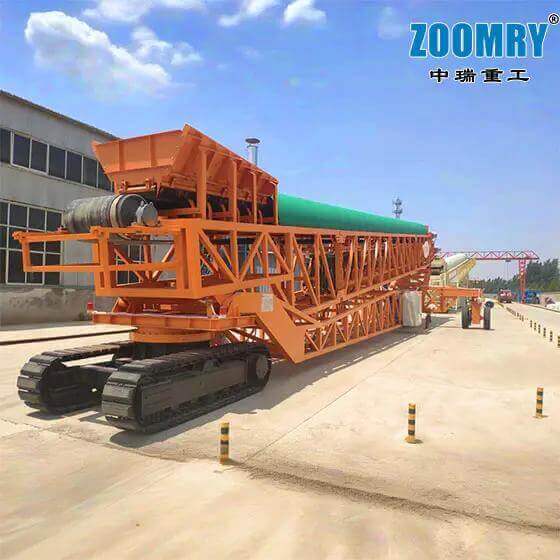
ZR800–ZR1200, 100–1,000 t/h, ground pressure ≤80 kPa
Related Reading
Tracked, wheeled, and telescopic configurations for changing stockyard layouts
Ground pressure, travel speed, and site preparation requirements

Bulk material handling projects across ports, mines, and terminals
Not Sure Which Stacker Configuration Fits Your Mine?
Send us your ground condition, relocation frequency, material type, and capacity requirement. ZOOMRY engineers will confirm the undercarriage and boom configuration that matches your site — tracked, wheeled, or telescopic.
Contact Our Engineers →