 ZOOMRY

Quick answer: A mobile telescopic stacker for sand and aggregate typically covers 500–3,500 m³/h with a telescopic boom of 10–22 m, stacking height up to 20 m, and wheeled or tracked mobility. Selection depends on stockpile layout, material bulk density, and how often the unit needs to reposition between piles. This guide covers capacity sizing, wheeled vs tracked choice, and the configurations that suit sand, gravel, and crushed aggregate.
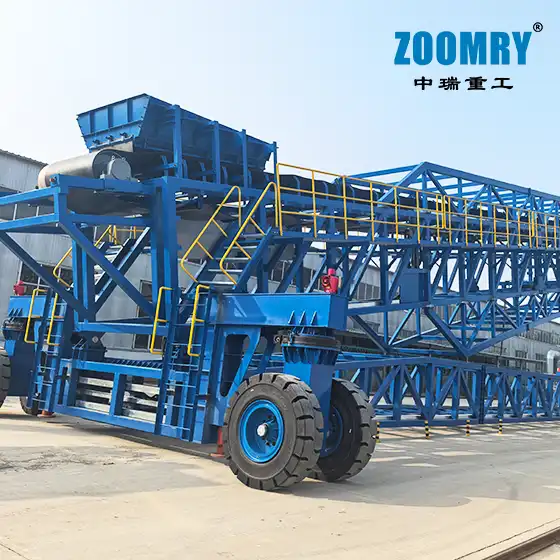
Why Sand and Aggregate Need a Different Stacker
Sand and aggregate behave differently from coal or ore in a stockpile. They are abrasive, free-flowing, and prone to segregation when dropped from a fixed height. A fixed conveyor that discharges at one point builds a steep conical pile, and the coarse and fine fractions separate as the material rolls down the sides.
A mobile telescopic stacker addresses three problems at once:
- Segregation: layered stacking from an adjustable discharge height keeps the pile more uniform than a single fixed drop point.
- Loader dependency: the stacker builds the pile directly from the conveyor, so the wheel loader is no longer needed for primary stacking.
- Stockpile coverage: radial slewing and a telescopic boom let one unit cover a larger stockpile area without moving the feed conveyor.
Capacity Sizing: From 500 to 3,500 m³/h
Capacity for a telescopic stacker is expressed in cubic metres per hour, not tonnes per hour, because sand and aggregate bulk densities vary widely. A figure in m³/h stays valid across materials; a figure in t/h changes with every material.
| Model | Belt Width (mm) | Capacity (m³/h) | Belt Speed (m/s) | Telescopic Travel (m) |
|---|---|---|---|---|
| ZR80SF | 800 | 500 | 2.5 | 10–22 |
| ZR100SF | 1,000 | 850 | 2.5 | 10–22 |
| ZR120SF | 1,200 | 1,500 | 3.15 | 10–22 |
| ZR140SF | 1,400 | 2,100 | 3.15 | 10–22 |
| ZR160SF | 1,600 | 3,500 | 4.0 | 10–22 |
To size the unit, start from the quarry's daily output and working hours, not from the stacker's maximum rating. A unit running at 70–80% of rated capacity handles surges without constant overloading. Final capacity depends on material bulk density, particle size, moisture content, and the feed arrangement, and should be confirmed per project. See the telescopic stacker range for the full model set.
Wheeled vs Tracked: Which Mobility Fits Your Site
Sand and aggregate sites differ mainly in ground condition and how often the stacker moves. The two configurations serve different layouts:
| Factor | Wheeled | Tracked |
|---|---|---|
| Ground | Paved or compacted yard, quarry floor | Soft ground, unpaved, uneven terrain |
| Relocation | Towed by site tractor | Self-propelled on crawlers |
| Travel speed | ≤20 m/min | ≤20 m/min |
| Ground pressure | Higher, depends on tyres and load | ≤80 kPa |
| Best for | Fixed quarry yard with regular but short moves | Temporary stockpiles, soft or shifting ground |
For a sand and gravel yard with a compacted floor and a stable stockpile layout, the wheeled unit is usually sufficient. For a site where the stockpile moves with the extraction face, or where the ground softens after rain, the tracked radial stacker avoids the risk of a wheeled unit bogging down.
Telescopic Boom and Stacking Height
The telescopic boom extends the discharge point without moving the base, and the stacking height determines how much material can be stored per unit of ground area. ZOOMRY mobile telescopic stackers use a 10–22 m telescopic travel with stacking height up to 20 m and an 18° incline.
Three layout variables decide the boom length and stacking height you need:
- Stockpile footprint: a taller stack stores more material in less ground area, which matters where the yard is constrained.
- Number of piles: a single unit serving several piles needs radial slewing and enough boom reach to cover the pile spacing.
- Feed point: if the feed conveyor is fixed, the stacker's reach must cover the full stockpile area from that one point.
For sites where the stockpile layout changes, a fixed radial telescopic stacker may be the better fit. See the fixed radial telescopic stacking conveyor page for the semi-permanent alternative.
Configuration Checklist for Sand and Aggregate
The table below summarises the configuration points to confirm before specifying a mobile telescopic stacker for sand or aggregate:
| Item | Options / Range |
|---|---|
| Belt width | 800–1,600 mm |
| Capacity | 500–3,500 m³/h |
| Belt speed | 2.5–4.0 m/s |
| Incline | 18° |
| Telescopic travel | 10–22 m |
| Stacking height | Up to 20 m |
| Mobility | Wheeled or tracked |
| Power | 75–220 kW, 380V/50Hz or 440V/60Hz |
| Max particle size | ≤150–400 mm depending on model |
For model-level detail and belt-width matching, see the mobile stacker and telescopic stacker product pages.
Frequently Asked Questions
How high can a mobile telescopic stacker stack sand or aggregate?
ZOOMRY mobile telescopic stackers stack up to 20 m, with a telescopic travel of 10–22 m and an 18° incline. The practical stacking height for a given site depends on the stockpile footprint and the feed point layout.
Should I choose a wheeled or tracked stacker for a sand and gravel yard?
Choose wheeled if the yard has a compacted or paved floor and the unit moves only occasionally. Choose tracked if the ground softens after rain, the stockpile moves with the extraction face, or the unit needs to reposition frequently without a tractor.
How do I convert the stacker capacity from m³/h to t/h?
Multiply the m³/h figure by the material bulk density in t/m³. For example, 1,500 m³/h of sand at 1.6 t/m³ is approximately 2,400 t/h. Because bulk density varies with moisture and gradation, capacity for a project should be confirmed against the actual material.
Can a mobile telescopic stacker reduce wheel loader use?
Yes. The stacker builds the pile directly from the feed conveyor, so the wheel loader is no longer needed for primary stacking. Loaders may still be used for reclaim and load-out, but their role in stockpile building is largely removed.
What maintenance does a mobile telescopic stacker require?
Routine maintenance covers belt tension and tracking, idler and pulley inspection, telescopic boom hydraulic checks, and undercarriage inspection. Wheeled units additionally require tyre pressure and brake checks; tracked units require track tension and wear checks.
Related Equipment
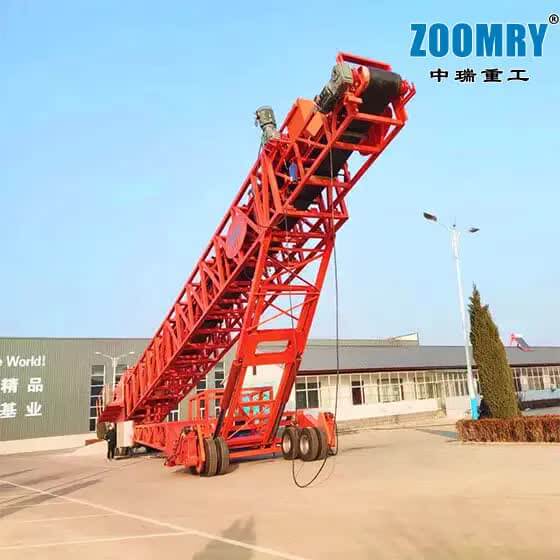
Self-propelled radial stacking conveyor for stockyards
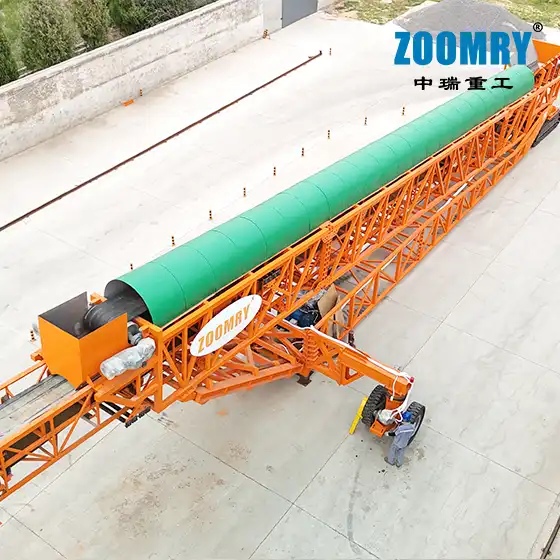
Adjustable discharge height for layered stacking
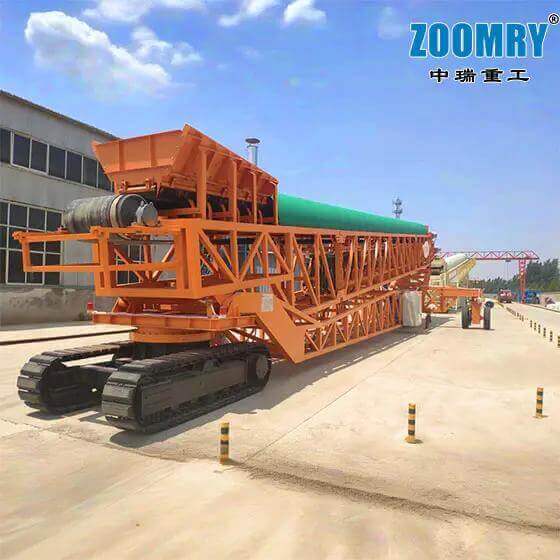
Crawler mobility for soft ground and temporary stockpiles
Related Reading
For the difference between telescopic and radial stackers, read Telescopic Stacker vs Radial Stacker. For stacker reclaimer selection, see Stacker Reclaimer vs Stacker Conveyor. For mobile stockpiling across mining and quarry operations, see Mobile Stockpiling Solutions. For integrated stockyard and port projects, explore the ZOOMRY EPC project case library.
Specifying a Stacker for Sand or Aggregate?
Share your material type, daily output, stockpile layout, and ground conditions. ZOOMRY engineers will recommend the belt width, telescopic travel, and wheeled or tracked configuration for your site.
Contact Our Engineers →