 ZOOMRY

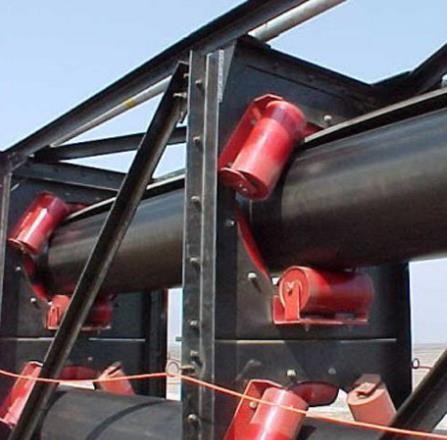
ZOOMRY Pipe conveyor belts are specially designed for enclosed tubular conveyor systems, available in two primary carcass categories: Steel Cord Type for high-tensile, long-distance applications, and Fabric Type (EP/NN) for moderate distances with enhanced flexibility. Unlike standard flat Conveyor Belts, pipe conveyor belts are engineered to form a sealed tubular shape through hexagonal idler groups — completely enclosing the material to prevent spillage, dust emissions, and environmental contamination along the entire conveying route.
How Do Pipe Conveyor Belts Differ from Standard Conveyor Belts?
Standard conveyor belts transport material on a flat or troughed surface — exposed to wind, rain, and potential spillage. A pipe conveyor belt is fundamentally different: it transitions from a flat profile at the loading point into a sealed tubular shape through a series of hexagonal idler panels, and remains enclosed throughout the entire conveying distance. At the discharge point, the belt opens back to a flat profile for clean material release.
This enclosed design provides three critical advantages: zero material spillage along the route, complete dust containment for environmental compliance, and protection of the conveyed material from rain, wind, and contamination. Pipe conveyor belts can handle steep inclines up to 30° and navigate tight horizontal and vertical curves — capabilities that would require multiple transfer points with conventional troughed conveyors.
Specification
| No | Item | Data |
| 1 | Cover Rubber Grade | 8MPA, 10MPA, 12MPA, 15MPA, 18MPA, 20MPA, 24MPA, 26MPA |
| 2 | Belt Width (mm) | 400, 500, 600, 650, 700, 800, 900, 1000, 1200, 1400, 1500, 1600, 1800, 2000, 2200, 2500 |
| 3 | Tensile Strength | EP200/2, EP315/2, EP315/3, EP400/3, EP500/3, EP600/3, EP400/4, EP500/4, EP630/4, EP800/4, EP1000/4, EP500/5, EP600/5, EP750/5, EP1000/5, EP1250/5, EP600/6, EP1200/6 |
| 4 | Top + Bottom Thickness | 3+1.5, 4+2, 4+1.5, 4+3, 5+1.5, 6+2, 7+2, 8+2 |
| 5 | Belt Thickness | 4mm – 25mm |
| 6 | Belt Length | 50m, 100m, 200m, 250m, 300m |
| 7 | Belt Edge Type | Moulded (rubbered) edge or cut edge |
| 8 | Surface | Smooth, chevron, rough top |
| 9 | Kind | EP/NN conveyor belt, Wear resistant, Heat resistant, Cold resistant, Oil resistant, Flame retardant, Acid-alkaline resistant, Steel cord, Chevron, Pipe, Endless, Sidewall, Rough top, White conveyor belt & more |
How to Select the Right Pipe Conveyor Belt?
The choice between Steel Cord and Fabric carcass depends primarily on the conveying distance and tension requirements:
- Steel Cord Type: For long-distance pipe conveyors (several kilometers) and high-tension applications. Steel cord belts provide minimal elongation, high tensile strength (up to ST4000), and excellent dimensional stability — ideal for mining and cement applications with significant elevation changes.
- Fabric Type (EP/NN): For moderate distances and loads. EP (polyester-nylon) carcass provides lower elongation and better dimensional stability; NN (nylon-nylon) carcass offers maximum flexibility and impact absorption. More economical and easier to splice than steel cord.
Additionally, the cover rubber grade should be selected based on material characteristics: abrasion-resistant covers for sharp, abrasive materials; heat-resistant covers for hot materials; and flame-retardant covers for underground coal applications. ZOOMRY's engineering team can recommend the optimal carcass type and cover compound based on your material, route, and capacity requirements.
Advantages
- Enclosed material transportation: The sealed tubular design protects both the environment and the conveyed materials — preventing dust emissions, spillage, and contamination along the entire conveying route.
- Steep angled conveying: Capable of inclines up to 30°, eliminating the need for multiple transfer points and reducing civil engineering costs when navigating elevation changes.
- 3D spatial curve capability: The conveying line can be set up to follow the natural terrain curve in three dimensions — horizontal and vertical bends can be combined in a single flight without transfer towers.
Related Industry Solutions
Need Custom Pipe Conveyor Belts?
Contact ZOOMRY for pipe conveyor belts in steel cord or fabric carcass — engineered to your pipe diameter, tensile strength, and cover grade requirements.
Contact Us Today